
The Mythological Cycle
Boann and the Secret Well
Dindshenchas
Whoever looks into Nechtan’s secret well, his eyes burst. Boann walks three times round it to show it has no power over her, and the water rises.
I Síd Nechtain
There is a green hill at Carbury in Kildare, and at the foot of it the Boyne rises out of the ground. Long ago the hill was called Síd Nechtain, and the Dindshenchas, the lore of places, says it was two things at once: the síd of Nechtan son of Labraid, and his grave.
Nechtan’s wife was Boann. And in the green of his síd there was a secret well.
Every kind of hidden harm came welling up out of it. Whoever looked down to the bottom of that well, his two eyes burst. Whichever way he turned from it, to the left hand or the right, he did not come away without a blemish. So no one dared go near it but Nechtan himself and his three cup-bearers: Flesc, and Lám, and Luam.
Boann was the mother of Aengus, the poem says: the son she bore to the Dagda, in spite of the lord of the síd.
And Boann was proud.

II Three Times Round
One day white Boann came to the well. She was not thirsty. Her pride had lifted her up, and she had come to put its power to the test.
There is no hidden power in it, she said, that could spoil my beauty.
Then she walked round the well: once, and twice, and a third time, heedless, going against the sun.
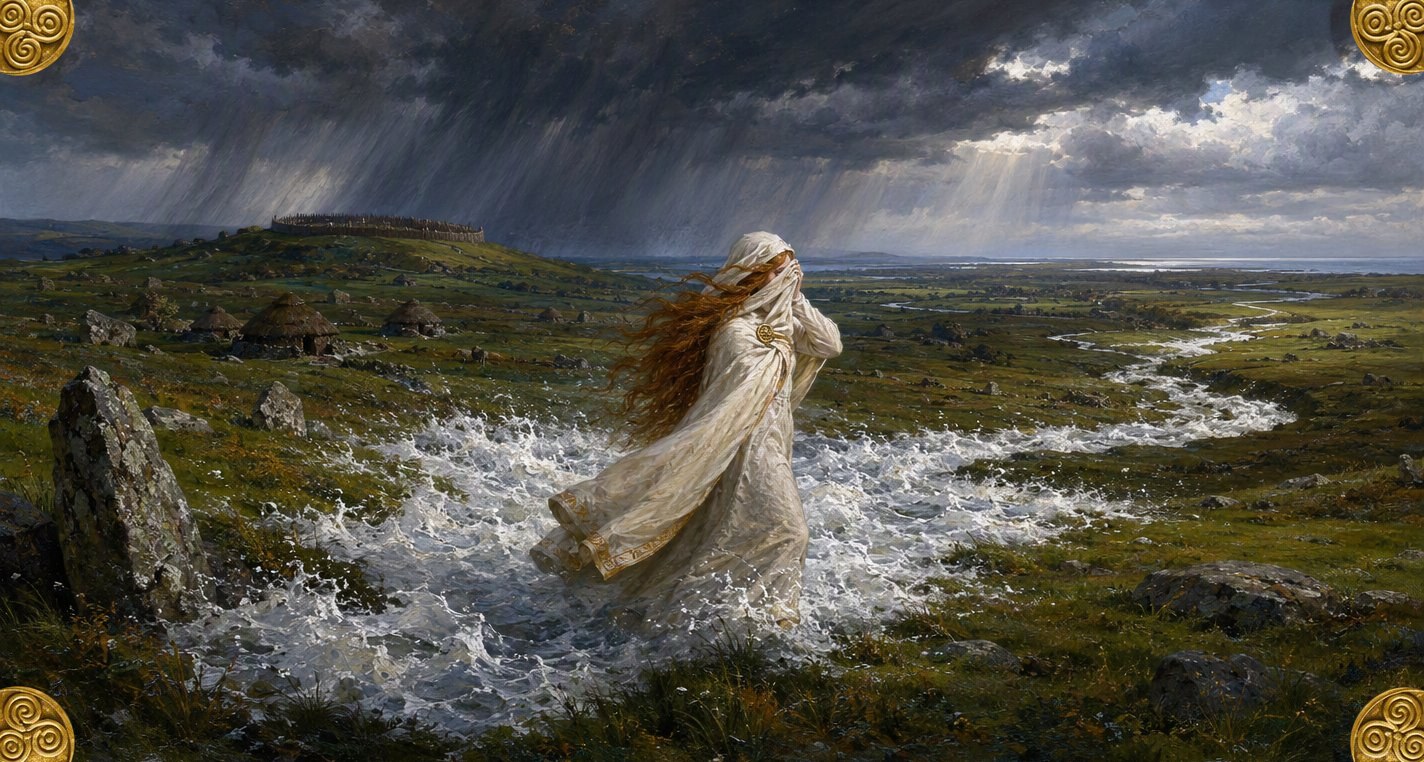
As she went round, three waves burst up out of the well, and each wave went for a limb. One wave struck her foot. One struck her eye, that had been perfect. The third wave shattered one of her hands. 1
That was the death of Boann, though she did not die there. She turned from the well and ran, and the water came after her.
III The Cold White Water
Boann ran for the sea, to hide her maiming, so that no one would see what the well had done to her. But she could not leave the well behind.
Every way the woman went
the cold white water followed 2
It came after her out of the síd and across the plains of Meath, all the way to the sea, and where the river meets the sea it overtook her, and she was drowned. The flood that followed her is the river, and it is called Bóand, the Boyne, after her. 3
She had a little lapdog called Dabilla, a faithful dog, and when she died it went after her. The current swept it out as far as the rocks, and the rocks broke it in two. Two stones stand there in the blue water, east of the plain of Breg, and they have been called Cnoc Dabilla from that day to this, after the little dog of the síd.

IV Fifteen Names
Bóand is the river’s everyday name, from the síd to the sea. But the poem counts fifteen names for her, and it does not let her stop at the sea. 4
In the síd she is Segais, and she is the River of Segais down to the pool of Mochua the cleric. From there to the edge of the plain of Meath she is the Arm of Nuada’s Wife, and her Leg. Then, all the way down past the ridge of the Brú, where her son has his house, she is the Great Silver Yoke and the White Marrow of Fedlimid, until she reaches the sea.
Out on the sea she is the Stormy Wave, as far as Cúailnge; then the River of the White Hazel, as far as Lough Neagh. Out of Lough Neagh she is Banna, and the Roof of the Ocean as far as Alba, and in Alba she is Lunnand.
Then she goes further than any river goes. She is the Severn in the land of the Saxons and the Tiber in Rome. In the east she is the Jordan and the great Euphrates, and in paradise she is the Tigris. She is a long time in the east, wandering.
And then she comes back out of paradise, home to the streams of the síd.

What the tale keeps
The Dindshenchas asks one question of every hill and ford and river in Ireland: why is it called what it is called? Here the answer is a woman who walked three times round a well that none but its keepers dared go near. It rose and followed her, and it has been following her ever since.
The poem was made in Christian Ireland, and it gives the river a longer road than any map: over the sea to Alba, through the Jordan and the Tigris into paradise, and home again after a long wandering to the streams of the síd.
The well, they say, is still there at the foot of Carbury Hill, under another name: the Trinity Well. The river still carries hers.
Notes
- The first poem has “a wave against her foot, a wave against her perfect eye, / the third wave shatters one hand”, and says she went round “heedlessly” (Edward Gwynn, The Metrical Dindshenchas, Part III, 1913). The prose Dindshenchas says she walked round the well “withershins”, against the sun, and that the waves took a thigh, a hand and an eye (Whitley Stokes, The Prose Tales in the Rennes Dindshenchas, 1894). ↩
- “Every way the woman went / the cold white water followed / from the Sid to the sea (not weak it was), / so that thence it is called Boand.” (Edward Gwynn, The Metrical Dindshenchas, 1913) It is the prose that puts her death at the river’s mouth: “with the water behind her as far as Boyne-mouth, (where she was drowned)” (Whitley Stokes, The Prose Tales in the Rennes Dindshenchas, 1894). ↩
- The Dindshenchas tells much the same of the Shannon. Sinann, daughter of Lodan son of Ler, went from Tír Tairngire to Connla’s Well under the sea to seek wisdom; the well left its place and overwhelmed her, and the river is named for her. Connla’s Well has what Nechtan’s lacks: “the hazels of the science of poetry”, whose nuts the salmon eat (Whitley Stokes, The Prose Tales in the Rennes Dindshenchas, 1894). ↩
- The names are Edward Gwynn’s English of the Irish (The Metrical Dindshenchas, 1913). The poem promises “Fifteen names, certainty of disputes”, counted “from Sid Nechtain away / till it reaches the paradise of Adam”. In the second poem on the Boyne, Christ blesses the stream: “so she from glen to glen / is the river Jordan of Erin.” ↩
Where the tale comes from
Medieval manuscript. Place-lore of the Dindshenchas, which Christian scholars gathered in verse and prose from the 11th century on: two poems on the Boyne, one of them addressed to a king of Meath who died in 1022, and a prose telling.
- The tale is told in the Dindshenchas, the lore of places, in two poems and in prose. Edward Gwynn edited and translated the poems, “Boand I” and “Boand II”, in Part III of The Metrical Dindshenchas (1913), and Whitley Stokes the prose, from a manuscript now at Rennes, in Revue Celtique (1894). This retelling follows the first poem, and the prose where the poem says less: Boann’s boast, her walk against the sun, and her drowning at the river’s mouth. The little dog comes from the first poem.
- The second poem tells it another way. Boann, the wife of Nechtan, comes to a tryst at the house of Elcmar, “lord of horses”, and the Dagda comes there by chance and presses her. The sun is made to stand still for nine months, so that she bears Aengus in a single day. Then she hurries to the well, sure that she can hide her guilt if she can bathe in it. Nechtan has set three cup-bearers to watch it, here named Flesc, Lesc and Luam, and the strong fountain rises over her and drowns her. The poem is addressed to Máel Sechnaill son of Domnall, “prince of Meath”, who died in 1022.
- The tales do not agree on her end. In The Dream of Aengus Boann is alive at the Brú with the Dagda, and when her son falls sick for love of a girl seen in a dream, she has all Ireland searched for her for a whole year.
- Modern retellings call Nechtan’s well the Well of Segais, and ring it with nine hazels whose nuts feed the salmon of knowledge. The poems of the Boyne give it neither hazels nor salmon. In the Dindshenchas of the Shannon they are at Connla’s Well under the sea, where the hazels shed their fruit, their blossom and their leaves into the water all at once and seven streams of wisdom spring up; in Cormac’s adventure they are at the fountain in the Land of Promise. Segais, in the first poem, is the river’s name inside the síd.
- P. W. Joyce, in A Smaller Social History of Ancient Ireland (1906), placed Síd Nechtain at the hill of Carbury in Kildare, and the well at the Trinity Well near its foot, the source of the Boyne: “the enchanted well that in old time burst up and overwhelmed Boand, Nechtan’s queen”. Christian missionaries, he wrote, had taken away its heathen character and dedicated it to the Holy Trinity.
Sources
- The Metrical Dindshenchas: "Boand I" · ed. Edward Gwynn, via CELT
- The Metrical Dindshenchas: "Boand II" · ed. and tr. Edward Gwynn, Part III (Todd Lecture Series 10, Dublin, 1913), via CELT
- The Prose Tales in the Rennes Dindshenchas: "Sinann" · ed. and tr. Whitley Stokes, Revue Celtique 15 (1894), tales 33 to 80, no. 59, p. 457, via the Thesaurus Linguae Hibernicae (UCD)
- Celtic Folklore: Welsh and Manx, chapter VI: "The Folklore of the Wells" · John Rhys (Oxford, 1901), quoting Whitley Stokes's translation of the prose Dindshenchas of Boand
- A Smaller Social History of Ancient Ireland: "Side-Nechtain, or the Hill of Carbury, County Kildare" · P. W. Joyce (1906), via Library Ireland
- River Boyne · Wikipedia
- Carbury, County Kildare · Wikipedia