
The Fenian Cycle
The Colloquy of the Ancients
Acallam na Senórach
The last two of the Fianna part in tears. One goes into a hill to his mother; the other finds Patrick blessing Fionn’s old fort, and tells him the story of every hill.
I The Twice Nine
The battles were fought, Comar and Gabhra and Ollarba, and after them there was not much left of the Fianna. What was left went about Ireland in small bands, and the bands grew smaller, until only two of the great men were left alive: Oisín, son of Fionn, and Caílte son of Rónán. Caílte’s strength had gone down in him by then, and his spear-throwing was not what it had been. They had a few fighting men left with them, so that all together they were twice nine.
One day the twice nine came down out of the flowery, wooded borders of Sliabh Fuaid into the plain of Louth. Evening came on them there, and the clouds came down with it, and they were heavy-hearted and low.
Oisín, said Caílte, where will we go tonight, for a bed and a meal?
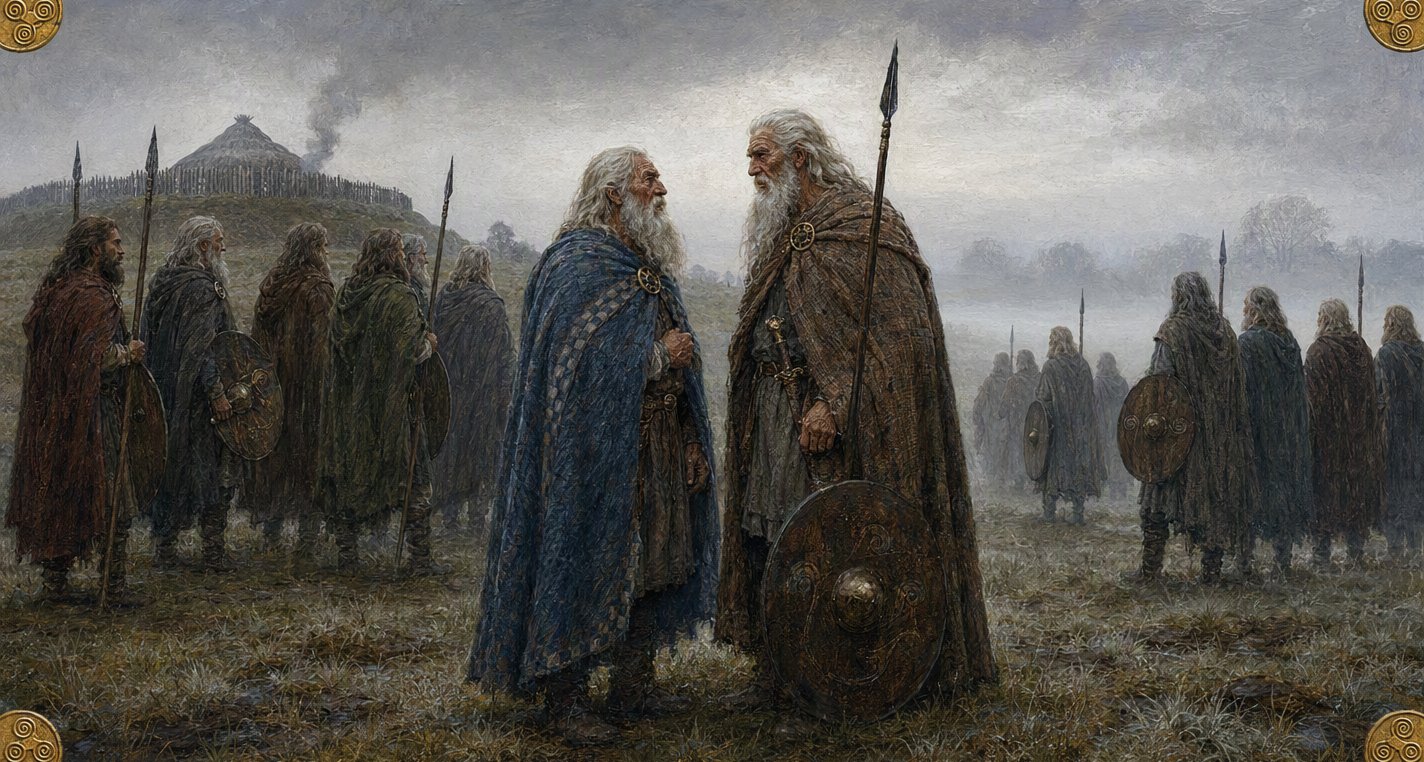
I don’t know, said Oisín. Of all the old ones of the Fianna, of Fionn’s people as they were, there are only three left alive: you and I, Caílte, and Cámha. She is the woman-chief who kept Fionn safe from the time he was a boy until the day he died.
Then we have a right to a night’s lodging from her, said Caílte. No one could reckon the treasure Fionn gave her. He gave her the Anghalach itself, the drinking-horn that Moriath, a king’s daughter, gave to him.
So they went to Cámha’s house.
II Soul and Body
Cámha took them in for the night. She asked them their names, and when she heard them she wept in floods. Then they asked each other for news.
She knew how men like these were used to being fed, and how much it had taken, many a time, to satisfy Oisín and Caílte. So she had the freshest of every kind of meat set before them, and the oldest of every kind of drink.
Then she rose, slowly and weakly, and began to talk: of the Fianna, and of Fionn mac Cumhaill, and of Oisín’s son Oscar, and of Mac Lugach, and of the battle of Gabhra. And at the end of it a great silence came down on them all.
Then Caílte spoke. None of this is harder to bear, he said, than what is still to come: the twice nine of us, all that is left of that great fellowship, must part now, and go our own ways.
With the rest of them gone, said Oisín, there is no fight left in me, and no strength.
Great fighting men as they were, they sat there with Cámha and wept, in gloom and in sorrow.
They stayed three days and three nights with her. When they said goodbye, Oisín made a verse over her: Cámha is sorrowful today, Cámha without son or grandson; it has fallen to her to be old.
They went out of the place and onto the green, and there they made up their minds to part. That parting of theirs was like the soul parting from the body. 1
So Oisín went to the síd of Ucht Cleitigh, where his mother was, Blái daughter of Derc. And Caílte took the road south, to the mouth of the Boyne.
III Druim Derg
Caílte came to the mouth of the Boyne, where the monastery of Drogheda is now. In those days it was called Inbher Bic Loingsigh, after Beg Loingsech, son of the king of the Romans, who came to take Ireland and was drowned there in the estuary by a great wave. He went on up the bright Boyne to Linn Féic, the pool of the salmon of knowledge, and south over the old plain of Brega, to the ráth of Druim Derg. Patrick son of Calpurn was there.
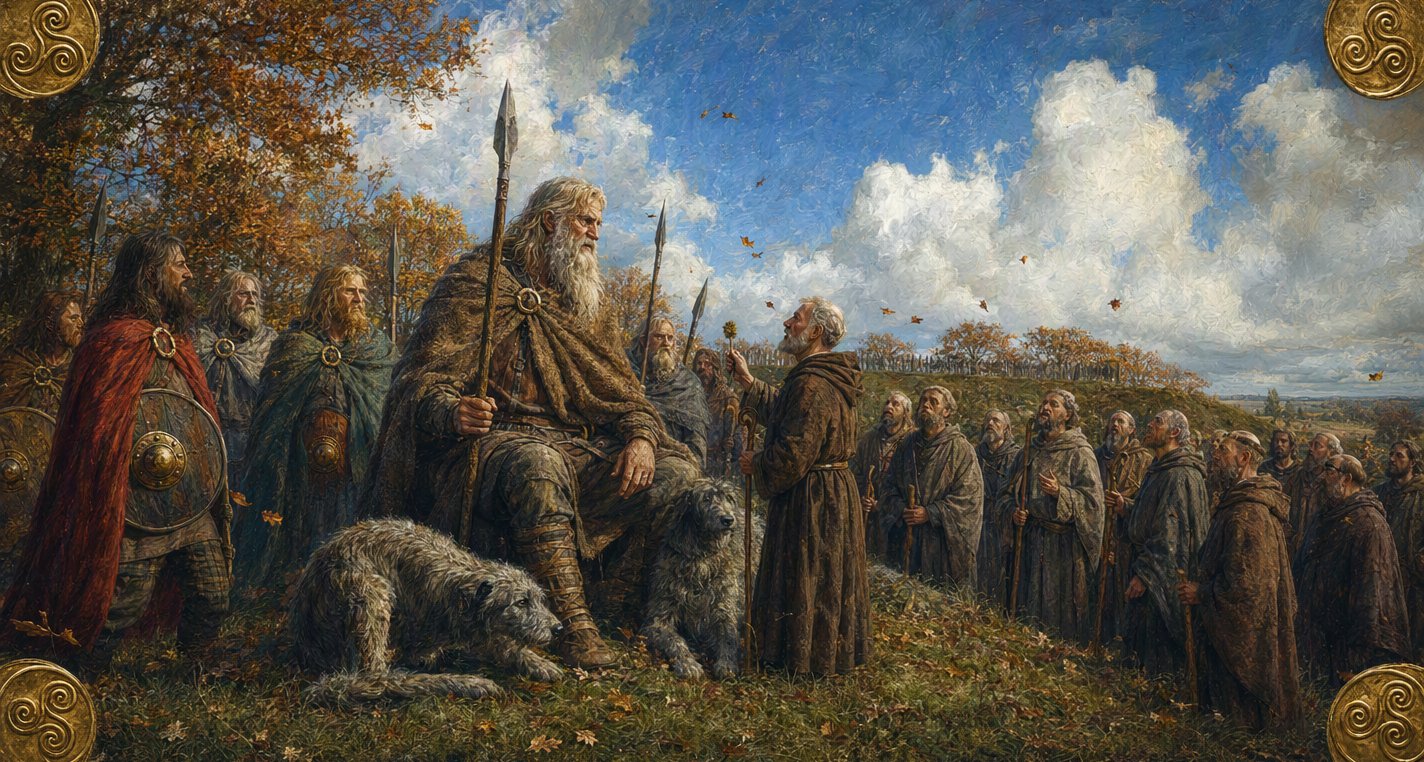
Patrick had just sung Mass, and praised the Creator, and blessed the ráth where Fionn mac Cumhaill had once been. Then the clerics saw Caílte and his men coming towards them, and fear fell on them: the men were so tall, and the wolfhounds with them so huge, and they were not people of one age or one time with the clergy. 2
Patrick rose, the apostle of the Gael, and took up his sprinkler, and shook holy water over the big men. A thousand legions of demons, the old book says, had hovered over them until that day. At the touch of the water the demons fled in every direction, into the hills and the clefts of the rocks and the far edges of the country. And the big men sat down.
What is your name, warrior? said Patrick.
I am Caílte, son of Crunnchu son of Rónán.
For a long while the clerics only gazed at them and marvelled. The tallest of the clerics came only to the waist, or at most the shoulder, of any one of those men; and the men were sitting down.
Caílte, said Patrick, there is a favour I would ask of you.
IV The Well of Tráigh Dá Bhan
If I have the strength or the power for it, said Caílte, you will have it. Tell me what it is.
A well of pure water near us here, said Patrick, so that we can baptise the peoples of Brega, and of Meath, and of Uisneach.
Noble and righteous one, said Caílte, I have that for you.
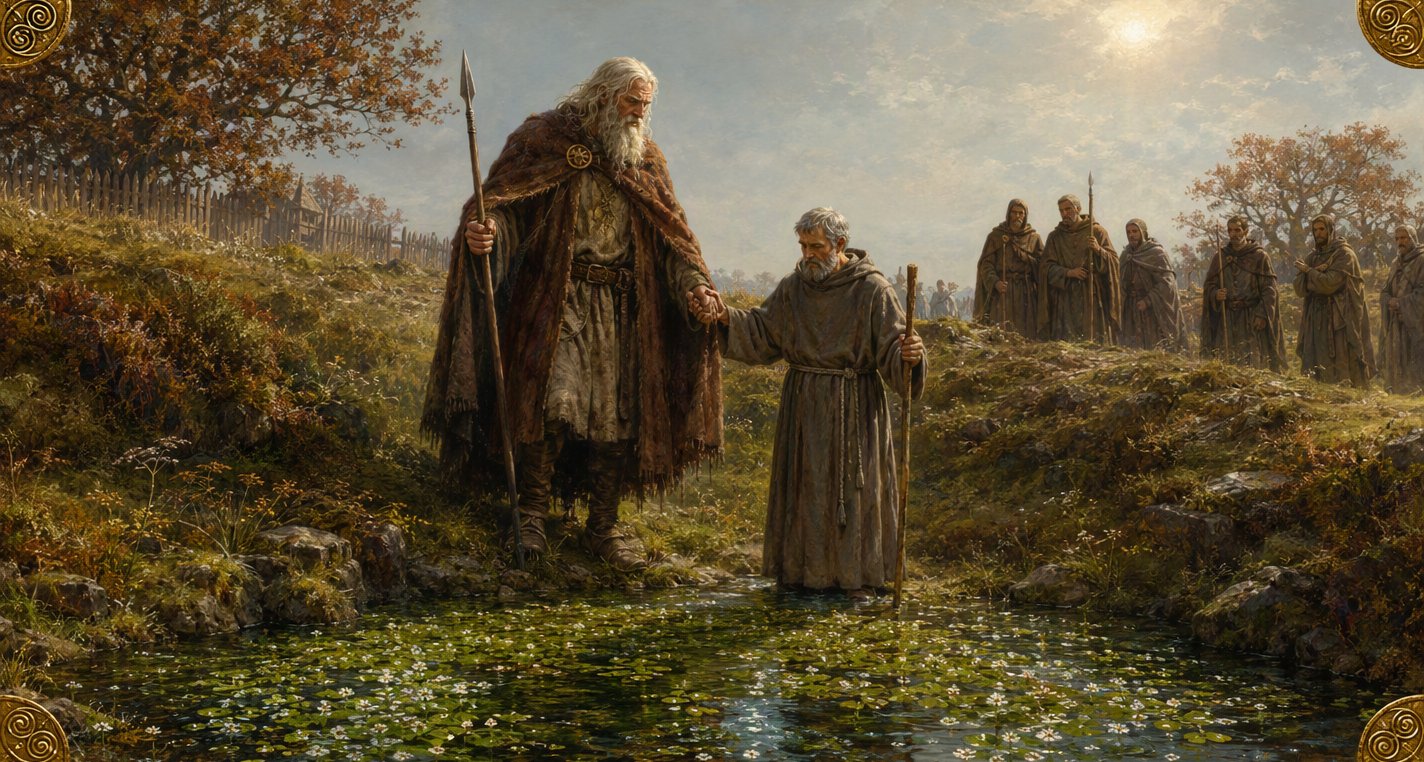
They went out over the bank of the ráth, and Caílte took Patrick’s hand in his. They had not gone far when there in front of them was a well, bright and clear as glass, and the cress and the brooklime grew on it so thick and so tall that they wondered at them. Then Caílte began to tell the fame of the well, and he made a poem on it. He called it the Well of Tráigh Dá Bhan, the Strand of the Two Women, and he praised its cresses, and everything that lived around it:
Forth from thy banks thy trouts are to be seen,
thy wild swine in thy wilderness;
the deer of thy fair hunting cragland,
thy dappled and red-chested fawns! 3
He sang of the mast hanging on its trees, and the fish in the mouths of its rivers, and of its water, blue, and then green again with the woods all round it.
It is well, said Patrick. Has our dinner come yet?
It has, said Bishop Sechnall.
Divide it, said Patrick, and give half of it to these nine tall warriors, who are what is left of the Fianna.
Then Patrick’s bishops and priests and psalm-singers rose and blessed the food, and they all had their fill of meat and drink, as far as was good for their souls.

V The Brown Leaf and the White Wave
Then Patrick asked him: Was he a good lord, the man you were with? Fionn mac Cumhaill, I mean.
And Caílte praised him in a few words:
If the brown leaf the wood lets fall were gold, and the white wave silver, Fionn would have given it all away. 4
And who or what was it, said Patrick, that kept you like that, all your lives?
Truth that was in our hearts, said Caílte, and strength in our arms, and fulfilment in our tongues.
Patrick asked him whether, in the houses he went to before Patrick’s time, there were drinking-horns, and cups, and goblets of crystal and pale gold. Twelve drinking-horns and three hundred, all of gold, Fionn had, said Caílte, and when the drink was poured into them there was no measuring what they held.
If it were not a falling-off in our devotion, said Patrick, and a neglect of prayer, and a turning away from talk with God, the time would go quickly, warrior, talking with you.
All the same, he kept asking. Caílte named the horns for him, and the chiefs and lords whose they had been; and he told him how the Fianna came by their horses, and named the chiefs who had owned them.
All this is a refreshment to us, mind and spirit, said Patrick, if only it were not the ruin of devotion and the neglect of prayer.
And there they stayed until morning.
VI The Angels’ Answer
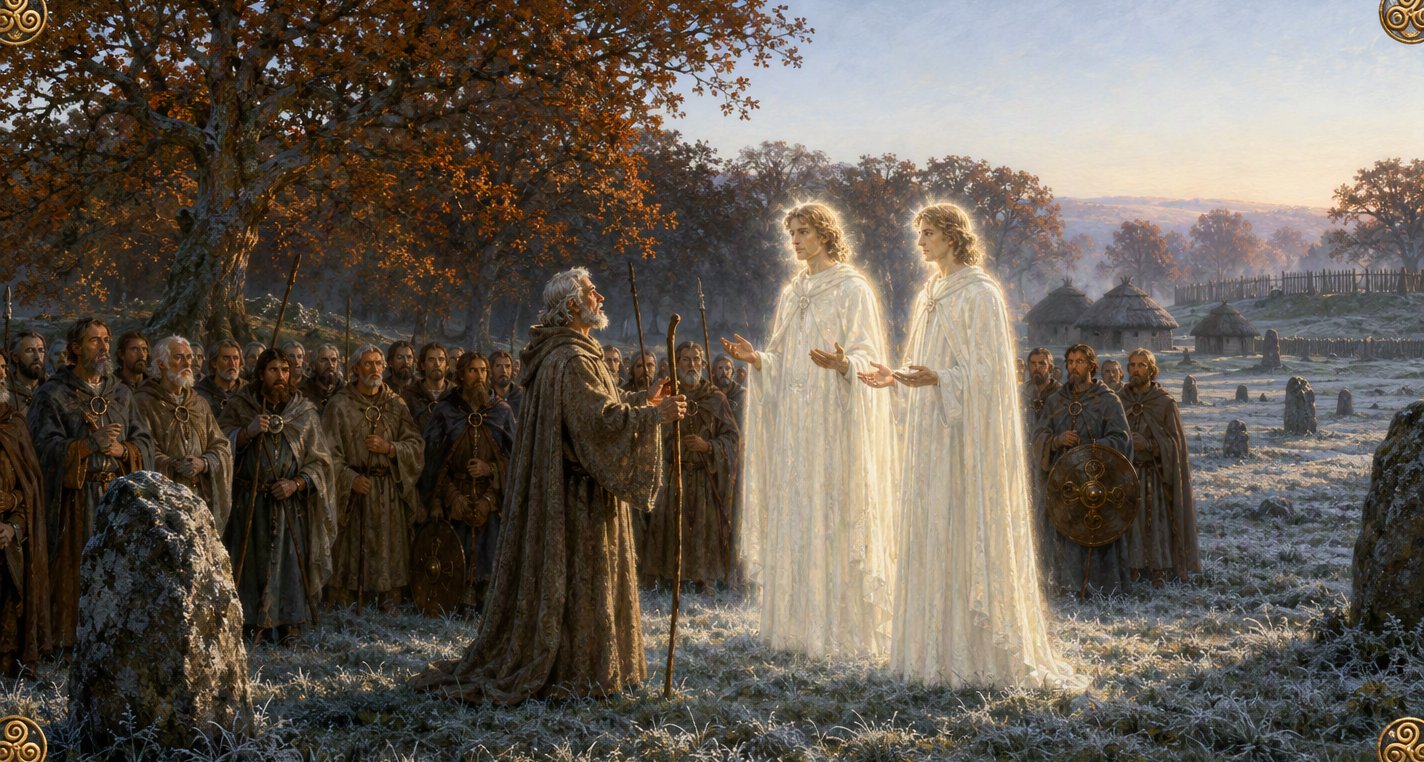
In the morning Patrick put on his vestments and went out onto the green, and with him his three score priests, and three score psalm-singers, and three score holy bishops, who were spreading the faith with him through Ireland.
His two guardian angels came to him there, Aibellán and Solusbrethach. He asked them whether it was right in the sight of God that he should be listening to the stories of the Fianna.
The angels answered him together, with one voice. Holy cleric, they said, those old warriors do not tell a third of their stories, because they have forgotten them, and their memory fails them. But have whatever they do tell written down, on the staves of poets and in the words of the ollamhs; for in a time to come the companies and the nobles will listen to these stories, and it will be a pastime to them. 5
And the angels went from him.
Then Patrick sent for Caílte, and Caílte was brought to him with his men. Do you know why you have been brought here? said Patrick. So that you will take the gospel of the King of heaven and earth. And there on the green he sprinkled the water of baptism over them.
Then Caílte reached across to the rim of his shield, and took from it a ridged mass of gold, three times fifty ounces, and gave it to Patrick. That was Fionn’s last wage to me, he said. Have it, Patrick, for my soul, and for my lord’s soul. It was as long as Patrick’s arm, from the tip of his middle finger to the top of his shoulder, and a man’s cubit across, and as thick.
Now, Caílte, said Patrick: what was the best hunting the Fianna ever had, in Ireland or in Alba?
VII Arran of the Many Stags
The hunting of Arran, said Caílte.
Where is that country? said Patrick.
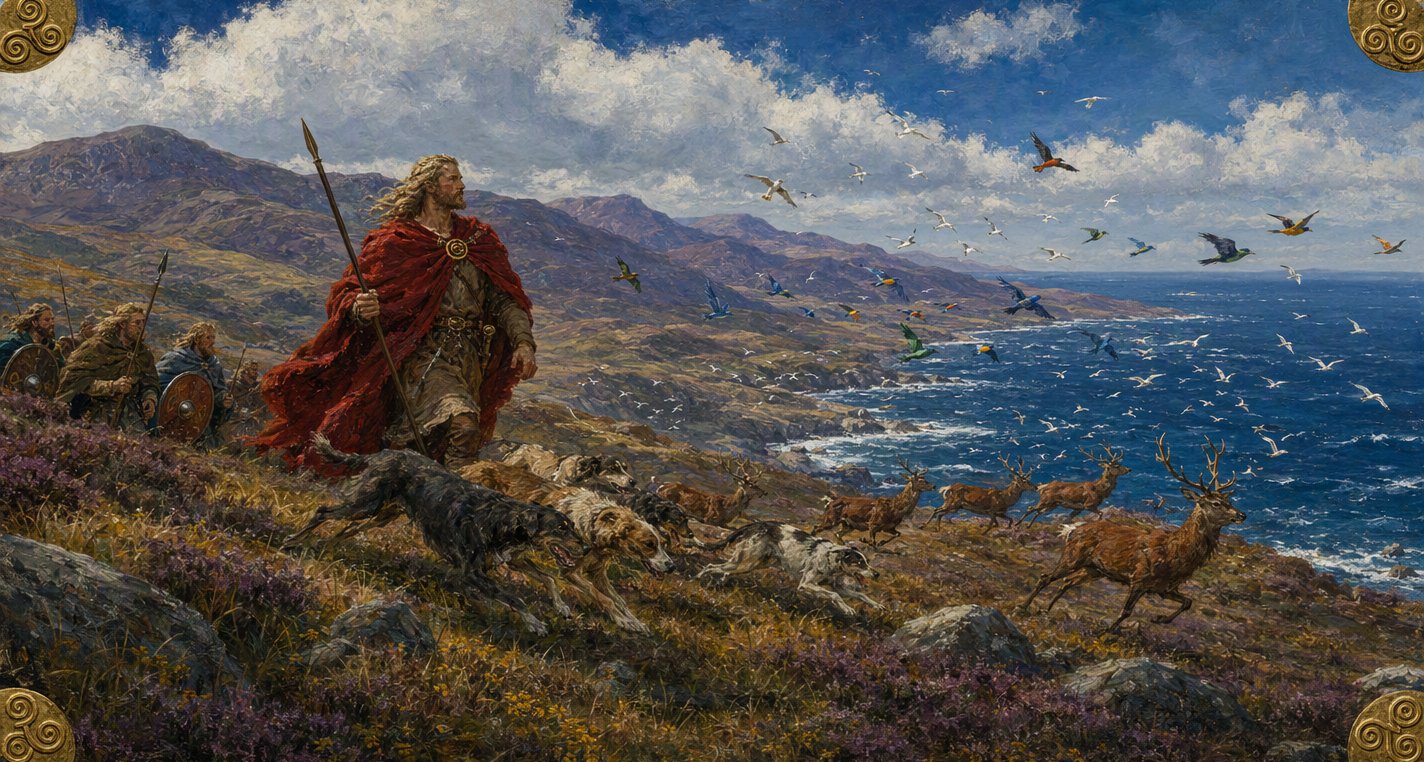
Between Alba and the land of the Picts, said Caílte. On the first day of Lughnasa we would go over to it, the three battalions of the Fianna, and hunt there to our hearts’ content, until the cuckoo called from the treetops in Ireland. It was sweeter than any music to hear the birds rising off the waves and from all along the island’s shore. Thrice fifty flocks of them circled her, and every flock was bright with colour, blue and green and azure and yellow.
And he made a poem on it:
Arran of the many stags,
The sea strikes against its shoulder,
Isle in which companies are fed,
Ridge on which blue spears are reddened. 6
He sang of the skittish deer on her peaks and the berries on her heather, the cool water in her rivers and the mast on her dun oaks; the greyhounds and the beagles; the fawns skipping over her crags; the nuts on her hazels; the trout under the banks of her rivers, and the seagulls answering each other round her white cliff. And he ended it:
Delightful at all times is Arran!
Victory and blessing on you, Caílte, said Patrick. From now on your stories are dear to us, and you yourself.
VIII Créde’s House
After that Caílte went about Ireland with Patrick, and wherever they came, Patrick asked him the story of the place. They came to a hill called Fionntulach, the White Hill. It was from here, said Caílte, that the three battalions of the Fianna marched to the battle of Ventry. Fionn looked round the hill and said: The hill is white. What better name could it have?
And as we marched, he said, a young man of Fionn’s people met us: Cael ua Nemhnainn, the hundred-slayer. A woman had been shown to him in a dream, a sweetheart of the sídhe: Créde, daughter of Cairbre Whiteskin, king of Ciarraige Luachra.
She is the greatest deceiver of all the women of Ireland, Fionn told him. There are few precious things in Ireland she has not coaxed away to her own house. And she will take no man who cannot make her a poem on her cups and her horns and her goblets, and on her great halls.
I have the poem, said Cael. My nurse, Muirenn daughter of Derg, gave it to me.
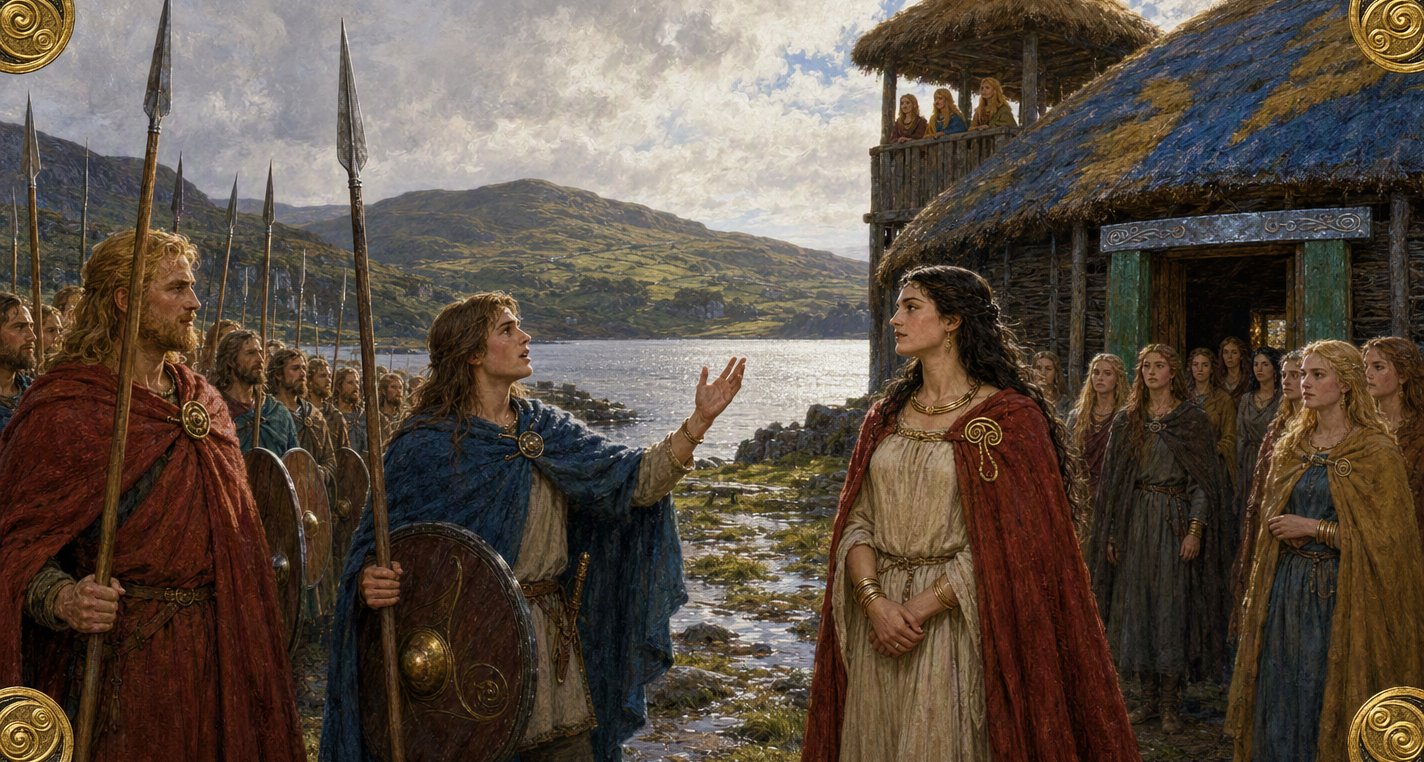
So the Fianna put off the battle for that while, and went over hills and rocks until they came to Loch Cuire in the west, to the door of Créde’s síd. There they made the dord fiansa with the shafts of their long, gold-socketed spears. Yellow-haired girls looked out from the bowers, and Créde came out to them with three fifties of women.
We have come to woo you, said Fionn, for Cael the hundred-slayer.
We have heard of him, said Créde, though we never saw him. But has he my poem?
I have, said Cael, and he stood up and sang it:
Her roof with its thatch of blue and yellow birds’ wings;
her parapet in front at a well,
of crystal and of carbuncle gems. 7
He sang of the fairy birds on the bright eaves of her bower, singing so sweetly that wounded men would fall asleep to them.
So the two were wedded, and the Fianna stayed there seven days, drinking and feasting and wanting for nothing, except that one care weighed on Fionn: the foreigners at Ventry. Créde gave every man of them a battle-dress, and they took their leave of her.
IX The Harbour Roars
But Fionn said: Let the woman come with us, so that we may learn which of us this business will bring good, and which of us ill.
So Créde went with them to Ventry, and she brought great herds of cattle for the sick and the wounded. As long as the battle lasted she fed them all on new milk, and the sick and wounded of the Fianna lay in her house. As far as she outdid all the women of the Fianna in giving away jewels and treasure, so far did Cael outdo the three battalions of the Fianna in valour and in the use of arms.
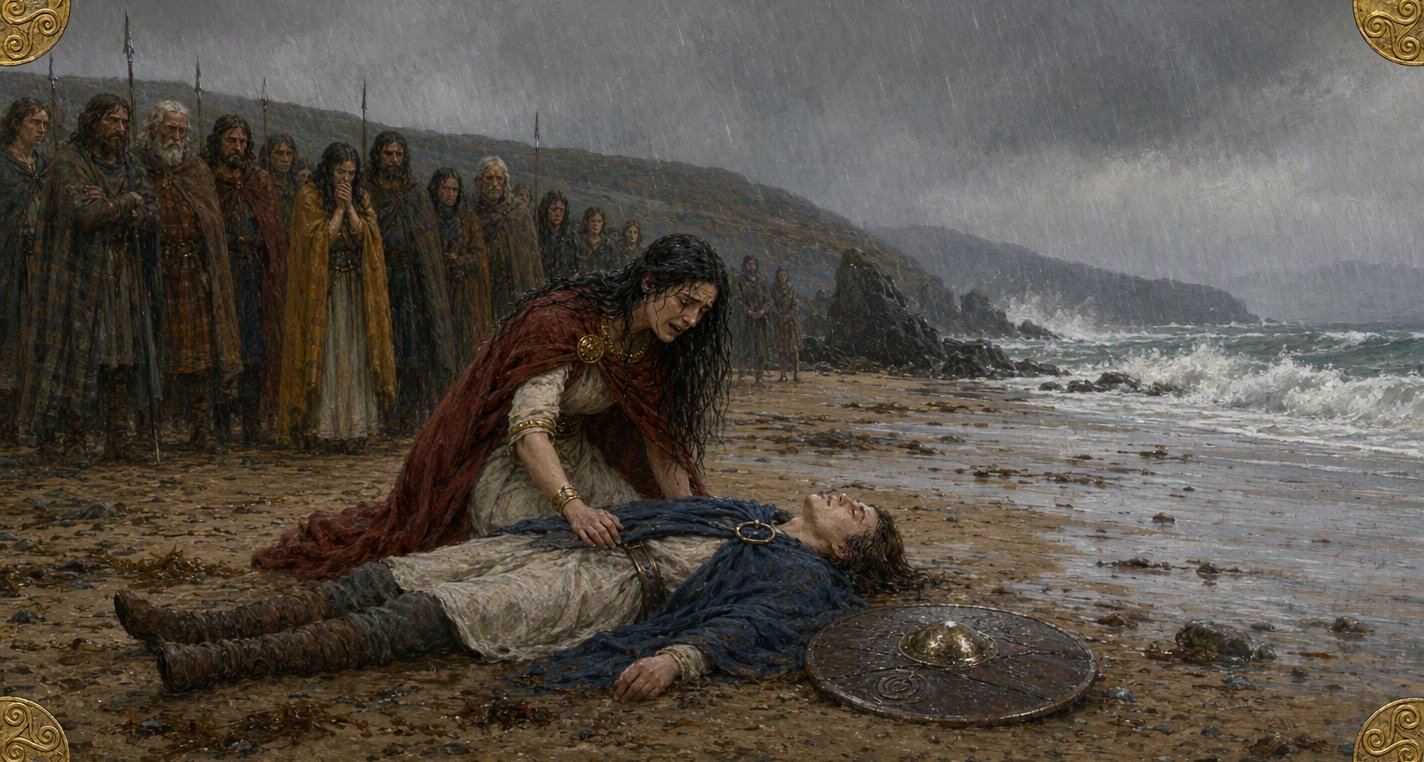
On the last day of the battle, Cael was drowned. Wild creatures died that day too, the tale says, whose span of life had been the same as his. The swell from the open sea washed him in, and the women and the nobles of the Fianna came looking for him, and carried him to the strand south of Ventry. Ever since, that shore is called Tráigh Chaeil, Cael’s Strand, and Fert Chaeil, Cael’s Grave.
Créde came and lay down beside him, and keened him aloud. Why should I not die of grief for my mate, she said, when even the restless wild creatures are dying of sorrow for him? And she made her lament:
The harbour roars, O the harbour roars,
over the rushing race of the Headland of the Two Storms,
the drowning of the hero of the Lake of the Two Dogs,
that is what the waves are keening on the strand. 8
She keened the crane in the marshes that cannot save her nestlings from the wild dog, and the thrush, and the blackbird, and the stag that bells after the doe lying dead, and the wave that fights with the southern shore. Since Crimthann’s son is drowned, she said, there is no one I can love after him.
Then she stretched herself out by Cael’s side, and died of grief for him. They were buried in the one grave, said Caílte, and it was I myself who raised the stone over them. It is called the tomb of Cael and Créde.
A blessing on you, Caílte, said Patrick. That is a good story. Where is Brogan the scribe?
Here I am, said Brogan.
Write down everything Caílte has told us.
And it was written down.

What the tale keeps
Two old men outlive their world, and part on a green in Louth as the soul parts from the body. One goes into a hill, to his mother. The other finds a saint blessing his dead lord’s fort, and the clerics are afraid of him.
He can tell no more than a third of the stories, the angels say; the rest are forgotten. But the saint, who should be at his prayers, keeps asking, and the angels tell him to have it all written down, for the people who come after to listen to.
So we have them still: a well among the cresses, an island of many stags, a strand where a woman lay down by her drowned husband. And a lord who would have given away the brown leaves of the wood, if they had been gold.
Notes
- This is the same Oisín who went to Tír na nÓg, but in the Acallam he is simply one of the last two great men of the Fianna, an old warrior like Caílte; his mother, Blái daughter of Derc, lives in a síd. The tale of Niamh and the Land of the Young comes from a poem of about 1750: Oisín in Tír na nÓg. ↩
- “Fear fell on them before the tall men with their huge wolf-dogs that accompanied them, for they were not people of one epoch or of one time with the clergy.” (Standish Hayes O’Grady, The Colloquy with the Ancients, 1892) The Acallam was written by a Christian scholar about 1200, some seven centuries after Patrick, and he begins the meeting of the two ages with holy water. ↩
- The verse is from Standish Hayes O’Grady’s translation (1892), leaving out the word “neighbouring” that he added in brackets before “wilderness”. He keeps the well’s name in Irish, “tráigh dá bhan”, and translates it “two women’s strand”. ↩
- “Were but the brown leaf which the wood sheds from it gold, were but the white billow silver, Finn would have given it all away.” And: “truth that was in our hearts, and strength in our arms, and fulfilment in our tongues.” (Standish Hayes O’Grady, The Colloquy with the Ancients, 1892) ↩
- The angels’ words, in O’Grady’s translation (1892): “by thee be it [such as it is] written on tabular staffs of poets, and in ollaves’ words; for to the companies and nobles of the latter time to give ear to these stories will be for a pastime.” ↩
- The verses are Kuno Meyer’s translation (Selections from Ancient Irish Poetry, 1911). In O’Grady’s (1892) the poem begins “Arran of the many stags, the sea impinges on her very shoulders!”, and the Fianna go over “on the first day of the trogan-month (which now is called lughnasadh i.e. ‘Lammastide’)”. ↩
- The verse is O’Grady’s translation (1892). The poem goes on through her beds with posts of gold and silver, her vat of bronze, her cups and goblets, and the bowl of berry-juice she used “to make her eyebrows black”. ↩
- The verse is Lady Gregory’s (Gods and Fighting Men, 1904). O’Grady (1892) keeps the place-names in Irish: “the rushing race of rinn dá bharc”, “the warrior of loch dá chonn”. ↩
Where the tale comes from
Medieval manuscript. A Middle Irish tale in prose and verse, written about 1200, in which the last of the Fianna tell Saint Patrick the lore of Ireland’s places. It survives in five late manuscripts, three of them of the 15th century, among them the Book of Lismore.
- The Acallam na Senórach was written about 1200, in prose with many poems, by a Christian scholar. It survives in five later manuscripts: three of the 15th century (Laud Misc. 610 and Rawlinson B 487 in the Bodleian Library, Oxford, and the Book of Lismore), one of the 16th century, and a copy of that one. A shorter telling, the Acallam Bec, has its oldest copy in the Book of Lismore.
- Standish Hayes O’Grady printed the Irish text in the first volume of Silva Gadelica (1892) and his English translation, The Colloquy with the Ancients, in the second. Whitley Stokes edited the Irish from the manuscripts in 1900. This retelling follows O’Grady.
- This is the same Oisín as in the tale of Tír na nÓg, but the Acallam is more than five hundred years older than the poem of Oisín and Niamh (Oisín in Tír na nÓg), and its Oisín is simply one of the last two of the Fianna, who goes to his mother’s síd when he and Caílte part.
- The Colloquy holds far more than is told here: how the Fianna came by their horses when they went after Arthur son of Béine Brit, who had stolen Fionn’s hounds; the names of Fionn’s drinking-horns; and how the young Fionn kept Tara from burning, told on this site as Fionn and the Burning of Tara.
- Lady Gregory retold the wooing of Créde and her lament in Gods and Fighting Men (1904), with the place-names put into English. In her telling Cael “and the last man that was left of the foreigners, Finnachta Fiaclach, are after drowning one another in the sea.”
- Lady Gregory (1904) also tells of Caílte’s end: “after a while he went into a hill of the Sidhe to be healed of his old wounds”, and whether he came back is not known, “and there are some that say he used to be talking with Patrick of the Bells the same time Oisin was with him.”
Sources
- Silva Gadelica, vol. 2: "The Colloquy with the Ancients" · ed. and tr. Standish Hayes O'Grady (London, 1892)
- Selections from Ancient Irish Poetry · Kuno Meyer (1911)
- Gods and Fighting Men: "Cael and Credhe" and "Credhe's Lament" · Lady Gregory (1904)
- Gods and Fighting Men: "The Best Men of the Fianna" and "The Last of the Great Men" · Lady Gregory (1904)
- Placenames Database of Ireland · logainm.ie
- Ventry · Wikipedia
- Isle of Arran · Wikipedia