The Fenian Cycle
Fionn and the Burning of Tara
Acallam na Senórach
For twenty-three years a man of the sídhe has played Tara to sleep at Samhain and burned it. Then a boy of ten, an outlaw, offers to keep it till morning.
I The Spear at Ess Ruaid
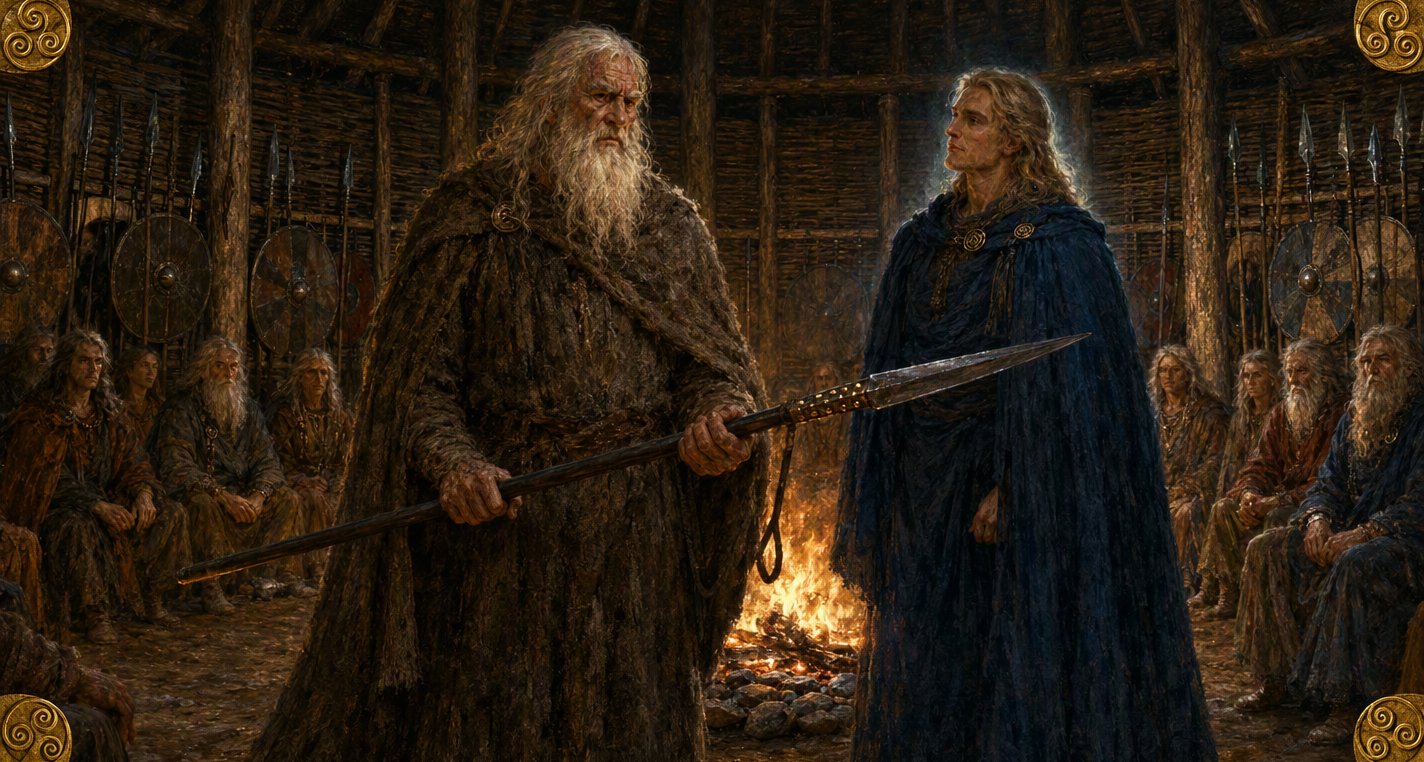
When the great days of the Fianna were long over, and Patrick had come into Ireland, only two of their warriors were left alive, and with their men they made twice nine. One of the two was Caílte mac Rónáin, an old man now. For a while he went about Ireland with the saint and told him the story of every hill they came to, and that is another tale: The Colloquy of the Ancients.
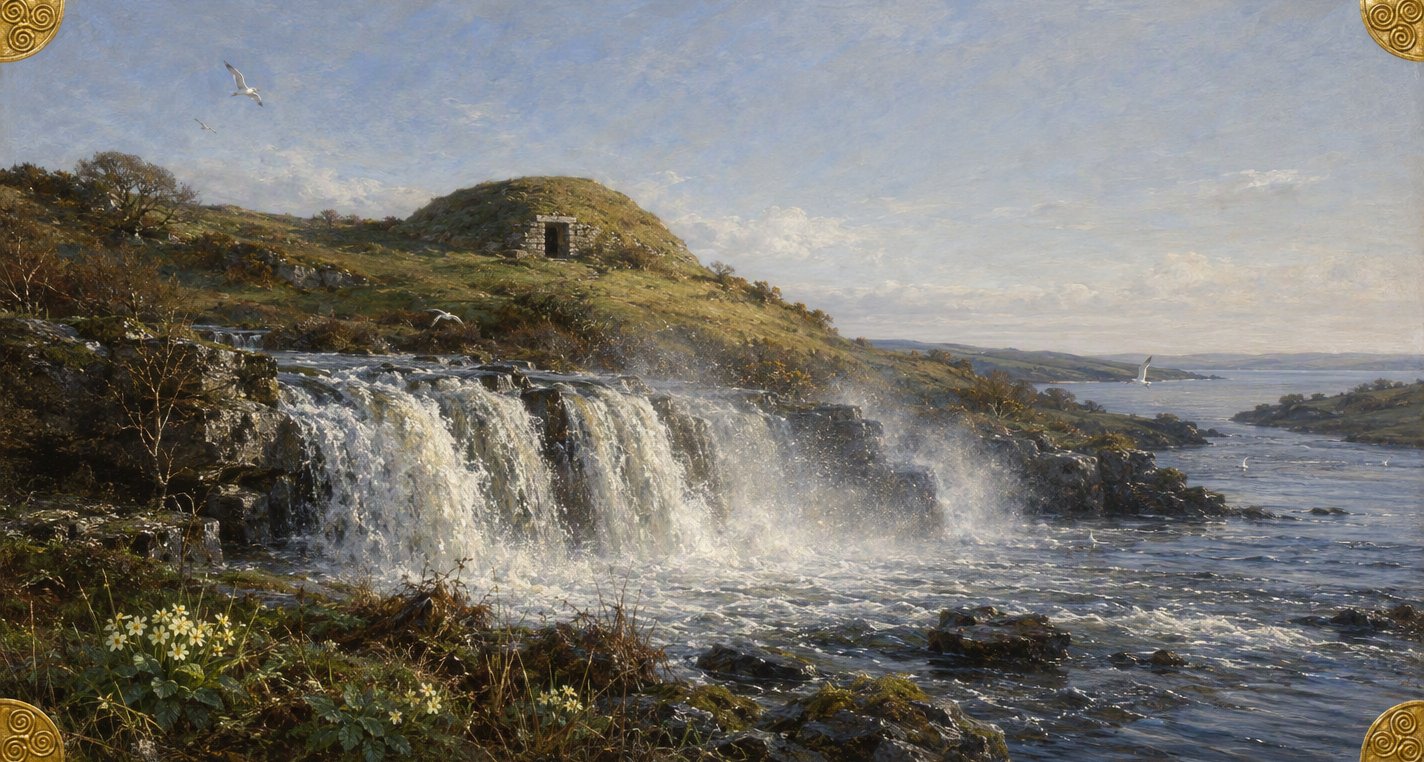
Then Caílte left the saint and went north with the few men he had. He crossed the falls of Ess Ruaid and came to the sí of Áed that is there. 1 In those days there was a great war between Ilbrec of Ess Ruaid and Lir of Síd Fionnachaidh.
Ilbrec reached up and took a spear down from its rack, a sharp spear with blue-grey edges, and he put it into Caílte’s hand.
Caílte, my soul, he said, look at this spear, and tell me which of the Fianna owned it.
Caílte stripped off its covers and its wrappings. In its socket were thirty rivets of Arabian gold.
That is the spear of Fiacha mac Congha, said Caílte. It was with this spear that Fionn mac Cumhaill first took the leadership of the Fianna of Ireland, and it was brought out of the green sí of Fionnachaidh. 2
And there, inside a hill of the sídhe, he told them how.
II The Burner of Tara
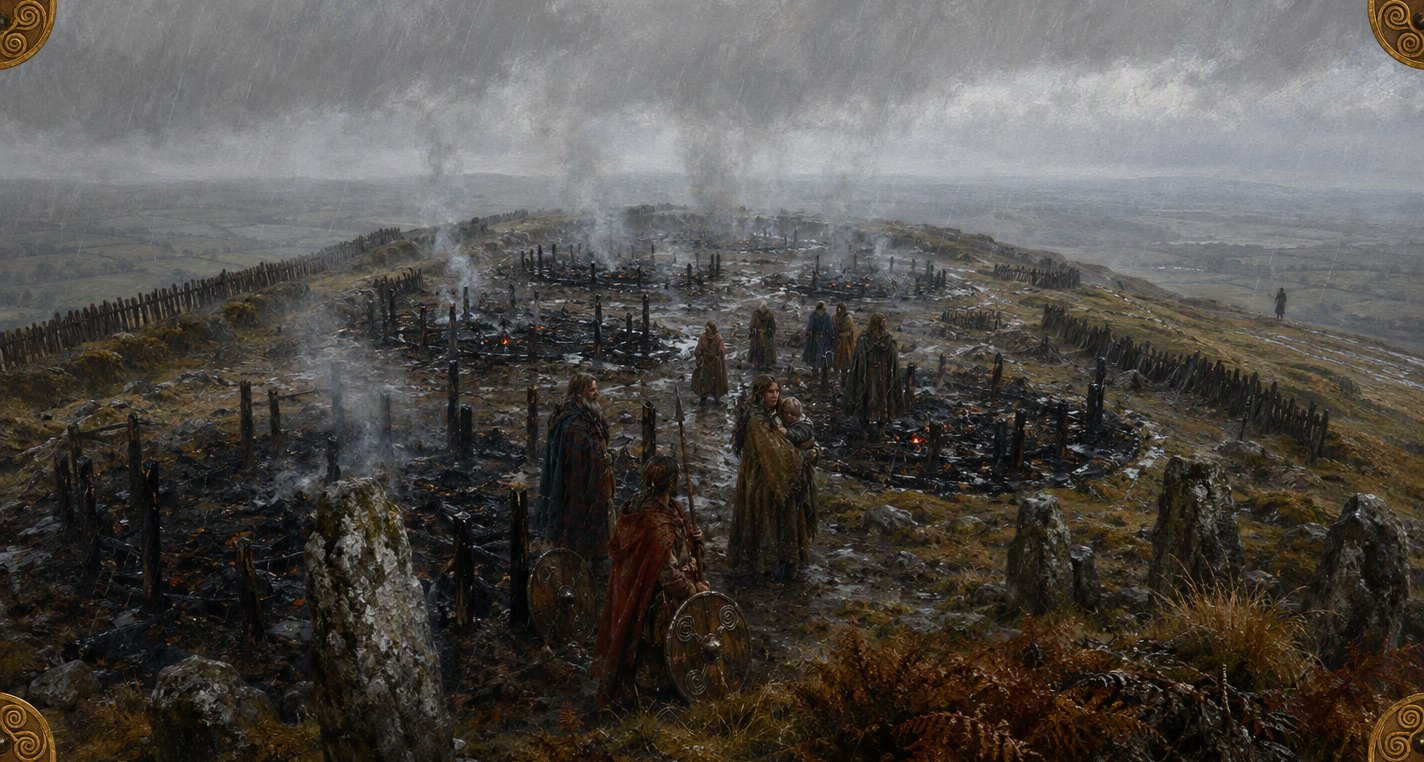
Aillén mac Midgna was one of the Tuatha Dé Danann, of Síd Fionnachaidh in the north. Every year at Samhain he came out of it and down to Tara, with a timpán in his hand. 3
Whoever heard that timpán fell asleep. When he had played all Tara to sleep, he blew a blast of fire out of his mouth and burned Tara, and everything in it. He did that every Samhain for twenty-three years.
In those years the battle of Cnucha was fought, and Cumhall son of Trénmór fell in it. He left a wife behind him, and she was carrying his child: Muirne of the fair neck, daughter of Tadg son of Nuada.
When Cumhall was gone, the leadership of the Fianna was given to Goll mac Morna, and Goll held it for ten years.
Cumhall’s son was born, and that was Fionn. Until he was ten years old he lived by raiding, an outlaw.
In his tenth year Conn of the Hundred Battles, king of Ireland, held the Feast of Tara.
III The Boy at the Feast
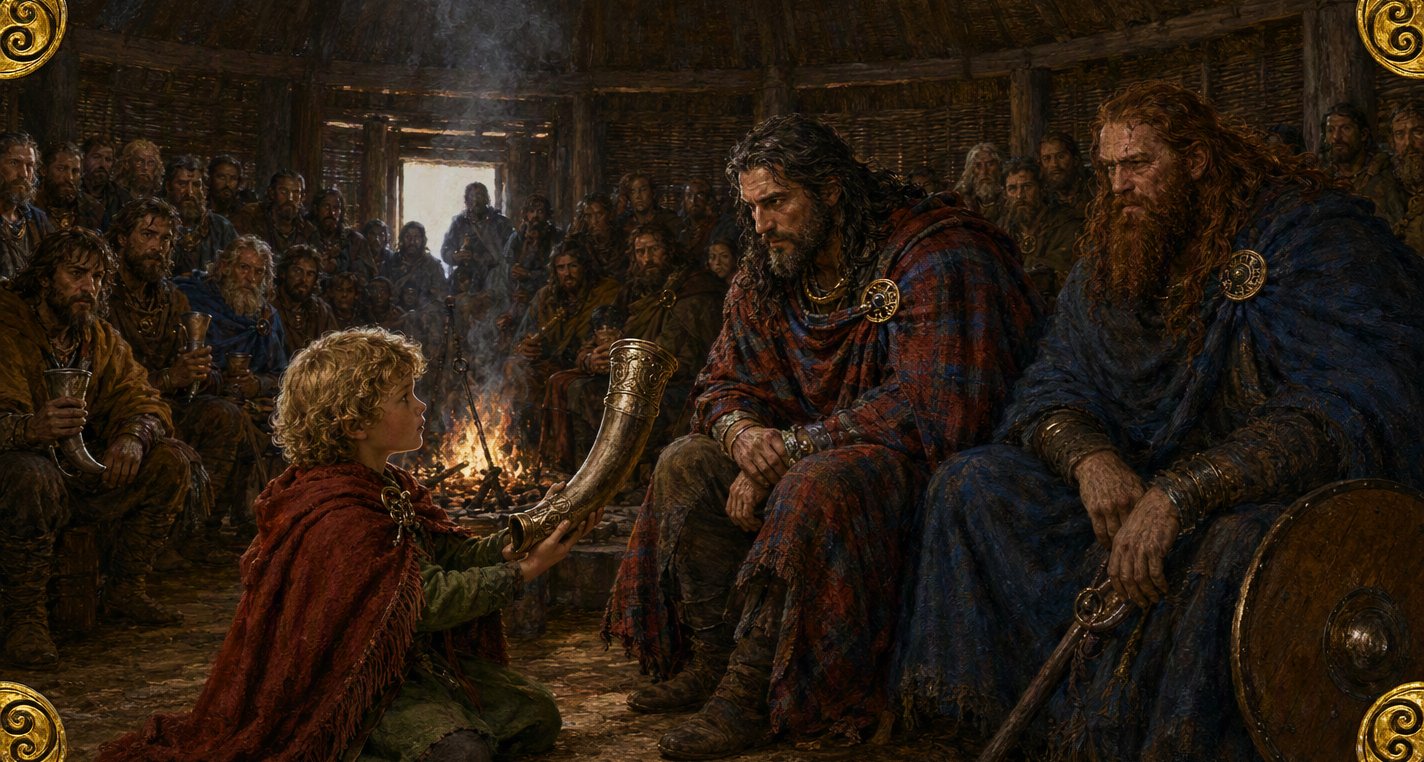
All Ireland was at the Feast of Tara, drinking and taking its ease in the great House of the Midchuart, and nobody noticed anything until there was a boy among them, very young. He sat down in front of Conn and of Goll mac Morna, with the nobles of Ireland all round him in the house.
This was the law of the Feast of Tara: for a fortnight and a month, while it lasted, no man there might raise a feud or a quarrel of any kind. 4
The king looked at the boy. Nobody in the house knew who he was.
Then the king’s horn of state was brought to him, and he put it into the boy’s hand.
Whose boy is this? said Conn.
I am Fionn, son of Cumhall, said the boy, son of the man who led the Fianna once. And I have come, king of Ireland, to make my peace with you.
You are the son of a friend, said Conn, and the son of a man of trust.
The boy rose, and swore service and loyalty to the king of Ireland. Conn took him by the hand and set him at the shoulder of his own son, Art, and for a good while they all drank and were merry.
Then the king of Ireland stood up, with a drinking-horn in his hand.

IV Fiacha’s Spear
Men of Ireland, he said, if I could find a man among you who would keep Tara until the day rises tomorrow, so that Aillén mac Midgna does not burn it, I would give him his rightful inheritance, whether it is much or little.
The men of Ireland said nothing. They knew the music of the man of the sídhe who came every year to burn Tara: women in the pains of childbirth fell asleep at it, and warriors lying in their wounds.
Then Fionn rose. Who will go surety for you, he said to the king, that this will be kept?
The kings of the provinces of Ireland, said Conn, and Cithruadh with his druids.
They all bound themselves to it, and Fionn took it on himself to keep Tara and everything in it until the next day’s dawn.
Now among the king’s people was Fiacha mac Congha, who had been a trusted man of Fionn’s father, Cumhall. He came to the boy.
Well, my lad, he said, if I gave you a deadly spear, one that never made a false cast, what would you give me for it?
What do you ask? said Fionn.
A third of whatever your right hand ever wins, said Fiacha, and a third of your trust: of your three closest counsellors, I am to be one.
You will have it, said Fionn, and he gave his word on it.
Then Fiacha told him what to do. When you hear the music of the sídhe, the sweet strings of the timpán and the sweet breath of the pipe, take the casing off the head of the spear and put it to your forehead, or to some other part of you. The point of the spear will not let sleep come on you.
V The Fire
So Fionn rose up in front of all Ireland to keep Tara. Fiacha gave him a shield and the spear, and none of the sons of Morna knew it, nor anyone else in the house of Tara. Then Fionn went the whole round of Tara.
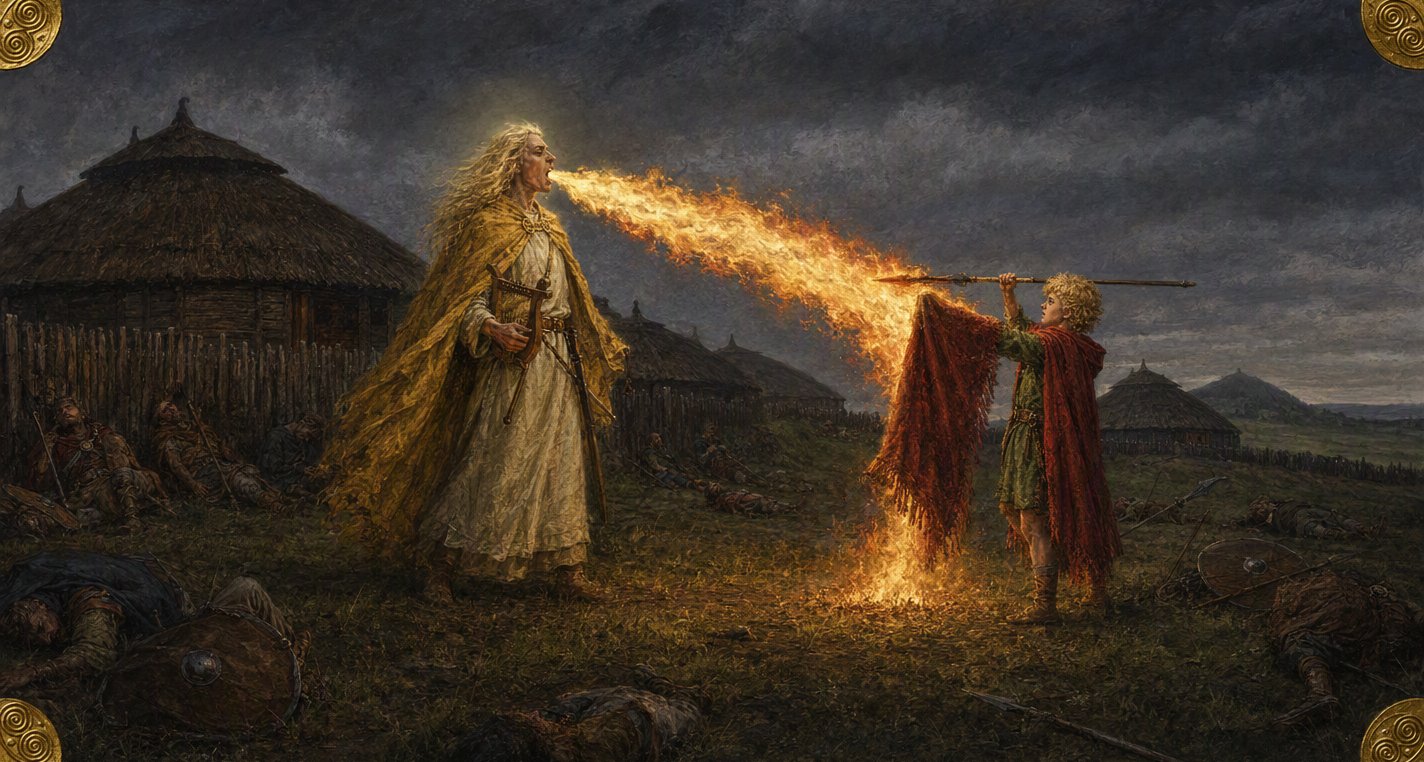
He was not long at it before he heard the music, a strain that would charm anyone to sleep. He put the spearhead to his forehead, the flat of the blade and its point.
Aillén played on his timpán, as he always did, until every other soul in Tara was asleep. Then he blew his blast of fire out of his mouth to burn Tara.
Fionn held up his cloak against it, the crimson cloak he wore, fringed and folded four times. The flame fell straight down through the air and went into the ground, and it took the cloak down with it, twenty-six spans deep into the earth.
That is why the height there is called the Height of the Fire, and the glen beside it the Glen of the Cloak. 5
And Aillén saw that his draíocht had come to nothing.

VI The Door of the Sí
He went back north the way he had come, to Síd Fionnachaidh on the top of Sliabh Fuaid, and Fionn went after him.
As Aillén was going in at the door of the sí, Fionn put his finger into the thong of the spear and made his cast, and it was a lucky cast and a true one. It went into Aillén high in the back, and it drove his heart out through his mouth in a flood of black blood.
Fionn cut off his head and carried it back to Tara. He set it up on a stake, and there it stayed until the sun rose.
Aillén’s mother came to him. There was great grief on her, and she went to look for a physician for him. And Caílte said:
By Fiacha mac Congha’s spear
by the fatal mantle and by the pointed javelin
Aillen mac Midhna is slain! 6

VII Goll’s Hand
In the morning the king and all the men of Ireland came out onto the green of Tara, where Fionn was.
King, said Fionn, there is the head of the man who used to burn Tara, and here are his pipe and his timpán, and all his music. Tara is saved, I think, and everything in it.
The men of Ireland filled the place of assembly and took counsel together, and what they settled on in the end was to give Fionn the leadership of the Fianna of Ireland.
Goll mac Morna, my soul, said Conn of the Hundred Battles, which will you choose? Will you leave Ireland, or put your hand in Fionn’s hand?
I give you my word, said Goll, it is my hand I will put in Fionn’s. 7
That was the story Caílte told in the sí at Ess Ruaid, with Fiacha’s spear in his hand. Before he left that place, there was a battle. Caílte asked the people of the sí which of their enemies they feared most, man to man, and they said Lir of Síd Fionnachaidh, the best fighter of all the Tuatha Dé Danann. Caílte and Lir met, and Lir fell by Caílte’s hand. 8
What the tale keeps
For twenty-three Samhains the music came down out of the north, and all Tara slept: women in childbirth, men lying in their wounds, everyone. Then came the fire.
The one who stayed awake was a boy of ten, an outlaw, with a spear that cost him a third of all he would ever win, holding its point against his own forehead. He caught the fire in his cloak, the ground took it, and the land kept the names.
The tale keeps the grief as well: a mother at the door of a sí on Sliabh Fuaid, going for a physician. And it was told long afterwards by an old man of the Fianna, inside a hill of the sídhe, with the same spear in his hand.
Notes
- Caílte tells this story inside a sí, not to Patrick. In Standish Hayes O’Grady’s translation (Silva Gadelica, 1892) he goes “across the falls of Assaroe, so to sídh of Aedh at Assaroe”, and “That was just the time when between Lir of Sídh Finnachaidh and Ilbhrec of Assaroe there was great war.” Ess Ruaid, Assaroe, was a waterfall on the Erne near Ballyshannon, in Donegal; its water was turned aside for a power station built in the late 1940s and early 1950s. ↩
- “Out of Finnachadh’s green-grassed sídh ‘twas brought.” (Standish Hayes O’Grady, Silva Gadelica, 1892) James Stephens took it to be Aillén’s own spear: “It is Aillen mac Midna’s own spear... and it was taken out of his Shi’ by your father.” (Irish Fairy Tales, 1920) ↩
- “With a musical timpán in his hand, the which whenever any heard he would at once sleep.” (Standish Hayes O’Grady, Silva Gadelica, 1892) In the morning Fionn shows the king “his pipe also, his timpan and all his music”. Lady Gregory (Gods and Fighting Men, 1904) gives him “the pipe and the harp”, and T. W. Rolleston (Myths and Legends of the Celtic Race, 1911) a harp. ↩
- “For the space of six weeks... none might dare to broach either feud or cross-feud”, while the Feast of Tara lasted (Standish Hayes O’Grady, Silva Gadelica, 1892). His literal rendering of the Irish is “a fortnight plus a month”. Goll had taken Cumhall’s place, and in The Boyhood Deeds of Fionn it was Goll who killed him. ↩
- “Whereby Ard na Teinedh or ‘fire hill’ is the name of that eminence, and Glenn an Bhruit or ‘the mantle glen’ that of the glen adjacent.” (Standish Hayes O’Grady, Silva Gadelica, 1892) The tale does not say where at Tara they are. In Lady Gregory’s telling (Gods and Fighting Men, 1904) the flame goes into the ground “bringing the four-folded cloak with it deep into the earth”, and the places are not named. ↩
- The lay as Standish Hayes O’Grady translated it (Silva Gadelica, 1892), with his dashes given here as line breaks. It follows the words “And Caeilte said”. It calls Aillén “fairy chief of Benn Boirche”, the Mourne Mountains, and near its end it says “nine times he burnt up Tara”, where the prose has twenty-three years. Lady Gregory (Gods and Fighting Men, 1904) gives the lament to Aillén’s mother: “Ochone! Aillen is fallen, chief of the Sidhe of Beinn Boirche; the slow clouds of death are come on him.” ↩
- “Goll, son of Morna, was the first to give him his hand the way there would be less shame on the rest for doing it.” (Lady Gregory, Gods and Fighting Men, 1904) In T. W. Rolleston’s telling (Myths and Legends of the Celtic Race, 1911), “first of all Goll mac Morna swore service, and then all the rest followed”. ↩
- “Caeilte and Lir of Sídh Finnachaidh encountered, aggressively and bloodily, and in the end of the affair Lir fell by Caeilte.” (Standish Hayes O’Grady, Silva Gadelica, 1892) It is the name and the hill of Lir in The Children of Lir, whose children came home as swans after nine hundred years and found Síd Fionnachaidh empty. In Lady Gregory’s telling (Gods and Fighting Men, 1904), Ilbrec gave Caílte “the enchanted spear of Fiacha” when the fighting was done. ↩
Where the tale comes from
Medieval manuscript. An episode of the Acallam na Senórach, the Colloquy of the Ancients, a long Middle Irish work of prose and verse written about 1200; Caílte tells it in a sí at Ess Ruaid. The Acallam survives, in pieces, in manuscripts of the 15th century and later, among them the Book of Lismore.
- This is an episode of the Acallam na Senórach, the Colloquy of the Ancients, written about 1200: a long work in prose and verse in which the last of the Fianna outlive their world, meet Patrick, and tell him the stories of the places they pass. Its author, a Christian, is unknown; he has Patrick’s guardian angels approve the stories of the Fianna. This one Caílte tells away from Patrick, in the sí at Ess Ruaid.
- The Acallam survives, in pieces, in manuscripts of the 15th century and later: the Book of Lismore, Laud 610 (written mostly in 1453–54, though the section with the Acallam is older) and Rawlinson B 487 among them. Standish Hayes O’Grady translated it in Silva Gadelica (1892), where this story is on pages 141 to 146 of the second volume; Whitley Stokes edited the Irish in 1900.
- Lady Gregory retold it as “The Coming of Finn” in Gods and Fighting Men (1904). Her Aillén burns Tara for nine years, as in the lay, and plays on a pipe and a harp; her king is not named; and Caílte and Conán son of Morna are at the feast when the boy comes in. In her “Illbrec of Ess Ruadh” it is Ilbrec, not Caílte, who names the spear.
- T. W. Rolleston (Myths and Legends of the Celtic Race, 1911) gives the king as Cormac mac Airt, not Conn, and does not name Aillén: in his telling it is “a goblin or demon that came at night-fall and blew fire-balls against the royal city”, playing on a harp. His spear has a different property: “when the naked blade was laid against the forehead of a man it would fill him with a strength and a battle-fury that would make him invincible in every combat.”
- James Stephens retold it in Irish Fairy Tales (1920). There the king is Conn, the man who gives Fionn the spear is Fiacuil mac Cona, and the spear is “the venomous Birgha”: “the heat of the spear, the stench of it, all its pernicious and acrid qualities will prevent you from going to sleep.”
- In The Boyhood Deeds of Fionn (Kuno Meyer’s translation, 1904) the young Fionn has a Samhain of his own: between the two Paps of Anu he sees the mounds of the sídhe standing open, and a spear he casts kills Áed son of Fidga.
Sources
- Silva Gadelica, vol. 2: "The Colloquy with the Ancients" · ed. and tr. Standish Hayes O'Grady (London, 1892)
- Acallamh na Senórach, ll. 1654–1761: "The story of Fiacha's spear and Find's defence of Tara" · Irish Sagas Online, University College Cork: the Irish of Whitley Stokes's edition (1900), with an English translation that follows Standish Hayes O'Grady's (1892)
- Acallamh na Senórach I: the manuscripts and editions · CELT, University College Cork, for the edition of Whitley Stokes (Irische Texte IV.1, Leipzig, 1900)
- Gods and Fighting Men: "The Coming of Finn" · Lady Gregory (London, 1904)
- Gods and Fighting Men: "Illbrec of Ess Ruadh" · Lady Gregory (London, 1904)
- Myths and Legends of the Celtic Race, chapter VI: "Tales of the Ossianic Cycle" · T. W. Rolleston (London, 1911)
- Irish Fairy Tales: "The Boyhood of Fionn" · James Stephens (London, 1920)
- "The Boyish Exploits of Finn", Ériu 1 (1904) · Kuno Meyer
- Assaroe Falls · Wikipedia