The Ulster Cycle
The Debility of the Ulstermen
Noínden Ulad
A woman walks into a lonely man’s house and stays, so long as he never speaks of her at the assembly. Then he boasts she can outrun the king’s horses.
I The Woman at the Hearth
Up in the lonely hills of Ulster lived a man rich in cattle, Crunniuc mac Agnomain. He had four sons, but their mother was dead, and for a long time there had been no wife in his house.
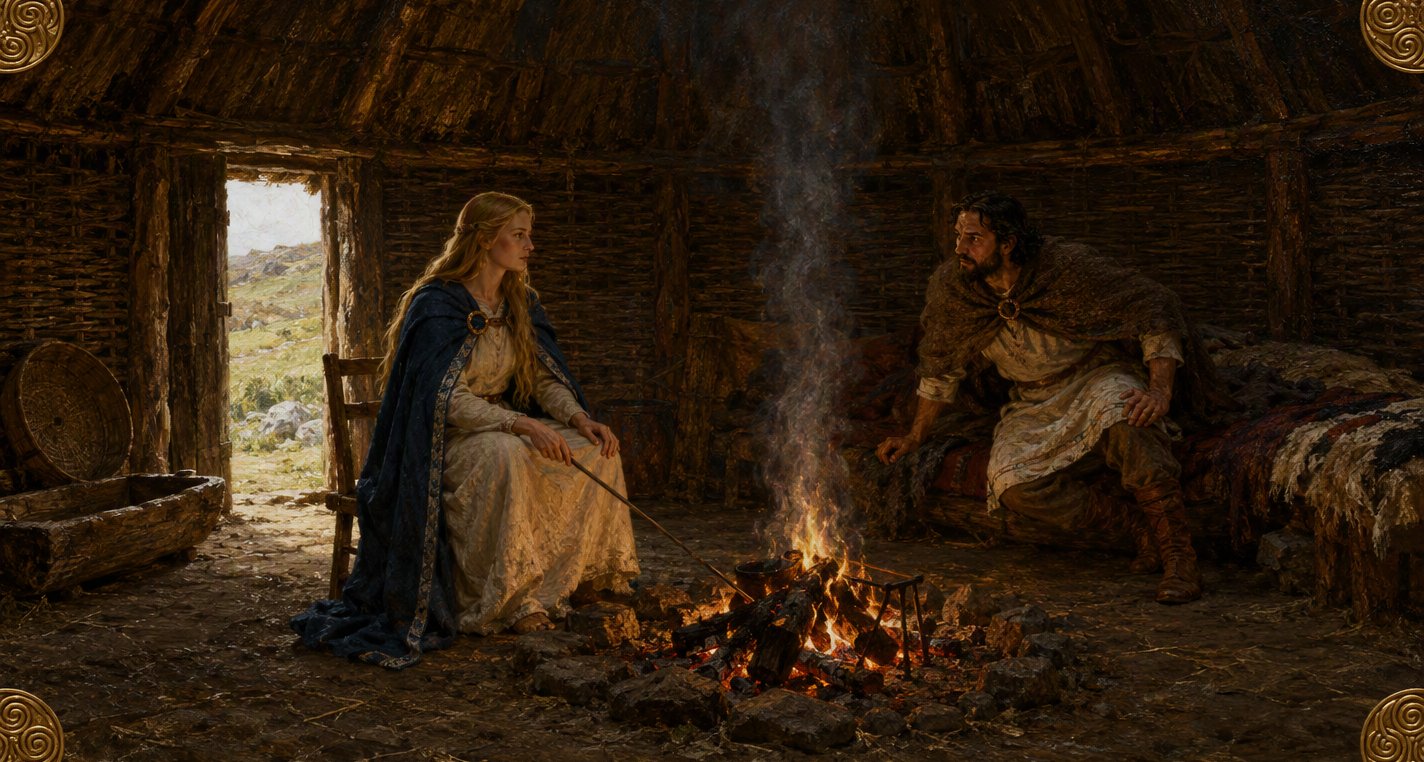
One day, as he lay alone on his couch, a woman walked in at the door, young and stately, fine in her looks, her dress and her bearing. Macha was her name, the learned say.
She sat down by the hearth and stirred up the fire, and there she sat the whole day long without a word to anyone. Then she took a kneading-trough and a sieve and got the food ready. At evening she milked the cow, still without a word. Coming in again, she turned about to the right, went into the kitchen and set the servants to their work, and sat down beside Crunniuc.
When the household went to bed she stayed up last of all, and put out the fire, and turned about to the right again, and lay down beside him with her hand on his side.
She stayed a long while. With her in the house he grew richer still, and she liked well the look of him. And there was one thing she asked of him.

II The King’s Horses
The Ulstermen held great assemblies, and every man and woman who could went to them. I’ll go too, said Crunniuc.
Don’t go, said his wife. You’ll be in danger of speaking of us, and we can stay together only as long as you never speak of me at the assembly.
I won’t say a word, said Crunniuc.
It was a brilliant gathering, full of people and horses and fine clothes, with races and contests, games and processions. At the ninth hour the king’s chariot was brought out onto the field, and his horses won the day. Then the bards praised them all: king and queen, poets and druids, the household, the people, the whole assembly. And the people shouted that there was no swifter pair in all Ireland than the king’s two horses.
My wife is quicker than those two, said Crunniuc.
Seize that man, said the king, and hold him until his wife is brought to race them. 1
III A Mother Bore Each of You
They bound him, and the king’s messengers went up into the hills. She made them welcome and heard them out.
My husband spoke foolishly, she said. It was no fit thing to say. And I am not well: my time is near.
Then he will die, said the messengers, if you don’t come.
Then I must go, she said.
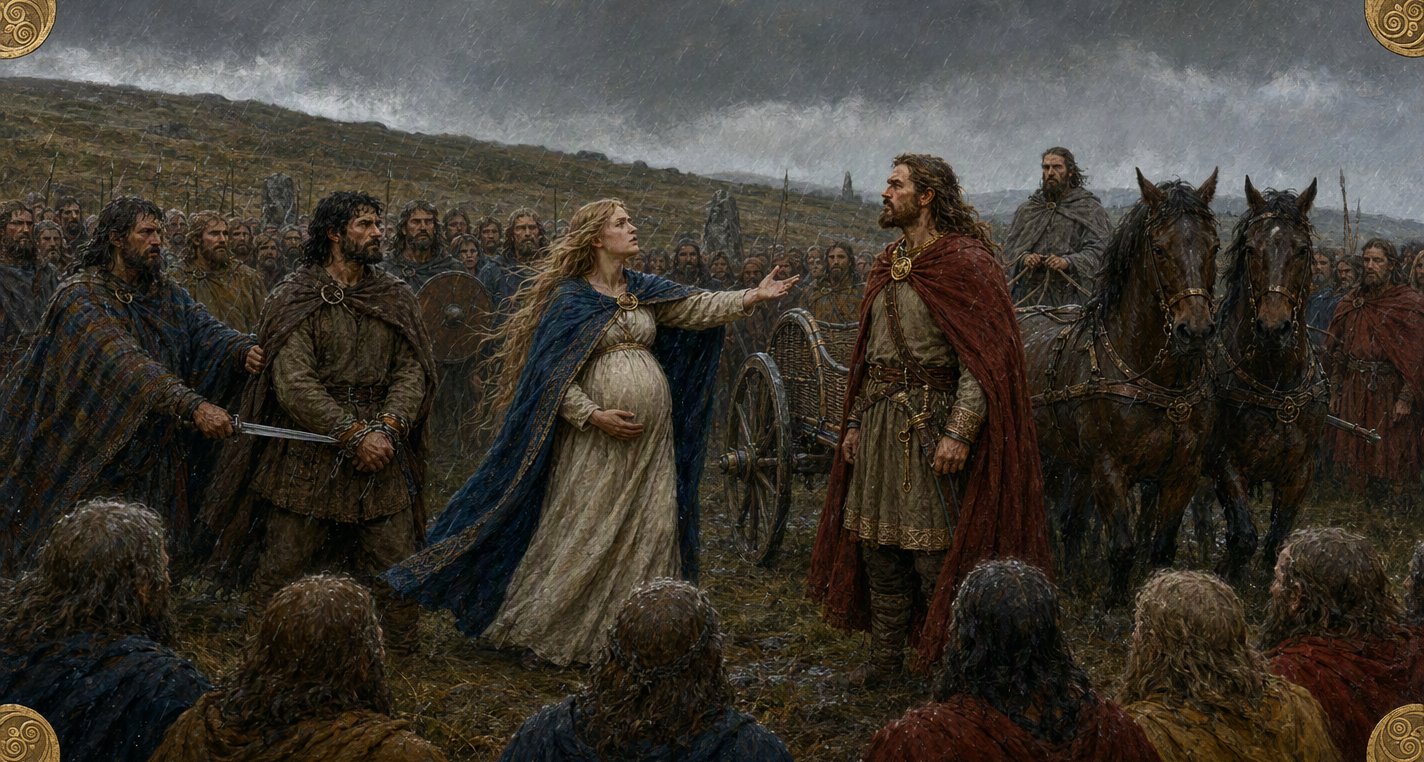
At the assembly the whole crowd pressed round to stare at her. It is not right, she said, to gaze at me like this. Why have I been brought here? To race the king’s two horses! they shouted.
My hour is almost on me, she said.
Draw your swords, said the king, and hew that man down.
She turned to the crowd. Help me, she said. A mother bore each one of you. Give me only a little while, king, until I am delivered.
It shall not be, said the king.
Then shame on you all, she said. Because you will not pity me, a heavier shame will fall on you.
What is your name? said the king.
My name, she said, and the name of what I bear, will cling to this place of assembly forever. I am Macha, daughter of Sainrith mac Imbaith. 2
Bring up the horses beside me.
IV The Twins of Macha
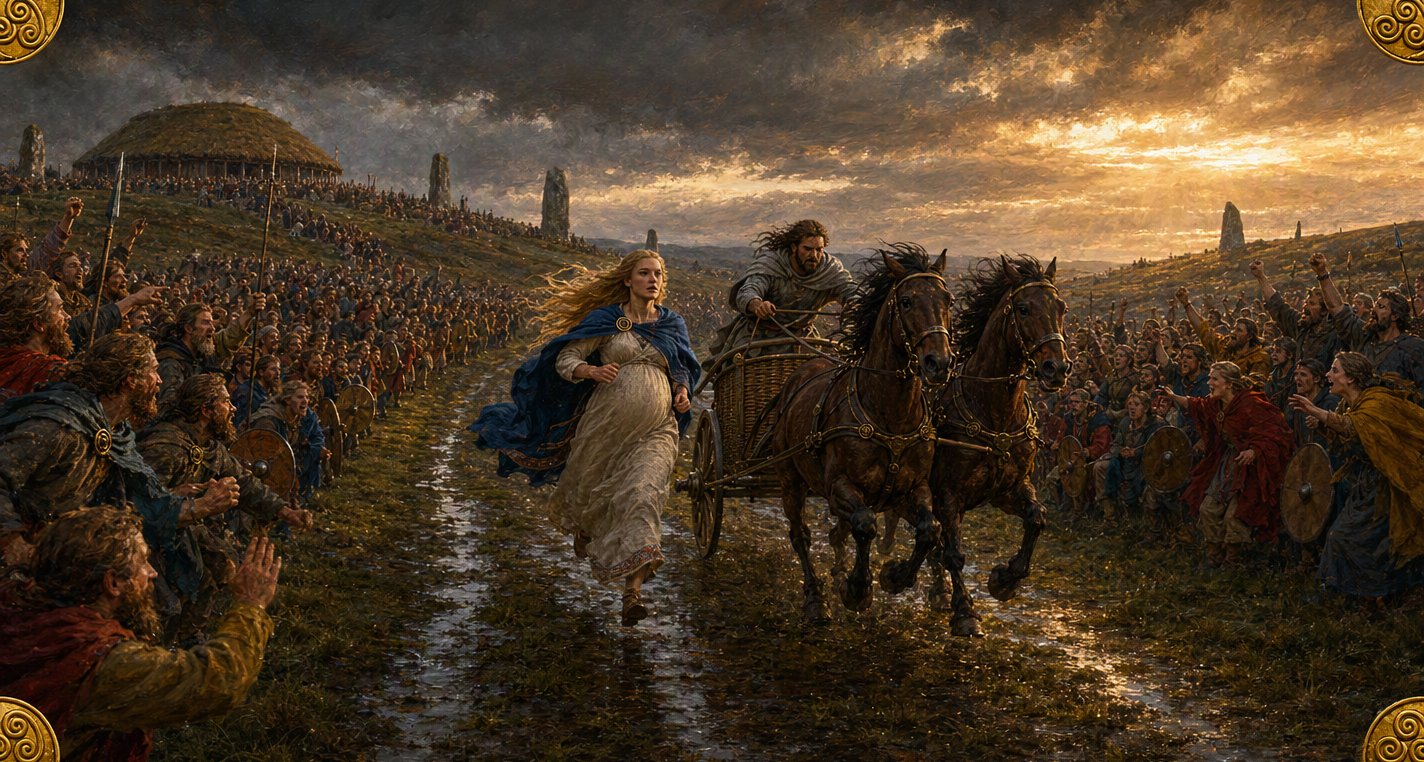
The horses were brought up beside her. She ran, and she outran them. She came first to the end of the course, and there she cried out in her pain and bore twins, a son and a daughter, before ever the king’s horses reached the goal. 3 That is why the place is called Emain Macha: the Twins of Macha.
Everyone who heard her cry was struck weak where they stood, with no more strength in them than the woman in her labour.
From this hour, said Macha, the shame you have put on me will be the shame of every one of you. When a time of oppression comes on you, every one of you who dwells in this province will be as weak as a woman in childbirth. It will last five days and four nights, and it will be so to the ninth generation.
And so it was. Three were spared: the children of Ulster, and its women, and Cú Chulainn, for he was not of Ulster’s blood. 4 Nor did it touch anyone from outside the province.
That is the noínden of the Ulstermen. It is why they lay helpless in their pangs when Medb’s armies came for the Brown Bull, and one young man stood alone at the fords. But that is another tale.
What the tale keeps
A woman walked in at a lonely man’s door, sat down at his hearth and kept his house. Where she came from, the tale never says. She asked one thing of him: that he should never speak of her at the assembly. He kept his word until the king’s horses won.
She asked one thing of the crowd as well, and told them why: a mother bore each one of you. No one helped her, and the king would not wait. So she left them her own pain, the weakness of a woman in labour, to carry into every hard hour for nine generations.
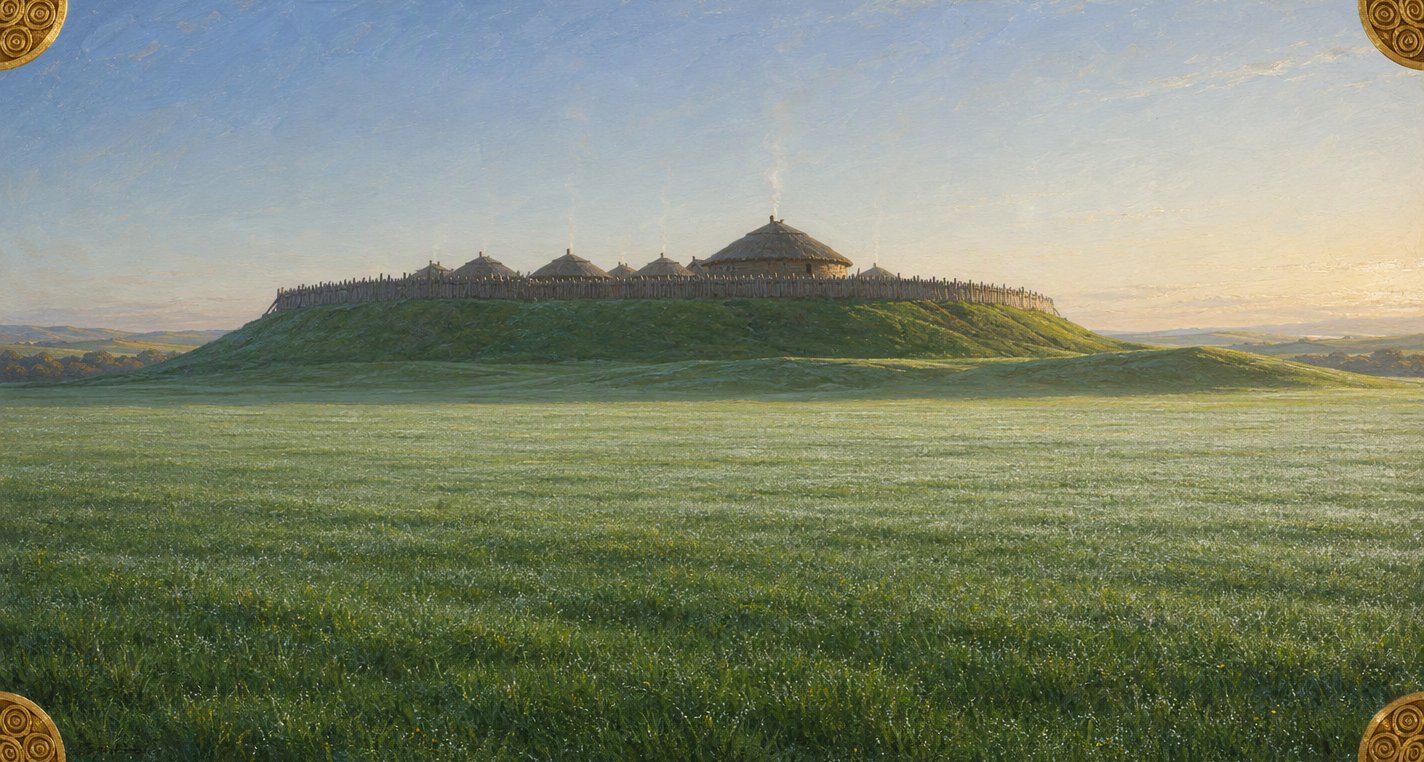
And she left her name on that place. Every king who ruled from Emain Macha ruled from the Twins of Macha.
Notes
- The prose tale never names the king. The Dindshenchas does: it is Conchobar’s horses that Macha races, and in the poem on Ard Macha Conchobar has Cruinn son of Agnoman held “till the warrior’s fair wife come to a noble race against my steeds” (Edward Gwynn, The Metrical Dindshenchas, Part IV, 1924). ↩
- The Dindshenchas gives her another father. In its poem on Ard Macha she is the daughter of Midir of Brí Léith, her “two names, not seldom heard in the west, were bright Grian and pure Macha”, and the king’s messenger goes “to bid her come from the ocean waves” (Edward Gwynn, The Metrical Dindshenchas, Part IV, 1924). ↩
- Hull’s English, made from Windisch’s German, says that she cried out in her pain, “but God helped her” (Eleanor Hull, The Cuchullin Saga in Irish Literature, 1898). The tale came down through Christian scribes, and here it is their God who helps her at the birth. ↩
- So Hull’s English has it: he was not descended from Ulster (Eleanor Hull, The Cuchullin Saga in Irish Literature, 1898). Other tales make his mother Conchobar’s sister, and T. W. Rolleston gives another reason: he was spared “as the son of the god Lugh” (Myths and Legends of the Celtic Race, 1911). ↩
Where the tale comes from
Medieval manuscript. A short medieval Irish prose tale that explains why the men of Ulster lay helpless when the Táin began. The oldest copy is in the Book of Leinster, written in the 12th century.
- Noínden Ulad, in full Noínden Ulad ocus Emuin Macha, is a short medieval Irish prose tale. It survives in four manuscripts, the oldest the Book of Leinster, and like the rest of the Ulster tales it was written down by Christian scribes. Ernst Windisch edited it with a German translation in 1884, and Eleanor Hull put his German into English as “The Debility of the Ultonian Warriors” in The Cuchullin Saga in Irish Literature (1898). This retelling follows Hull, but leaves out the curse’s end: in her English it lasted from Crunniuc’s day to the days of Fergus mac Donnell, or of Forc son of Dallan.
- The Dindshenchas, the lore of places, tells the story under Ard Macha, Armagh, and tells it otherwise. The king is Conchobar. Macha “asked a respite till her womb should have fallen, and this was not granted to her”; men say she was Grían Banchure, “the Sun of Womanfolk”; and after the race she died, and her tomb was raised on Ard Macha (Whitley Stokes, The Prose Tales in the Rennes Dindshenchas, 1895). The Ulaid suffered “from the reign of Conchobar to the reign of Mál son of Rochraide” (Stokes); in the poem, “till the ninth of nine lives”, and the poem names the twins: “Fir and Fial were the names of the twins that Grian bore” (Edward Gwynn, The Metrical Dindshenchas, Part IV, 1924).
- The same Dindshenchas remembers two other Machas on that ground: Macha wife of Nemed, another son of Agnoman, buried on the plain her husband cleared and gave her; and Macha daughter of Aed the Red, by whom “Emain was marked out”, buried there when Rechtaid of the red fore-arm killed her, and lamented at the Fair of Macha, which was founded for her (Stokes, 1895). The poem says she “shaped with her brooch for grim Dithorba’s sons” the fort of Emain (Gwynn, 1924).
- The Táin counts the spared a little differently: no weakness came “on women and boys, nor on any one who was outside the country of the Ulstermen, nor on Cuchulainn and his father” (L. Winifred Faraday, The Cattle-Raid of Cualnge, 1904). And there the pains last not five days and four nights but the whole winter, while Cú Chulainn holds the fords alone “from Monday at Summer’s end till the beginning of Spring” (Joseph Dunn, The Ancient Irish Epic Tale Táin Bó Cúalnge, 1914). Lady Gregory tells the whole story inside her Táin, in Cuchulain of Muirthemne (1902). In her telling the husband is Crunden, son of Agnoman; the woman and the king have no names; and of the men of Ulster “there was no one escaped that curse and that enchantment but only Cuchulain”.
- T. W. Rolleston retold it in Myths and Legends of the Celtic Race (1911), calling Macha “no mere woman, but a supernatural being” and repeating the observation that here is “the earliest appearance in postclassical European literature of the well-known motive of the fairy bride who can stay with her mortal lover only so long as certain conditions are observed”.
Sources
- The Cuchullin Saga in Irish Literature · ed. Eleanor Hull (1898)
- The Prose Tales in the Rennes Dindshenchas · ed. and tr. Whitley Stokes, Revue Celtique 16 (1895), tales 81 to 130, via the Thesaurus Linguae Hibernicae (UCD)
- The Metrical Dindshenchas: "Ard Macha" · ed. and tr. Edward Gwynn, Part IV (Todd Lecture Series XI, Dublin, 1924), via CELT
- Cuchulain of Muirthemne: "The War for the Bull of Cuailgne" · Lady Gregory (1902)
- Myths and Legends of the Celtic Race, chapter V: "Tales of the Ultonian Cycle" · T. W. Rolleston (London, 1911)
- The Cattle-Raid of Cualnge (Tain Bo Cuailnge): An Old Irish Prose-Epic · tr. L. Winifred Faraday (London: David Nutt, 1904)
- The Ancient Irish Epic Tale Táin Bó Cúalnge · tr. Joseph Dunn (London, 1914)
- Irish Sagas Online: Noínden Ulad ocus Emuin Macha, sources · University College Cork