The Ulster Cycle
The Cattle Raid of Cooley
Táin Bó Cúailnge
An argument in bed over who is richer ends in a war for a brown bull, and one young man holding a ford against all Ireland.
I The Pillow-Talk
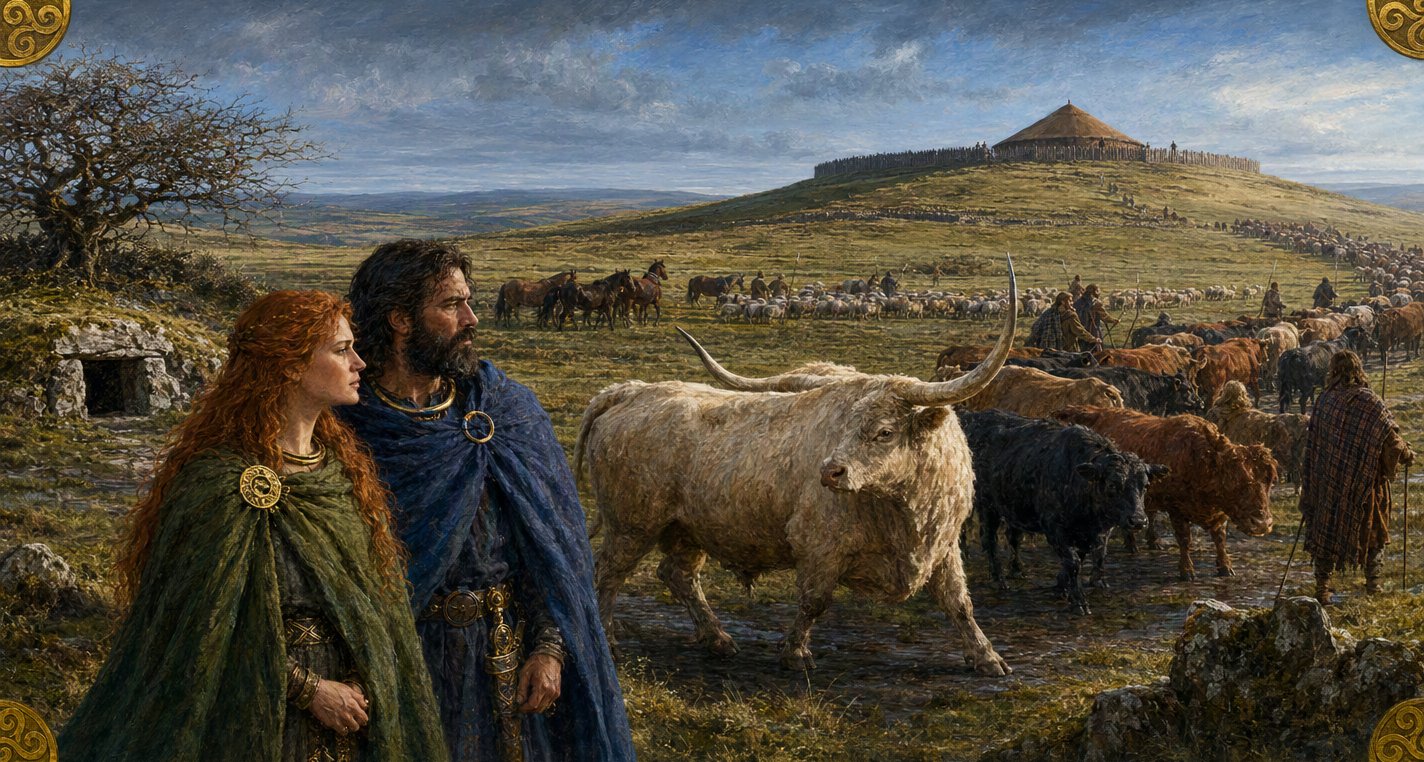
Once, when Ailill and Medb had spread their royal bed in Cruachan, the stronghold of Connacht, they fell to talking across the pillow. 1
It’s a true saying, said Ailill: well off is the woman who is a rich man’s wife.
I was well off before I ever saw you, said Medb. She was a high king’s daughter, and had asked a bride-gift no woman in Ireland had asked before: a husband without meanness, without jealousy and without fear. She had found him in Ailill, and paid the bride-price herself. You are a man kept by a woman, she said.
No one in Ireland, said Ailill, has more treasure than I have.
So it was all brought out and counted: buckets and cauldrons, rings and gold, clothes of every colour, sheep and horses and pigs, and the cattle last of all. Thing for thing and beast for beast, they were equal.
But in Ailill’s herd stood Finnbennach, the White-horned. He had been calved by one of Medb’s cows, but he thought it no honour to belong to a woman, and had gone over to the king. Medb had no bull to match him, and it was as if she owned not a pennyworth.
I know where there is a better one, said Mac Roth the messenger: the Donn Cúailnge, the Brown Bull of Cúailnge, in the house of Dáire mac Fiachna in Ulster.
So Mac Roth went north with Medb’s offer, nine messengers in all. Let Dáire lend her the bull for a year, and he would have him back with fifty heifers; and if he came with him himself, land as good as his own in Mag Aí, and Medb’s own close friendship.
Dáire leapt for joy until the seams of his bed burst under him. That night he feasted the messengers, and they grew loud with drink. It would have been work for four provinces, said one, to take that bull out of Ulster, and he hands it to nine of us on foot. If he hadn’t, said another, we’d have taken it by force. 2
Dáire’s steward heard them and went in to his master, and Dáire swore by the gods he worshipped: what they could not take by fair means, they would not take by foul. In the morning the messengers went home with nothing.
No need to smooth it over, said Medb. We knew that if the bull was not given, he would be taken. And taken he shall be.

II Fedelm
Then the host of four provinces gathered at Cruachan, and with them the exiles of Ulster under Fergus mac Róich, three thousand men who had come west after the death of the sons of Uisliu.
On the day they set out, Medb asked her druid what was to come. Whoever else does not come back, he said, you will.
Her charioteer turned the chariot to the right, for luck, so that they would come home. As it turned, Medb saw a girl standing on the shaft of a chariot that was coming towards her. She was weaving a border, with a rod of silvered bronze in her right hand. Her yellow hair hung in three tresses, two wound about her head and one falling behind her to her calves. She wore a speckled green cloak with a gold pin, and a hooded tunic worked with red. Her eyes were grey and laughing, and in each of them were three pupils.
Who are you? said Medb.
Fedelm, the prophetess from the síd of Cruachan, said the girl: a poet of Connacht, home from Alba, where she had learned the art.
Then tell me, Fedelm, said Medb, how do you see our host?
Crimson-red from blood they are;
I behold them bathed in red! 3
That cannot be, said Medb. Conchobar lies in his pains at Emain Macha, and all Ulster with him.
She named the champions of Ulster one by one, and each time Fedelm answered the same. Then she told what she saw: a young man with the hero’s light on his brow and seven gems in the middle of his eyes, and the host falling before him, bodies hewn and wives in tears. It was Cú Chulainn, son of Sualtam, the Smith’s Hound.

III The Hound at the Border
So the host went out, four of the five provinces of Ireland, and Fergus went before them as their guide, for he had once been king of Ulster. But love for his own people came over him on the road, and he led them wide to the north and to the south, to give Ulster time.
Of the men of Ulster only two were free of the pains that Macha had laid on them: Cú Chulainn and his father Sualtam. When the host drew near, Cú Chulainn sent his father north with the warning; he had a tryst of his own to keep that night. But first, at Ard Cuillenn, he cut an oak sapling with one stroke, bent it into a ring, cut ogham on it, and forced it down over a pillar-stone. No one was to go past that place, it said, until a man was found who could make a ring like it with one hand; and he excepted his master Fergus. 4
Further on, at Áth Gabla, they found a forked branch cut with one stroke of a sword and driven into the stream, and on its four points the heads of four of their men. Perhaps my foster-son, Fergus told Ailill: Cú Chulainn, the Hound of Culann, in his seventeenth year. And he told them the deeds of his boyhood.
From then on one young man held the border of Ulster against four provinces. By night his sling killed a hundred of them. Medb sent him offers, wine and mead in Cruachan at all times, if he would leave Conchobar. I would not sell my mother’s brother, he said, for any other king.
Then he made his own terms. Every day one man would come to fight him at a ford. While they fought, the host might march; when the man was dead, they would camp until sunrise, or send another. Better one man a day, said Medb, than a hundred every night.
So, day after day, the champions of Ireland went down to the fords of Muirthemne.

IV The Morrígan
In those days the Morrígan, the prophetess of the sídhe, came in the shape of a bird and perched on the standing stone at Temair in Cúailnge. Take heed, you unlucky one, she told the Brown Bull: the men of Ireland are on your track, and they’ll drive you off to their camp like any ox on a raid.
Fifty boys played on that bull’s back every evening, a hundred warriors sheltered in his shadow, no goblin or sprite of the glen dared come near him, and his lowing as he came home at evening was music. He went off with fifty heifers to the Heifers’ Glen on Sliab Culinn; but the men of Ireland found him there, and drove him to their camp.
Then a young woman came to Cú Chulainn, in a dress of every colour, beautiful beyond telling. She was the daughter of Buan the king, she said; she had loved him for the tales they told of him, and brought him her treasures and her cattle.
It’s a bad time you’ve come, said Cú Chulainn. We’re worn down with hunger, and I can’t be meeting women in the middle of this fight.
Then I’ll come against you, she said, when you’re fighting a man at the ford: as an eel under your feet, as a grey she-wolf driving the cattle, as a hornless red heifer at the head of the herd.
I’ll break your ribs between my toes, said he, and your eye with a sling-stone, and your leg under you. And she went from him.
She came when he fought Loch mac Mofemis at the ford, a heifer, an eel and a she-wolf, and each time he wounded her. While the eel was coiled round his feet, Loch wounded him across the breast. Then Láeg sent the Gae Bulga down the stream to him, and Loch fell.
Afterwards, mad with thirst, Cú Chulainn met an old woman milking a tawny cow with three teats, and begged a drink. She gave him the milk of one teat. A cure in time to me, he said, and one of her eyes was whole. With the second her head was healed, and with the third her leg: The blessing of gods and non-gods on you, woman! It was the Morrígan. No one Cú Chulainn wounded could be healed, unless he had a part in the healing himself. 5

V Sleep at Lerga
From the Monday before Samhain to the Wednesday after the start of spring, Cú Chulainn never slept, except for a snatch after noon, leaning on his spear, his head on his fist and his fist on his spear and his spear on his knee.
One evening, from the grave-mound at Lerga in Mag Muirthemne, he watched the arms of four provinces glittering over their camp in the setting sun. One man is coming towards us, said Láeg, straight across the camp. And it was as if no one in the camp could see him. He was tall and fair, in a green cloak with a brooch of white silver, with a black shield and a five-barbed spear.
One of my friends from the sídhe, said Cú Chulainn, come to pity me.
Sleep, said the stranger: three days and three nights here at Lerga, and I will hold off the host. And while Cú Chulainn slept, he put herbs of the síd and healing charms into every wound. The older telling gives his name: he was Lugh, Cú Chulainn’s father from the síd. 6
While he slept, the boys of Emain Macha came south: thrice fifty sons of the kings of Ulster, with Follomon, Conchobar’s son, at their head. They fought three battles in three days, and three times their number fell before them; and then the boys fell, all but Follomon, who vowed to bring home Ailill’s head with its golden diadem, and fell too.
How long have I slept? Cú Chulainn asked when he woke.
Three days and three nights, said the stranger, and he told him of the boys.
Alas, said Cú Chulainn, that I was not there in my strength! And the man of the sídhe went from him, and no one knew which way he went.
Láeg yoked the scythed chariot. The ríastrad came on Cú Chulainn, and he drove in a great circle round the host, and a hundred and thirty of their kings and lords fell. That was the Great Rout of Mag Muirthemne.
VI Ferdiad
Then the men of Ireland took counsel who could go against him, and they chose Ferdiad, son of Damán, of the Fir Domnann. He and Cú Chulainn had learned their skill together from Scáthach and Uathach and Aífe, and neither was the better, except that Cú Chulainn had the feat of the Gae Bulga. But Ferdiad had a skin of horn when he fought at a ford.
He would not come. He knew what they wanted of him: to fight his friend, his comrade and his foster-brother. So Medb sent the druids and the satirists, to raise three blisters on his face, Blame, Blemish and Disgrace, if he refused. He came for his honour’s sake. Better to fall by the shafts of valour than by the shafts of satire.
In the camp they poured strong drink for him until he was merry, and promised him everything: land in Mag Aí, free of tribute for his sons and their sons to the end of time, Medb’s daughter Finnabair, and Medb’s own ringed brooch. Then Medb told him Cú Chulainn had said it would be no great thing to kill him. That was not just, said Ferdiad: he never saw cowardice in me. And he swore to go to the ford.
Fergus drove out to warn his foster-son. It is not to a fight, said Cú Chulainn, that we would want our friend to come.
Ferdiad set out for the ford before full daylight. You were my servant at Scáthach’s, he said when Cú Chulainn came. We were heart-companions, said Cú Chulainn, comrades in the woods.
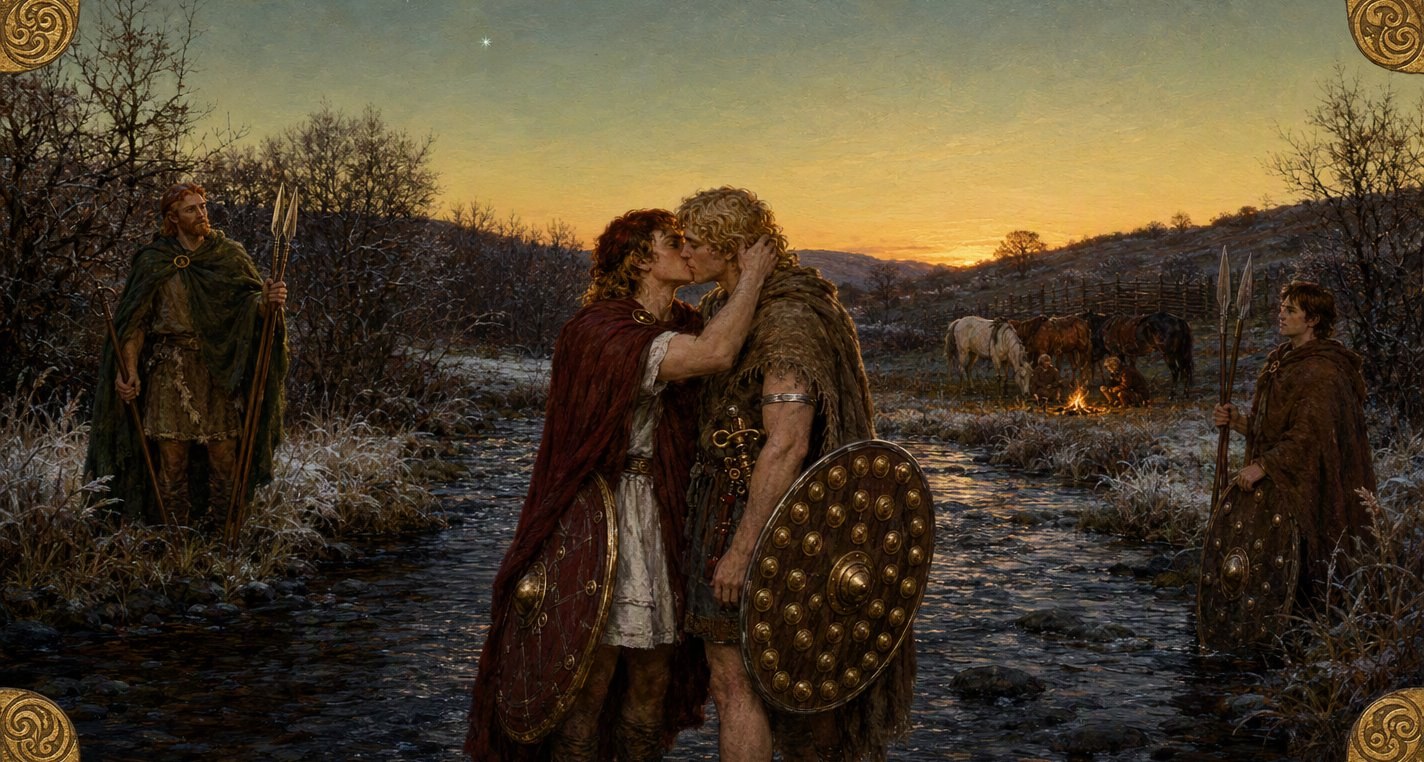
All that day they fought: with darts from dawn till noon, and neither drew blood; with spears from noon till sundown, and both bled. Then they threw their weapons to their charioteers, and each put a hand on the other’s neck and kissed him three times. Their horses were in one paddock that night, and their charioteers at one fire. Of every herb that went into Cú Chulainn’s wounds, he sent a like share across the ford to Ferdiad; and of all the food the men of Ireland brought Ferdiad, he sent a like share to Cú Chulainn, for only the men of Breg were feeding him.
VII The Feat of the Ford
On the second day they fought from their chariots with great lances, and if birds could fly through the bodies of men, they could have flown through theirs. On the third they fought with heavy swords. Your hair has darkened today, Cú Chulainn told Ferdiad, and your eye is heavy, and your shape has gone from you. That night their horses were not in one paddock, nor their charioteers at one fire.
On the fourth morning Ferdiad put on an apron of brown leather, and over it a flat stone the size of a millstone, and over the stone an apron of iron, for fear of the Gae Bulga. He gave Cú Chulainn the choice of weapons. The feat of the ford, said Cú Chulainn. Ferdiad agreed, and dreaded it, for every man who fought Cú Chulainn in that feat had died.
Cú Chulainn leapt onto the boss of Ferdiad’s shield, and Ferdiad threw him off with his knee, like a child, onto the bank. He’s shaken you, cried Láeg, the way a woman shakes her child! Then Cú Chulainn swelled like breath in a bladder, until he towered over Ferdiad like a giant or a man of the sea. They fought so close that their shields split, and they drove the river out of its bed, so that a king or a queen could have lain in the middle of the ford without a drop of water under them.
Cú Chulainn called for the Gae Bulga. Ferdiad lowered his shield to guard his body below, and Cú Chulainn’s short spear went over its rim and into his heart. Láeg sent the Gae Bulga down the stream; Cú Chulainn caught it in the fork of his foot and cast it, through the iron and the stone, into Ferdiad.
That is enough, said Ferdiad. I fall by that. But it was not fair, that I should fall by your hand.
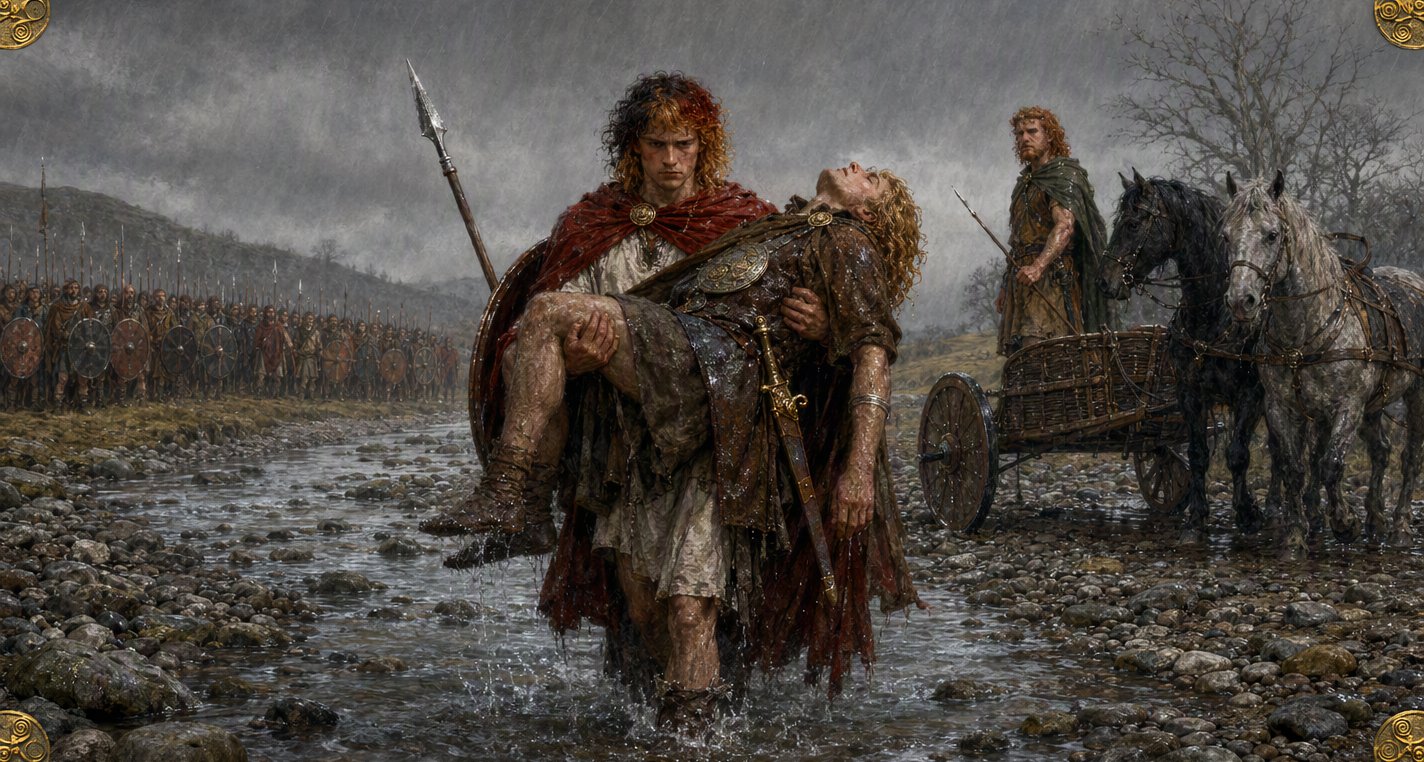
Cú Chulainn ran to him and carried him north across the ford in his arms, so that the victory would be on the north side, and not on the south side with the men of Ireland. Then a faint came over him, by Ferdiad’s head. Get up, said Láeg: the men of Ireland will be on us now. What good is it to get up, said Cú Chulainn, now that this one has fallen by my hand? He looked at the brooch Ferdiad had come for, and lamented him:
All was play, all was sport,
Till came Ferdiad to the ford! 7

VIII Ulster Rises
Cú Chulainn lay at the fords, so wounded that there was not a hair on him, from crown to sole, where a needle’s point could stand without finding blood, except the left hand that held his shield. His father Sualtam came to him. Go to Emain, said Cú Chulainn, and tell the men of Ulster to come and look after their cattle.
Sualtam rode the Grey of Macha north to Emain. Men are slain, women stolen, cattle driven off, men of Ulster! he cried, at the Flagstone of the Hostages. No one answered. It was geis for the men of Ulster to speak before their king, and for the king to speak before his druids. Who slew them, and who stole them? Cathbad asked at last, and Sualtam turned away in anger. The Grey reared under him at the rampart, and he fell on his own shield, and its rim cut off his head. The horse came back into Emain with the shield on its back and the head on the shield, still crying the warning.
Unless the sky falls, said Conchobar, or the earth bursts open, or the sea breaks over the land, I will bring every cow back to her byre and every woman to her home. And Ulster rose out of its pains and marched south to battle.
On the day of the battle Ailill gave Fergus back the sword he had kept from him all through the war, and Fergus struck three blows on Conchobar’s shield, so that it cried aloud. Turn your hand slantwise, called Cormac, Conchobar’s son; and Fergus sheared the tops off three hills instead, the three bald hills of Meath.
Cú Chulainn heard the blows where he lay. The dry wisps stuffed in his wounds flew up into the sky, and he went out with no weapon but his chariot on his back. Turn, Fergus, he cried, or I’ll grind you as a mill grinds grain! You promised to flee before me when I was wounded. For once before, Fergus had come against him with a wooden sword in his scabbard, and Cú Chulainn had fled before him in front of all Ireland, on Fergus’s word to do the same on the day of the great battle.
Fergus turned and took his three great strides back, and the men of Ireland turned with him and broke west over the hill. That is how it goes, said Fergus, with a herd that follows a mare. 8
IX The Bulls
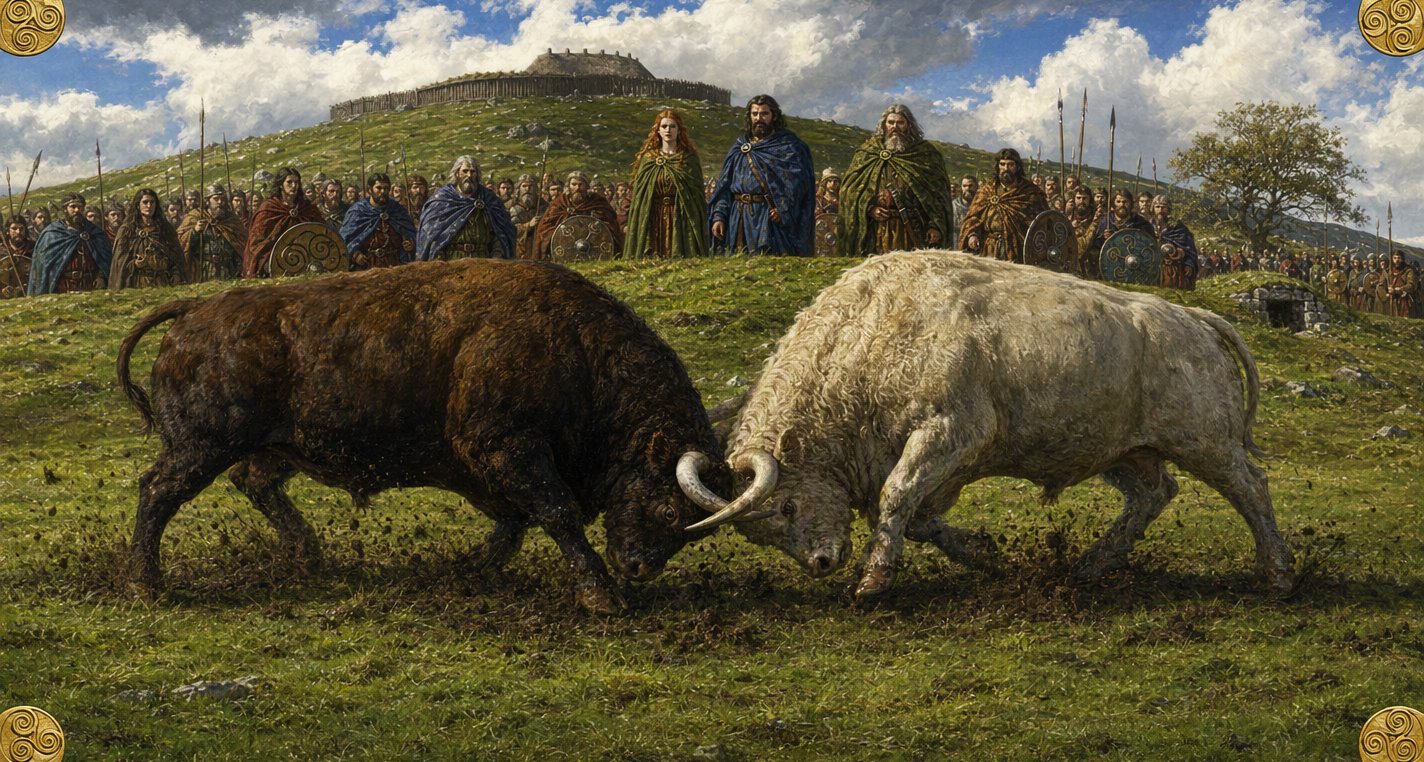
Medb had sent the Brown Bull ahead to Cruachan with fifty of his heifers, so that whoever else escaped, he would. Now she brought the men of Ireland to watch the bulls fight. Bricriu of the poison tongue was set to judge it, for he was no fairer to his friend than to his foe. He had spent the war at Cruachan, mending the head Fergus broke over a game of fidchell.
The Brown Bull saw the strange, beautiful country, and bellowed three times, and Finnbennach heard him and came. They met at Tarbga in Mag Aí, and their hooves trod Bricriu a cubit deep into the earth, and that was the end of him. They fought until night fell, and all night long they went over the greater part of Ireland.
In the morning the men of Ireland saw the Brown Bull coming over Cruachan from the west, with what was left of the White-horned hanging from his horns. They would have killed him. Leave him alone, said Fergus, and leave him his trophy.
He went east, and the land keeps the pieces. Where he left the loin of the White-horned is Áth Luain, Athlone, and where the liver fell is Áth Truim, Trim. Then he turned his face north, and he knew the land of Cúailnge, and went home to it.
The women and the boys and the children of Cúailnge were there, lamenting him, and they saw a bull’s great forehead coming towards them. He turned on them, and killed a great many of them. Then he turned his back to the hill, and his heart broke in his breast, the way a nut breaks. 9
That is the fate of the Brown Bull of Cúailnge, and the end of the Táin.
What the tale keeps
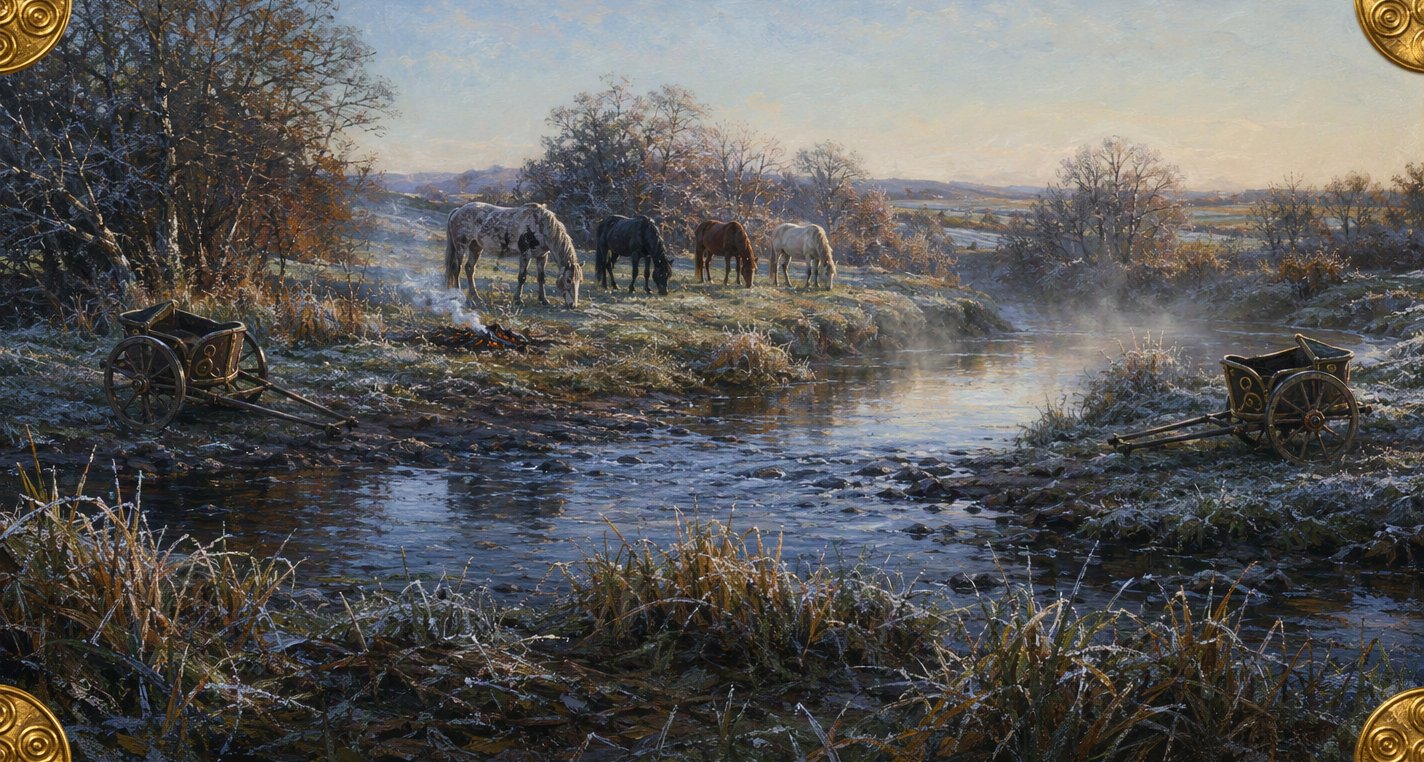
A quarrel in a bed over a bull, and a winter of killing at the fords. At the heart of it lie the first two nights at Ardee: two young men who had learned their trade together, sending herbs and food to each other across the water, their horses in one field and their charioteers at one fire. In the morning they went back into the ford.
And the land keeps the war. The Brown Bull scattered his enemy across Ireland, and the Táin says the places still carry the pieces in their names: Áth Luain, the ford of the loin; Áth Truim, the ford of the liver. Ferdiad’s ford is a town now. The bull himself knew his own country when he saw it, and went home to it, and his heart broke there like a nut.
Notes
- The Book of Leinster version begins in bed. Its preface ends: “Thus far the Augury and the Prophecy and the Preface of the Tale, and the Occasion of its invention and conception, and the Pillow-talk which Ailill and Medb had in Cruachan.” (Joseph Dunn, 1914) The older telling starts with the hosting: “A great hosting was brought together by the Connaughtmen” (L. Winifred Faraday, 1904). ↩
- The messenger’s boast: “were the bull not given willingly, yet should he be taken by force!” Dáire’s oath: “I swear by the gods whom I worship, they shall in no wise take by foul means what they cannot take by fair!” (Joseph Dunn, 1914) ↩
- Fedelm’s answer, in Joseph Dunn’s verse (1914). In the older telling she answers in prose, “I see very red, I see red”. There she holds “a shuttle of white metal, with an inlaying of gold”, and “there were two black horses to her chariot” (L. Winifred Faraday, 1904). ↩
- “Let no one go past here till a man be found to throw a withy like unto this, using only one hand” (Joseph Dunn, 1914). Ogham was cut as notches along an edge; here, on the plug of the ring. ↩
- After the blessing, the text stops to explain it: “Now these were their gods, the mighty folk: and these were their non-gods, the folk of husbandry.” (Joseph Dunn, 1914) The older telling has the same gloss, which Faraday calls “a gloss incorporated in the text”. In both tellings she is “blind and lame”, and at the end she reproaches him. In the older one she says: “You told me I should not have healing from you for ever.” He answers: “If I had known it was you, I would not have healed you ever.” (L. Winifred Faraday, 1904) ↩
- In Dunn’s English he is “the warrior from Faery”, and Cú Chulainn calls him “one of my friends of fairy kin”. Asked who he is, he answers: “Thy father from Faery am I, even Lug son of Ethliu.” (Joseph Dunn, 1914) The account of the Great Rout then adds: “What others say is that Lug son of Ethliu fought on Cuchulain’s side at the Sessrech Bresligè.” (1914) In the older telling he names himself: “It is I, your father from the síd, Lug Mac Ethlend.” (L. Winifred Faraday, 1904) Lady Gregory calls him “Lugh of the Long Hand” (1902). ↩
- The refrain of Cú Chulainn’s lament for Ferdiad, in Joseph Dunn’s verse (1914). In the older telling they fight a single day, and the lament begins: “Alas, O golden brooch, O Fer Diad!” (L. Winifred Faraday, 1904) ↩
- Fergus’s words to Medb: “even as a brood-mare leads her foals into a land unknown, without a head to advise or give counsel before them, such is the plight of this host to-day in the train of a woman that hath ill counselled them.” (Joseph Dunn, 1914) ↩
- “He turned his back to the hill then and his heart broke in his breast, even as a nut breaks.” (Joseph Dunn, 1914) In the older telling he “died between Ulster and Iveagh at Druim Tairb” (L. Winifred Faraday, 1904). In Lady Gregory’s he first gives “a loud bellowing of victory” (1902). ↩
Where the tale comes from
Medieval manuscript. Early Irish prose epic, the heart of the Ulster Cycle. The older telling is in Lebor na hUidre, of about 1100; this retelling follows the fuller Book of Leinster version, compiled about 1160.
- The Táin survives in two main recensions. The older, Recension I, is in Lebor na hUidre, “a MS. dating from about 1100”, and the Yellow Book of Lecan, “a late fourteenth-century MS.”; L. Winifred Faraday translated it in 1904, and thought that a version of the tale “goes back to the early eighth, or seventh century”. The Book of Leinster, compiled about 1160, tells it “longer, fuller, and later in both style and language” (Faraday). This retelling follows the Book of Leinster, in Joseph Dunn’s translation of 1914. To give the Táin “in its completest form”, Dunn worked into it “conflate readings” from other manuscripts, among them Stowe 984, written in 1633, and H. 1. 13 in Trinity College, Dublin, written in 1745, and marked them in his footnotes.
- The older telling differs in many places. It has no pillow-talk: Ailill and Medb simply call a hosting. Ferdiad fights Cú Chulainn for a single day, Findabair gives him “three kisses at every cup”, and the Gae Bulga, sent along the stream, “became twenty-four points”. The bulls meet “at Tarbga in Mag Ai”, and the tale ends in peace: “For seven years after there was no wounding of men between them.” (L. Winifred Faraday, 1904)
- Lady Gregory retold the war in Cuchulain of Muirthemne (1902), mostly from the Book of Leinster. Her chapter “The Two Bulls” tells where the bulls came from. Friuch, swineherd of Bodb, king of the sídhe of Munster, and Rucht, swineherd of Ochall Ochne, king of the sídhe of Connacht, quarrelled, and went through shape after shape, ravens and water-beasts and eels among them, until each was swallowed by a cow: one by a cow of Dáire’s in Cúailnge, one by a cow of Medb’s. “And it was from that cow, and from the cow that belonged to Daire, son of Fachna, the two bulls were born, the White-horned and the Brown.”
- Other tales were told as fore-tales of the Táin, to explain how things stood when the war began: among them The Dream of Aengus, The Adventure of Nera and The Exile of the Sons of Uisliu, which tells why Fergus and three thousand men of Ulster were in Connacht.
- Like nearly all early Irish literature, the Táin was written down and copied by Christian monks, centuries after the conversion. They kept the old oaths and the old gods in it: Dáire swears “by the gods whom I worship”, and when Cú Chulainn blesses the Morrígan by “gods and non-gods”, a gloss in the text explains what the words had meant (Joseph Dunn, 1914; L. Winifred Faraday, 1904).
Sources
- The Ancient Irish Epic Tale Táin Bó Cúalnge · tr. Joseph Dunn (London, 1914)
- The Cattle-Raid of Cualnge (Tain Bo Cuailnge): An Old Irish Prose-Epic · tr. L. Winifred Faraday (London: David Nutt, 1904)
- Cuchulain of Muirthemne, chapter XI: "The War for the Bull of Cuailgne" · Lady Gregory (1902)
- Cuchulain of Muirthemne, chapter XIII: "The Two Bulls" · Lady Gregory (1902)
- Placenames Database of Ireland · logainm.ie