The Ulster Cycle
Bricriu’s Feast
Fled Bricrenn
Bricriu of the Poison Tongue throws a feast, promises the champion’s portion to three heroes at once, and sits at his window to watch.
I The House at Dún Rudraige
Bricriu of the Poison Tongue made a great feast for Conchobar mac Nessa and all the men of Ulster, and he was a whole year getting it ready.
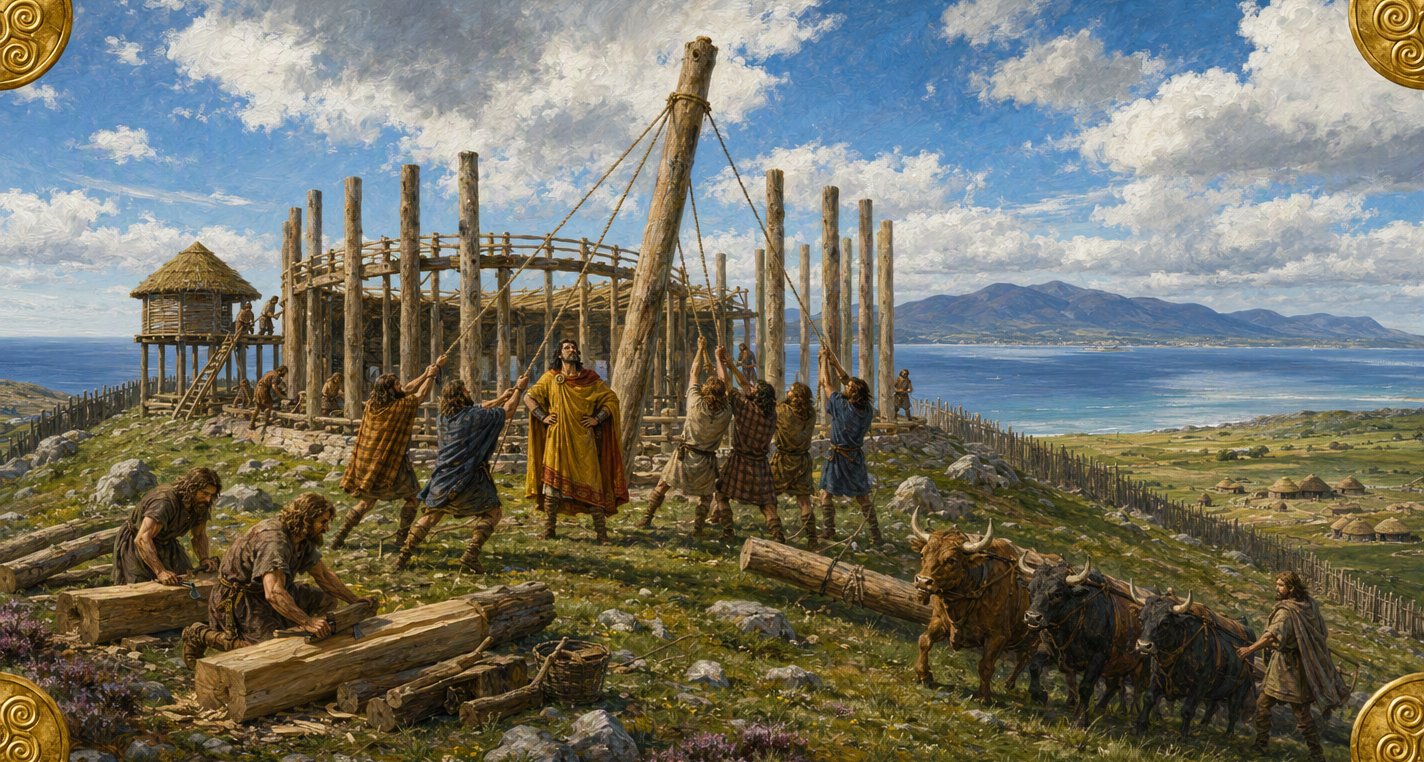
First he built a house to hold it, at Dún Rudraige, in the likeness of the Red Branch at Emain Macha. There were nine rooms in it from the fire to the wall, each faced with bronze thirty feet high and overlaid with gold. The king’s couch stood high above the rest, set with carbuncles and precious stones, and round it stood the couches of the twelve champions of Ulster. Thirty of the best craftsmen in Ireland built it, and it took seven men of Ulster to set up each pole.
Then he made himself a grianán, a sunny room up level with the king’s couch, with windows of glass in its sides. One of them was over his own couch, so that he could see the whole hall from where he sat. He knew the men of Ulster would never let him inside. 1
When all was ready he went to Emain and invited them.
Gladly, said Conchobar, if the men of Ulster are willing.
No, said Fergus and the nobles of Ulster. If we go, our dead will outnumber our living, once Bricriu has set us on each other.
It will go worse with you if you don’t, said Bricriu. I will set the kings and the champions on each other until they kill one another. I will set father against son and mother against daughter, and every woman in Ulster against the next.
Better to go, then, said Fergus.
Then Sencha mac Ailella gave his counsel. Since you must go, he said, take hostages from Bricriu, and set eight swordsmen round him to put him out of the house the moment the feast is laid.
So the host of Ulster set out from Emain, king and chief and leader, and Bricriu went along with them, thinking.

II Three Whispers
He came first to the company of Lóegaire Búadach.
Hail, Lóegaire the Triumphant, said Bricriu, mighty mallet of Brega, hot hammer of Meath! If the champion’s portion of my house is yours, the championship of Emain is yours for ever.
Then he told him what the champion’s portion was. A cauldron full of good wine, with room in it for three champions of Ulster. A boar seven years old, that had eaten nothing since it was little but fresh milk and fine meal in spring, curds and sweet milk in summer, nuts and wheat in autumn, beef and broth in winter. A bullock seven years old, that had tasted no heather or twigs since it was a calf, only sweet milk and herbs, meadow hay and corn. And a hundred cakes of wheat, baked in honey. 2
At the end of the day, said Bricriu, when the feast is spread, let your charioteer stand up, and it will be given to him.
There will be dead men if it isn’t, said Lóegaire.
Then Bricriu went to the company of Conall Cernach. Hail, Conall the Victorious, he said, hero of victories and battles! You guard the rear of the men of Ulster coming home, so that no enemy can get past you. What should keep the champion’s portion of Emain from you for ever?
Then he went to Cú Chulainn. Hail, Cú Chulainn, he said, victor of Brega, bright banner of the Liffey, darling of Emain! You are the champion of Ulster. You ward off their feuds and frays, and you see justice done for every man. Why would you leave the champion’s portion to anyone else, when no one in Ireland could take it from you?
By the god of my people, said Cú Chulainn, whoever comes to take it from me will lose his head.
Then Bricriu left them, and followed the host as if no quarrel had ever been made.

III Swords in the Hall
At Dún Rudraige every man went in to his place. Bricriu laid out the feast, and the moment it was spread the hostages ordered him out. At the threshold he called back to them. There’s the champion’s portion, he said, and it’s no portion from a fool’s house. Give it to the man of Ulster you think the bravest. Then he went up with his household to his grianán.
Then the stewards rose to serve. Up stood Sedlang mac Riangabra, Lóegaire’s charioteer. Give the champion’s portion to Lóegaire the Triumphant, he said. It is his alone by right. Up stood Id mac Riangabra, Conall’s charioteer, and claimed it for Conall. Up stood Láeg mac Riangabra. Bring it to Cú Chulainn, he said. It is no shame for all the men of Ulster to give it to him.
The three champions sprang out onto the floor. They took up their shields and drew their swords, and they hewed at one another until one half of the house was a haze of fire from the edges of swords and spears, and the other half white with the enamel of the shields. And it was two against one: Lóegaire and Conall together, against Cú Chulainn.
Conchobar and Fergus were furious to see it. Part them, said Sencha, and the king and Fergus came between them, and the three let their hands fall to their sides.
Here is my counsel, said Sencha. Divide the champion’s portion tonight among the whole company. After that, let Ailill judge it at Cruachan, for the men of Ulster count it unlucky to break up this gathering unless the matter is judged there.
So it was agreed. But up in his grianán Bricriu was already turning it over in his mind, how he could set the women on each other.
IV The Women’s Race
Bricriu sat in his grianán with his queen, where he could see the whole house. Out came Fedelm of the Fresh Heart, Conchobar’s daughter and Lóegaire’s wife, with fifty women behind her, in high spirits. 3
Hail to you tonight, wife of Lóegaire the Triumphant, said Bricriu. If you are the first into the house tonight, you will be queen over all the women of Ulster for ever.
Out came Lendabair, daughter of Eogan mac Durthacht and wife of Conall, and Bricriu laid it on twice as thick. Out came Emer, daughter of Forgall the Wily and wife of Cú Chulainn, and he laid it on three times as thick. As the sun outshines the stars of heaven, he told her, so you outshine the women of the whole world.
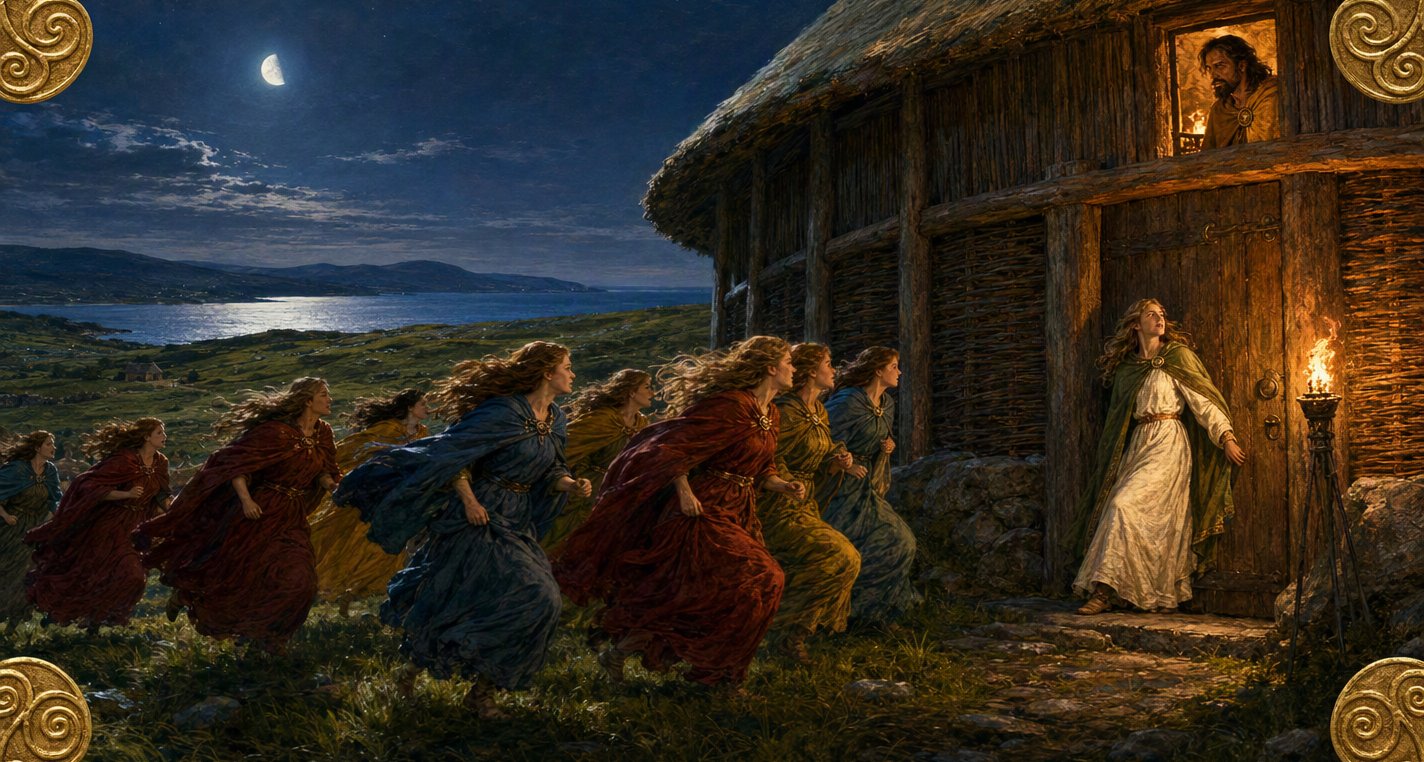
The three companies went out until they were three ridges from the house, and then turned back. On the first ridge they went at an easy, graceful walk. On the second their steps came shorter and faster. On the ridge next the house each was hard put to it to keep up with the others, and they hitched up their dresses and ran. The noise of them was like fifty chariots coming. The whole house shook, and the warriors sprang to their weapons.
Stop, said Sencha. These are no enemies. It is Bricriu who has set the women quarrelling. Shut the door against them, or our dead will outnumber our living.
The doorkeepers shut the doors. But Emer had outrun the other two, and she stood with her back against the door and called on the doorkeepers to open it. Inside, every husband leapt up to open it for his own wife, until Conchobar struck his silver sceptre on the bronze pillar of his couch, and the house was quiet.
This will be no war of weapons, said Sencha. It will be a war of words.
So each woman spoke up for her husband in turn, outside the door. Fedelm praised Lóegaire, who held the borders of Ulster against its enemies. Lendabair praised Conall, who came home proudly with heads in his hands. And Emer praised Cú Chulainn, and herself. There was no woman her equal, she said, in shape or grace or wisdom.
V The House Knocked Askew
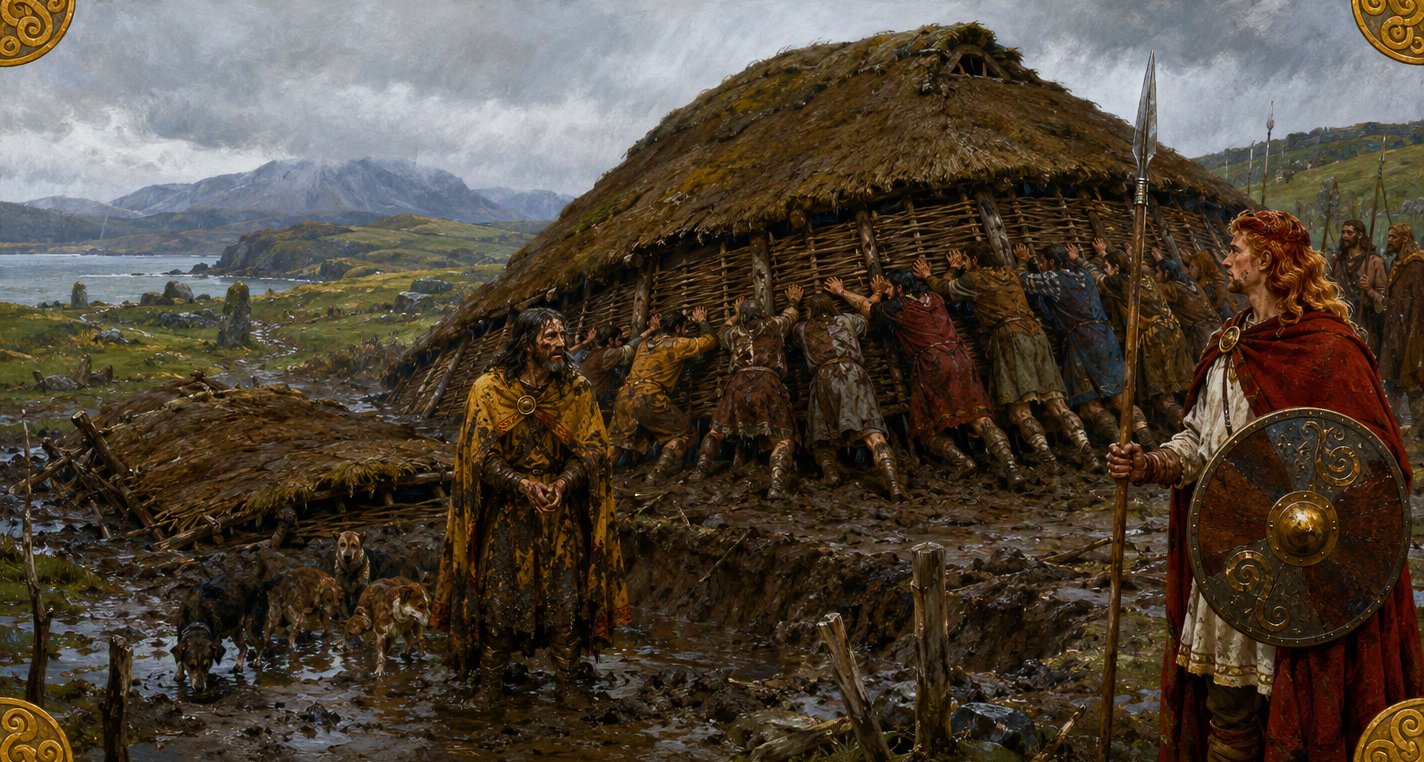
At that, Lóegaire and Conall each sprang up in his hero’s light and broke a stave out of the wall beside him, level with himself, to let his own wife in. But Cú Chulainn heaved up the side of the house over against his bed, so high that the stars of heaven could be seen under the wattle, and Emer walked in under it with her women.
Then he let it drop. Seven feet of the wall went down into the ground. The whole fort shook, the grianán was laid flat, and Bricriu and his queen tumbled out of it into the ditch in the middle of the yard, among the dogs.
Bricriu came in wringing his hands, so plastered that no one knew him until he spoke. Alas that I ever made you a feast, men of Ulster, he said. My house is dearer to me than everything else I have. It is geis on you now to eat or drink or sleep until you leave my house as you found it.
All the champions of Ulster went out and heaved at the house, and they could not lift it far enough for the wind to pass under. Then they begged Cú Chulainn. He tried it at one tug, and failed.
King of the heroes of Ireland, said Bricriu, if you can’t set it straight, no one in the world can.
Then the distortion came on him. There was a drop of blood at the root of every hair. He drew his hair into his head, so that his dark-yellow curls looked as if they had been cropped with shears, and he spun like a millstone and strained until a warrior’s foot would have fitted between each pair of his ribs. Then his strength came back into him, and he heaved the house up and set it down level, where it had stood before. 4
After that the feast was eaten in comfort. But the quarrel was not over, and in the end the men of Ulster set out for Cruachan, as Sencha had said, to have it judged.

VI The Cats of Cruachan
The men of Ulster came to Cruachan so fast and so furious that the whole place shook, and the weapons fell from the walls. I have never heard thunder without a cloud, said Medb, since the day I came to live here. She went out to meet them with thrice fifty women and three vats of cold water, to cool the heat of the three champions.
Ailill heard them out in silence, and he was not happy. It isn’t to me this should have been brought, he said, unless it was out of hatred.
One night, as their portion was set before them, three cats were let loose on them out of the cave of Cruachan: three beasts of draíocht. 5 Lóegaire and Conall made for the rafters, left their food to the beasts, and slept up there till morning. Cú Chulainn did not stir from his place. When his beast stretched out its neck to eat, he struck it on the head with his sword, and the blade slid off as if from stone. The cat settled itself down. All night Cú Chulainn neither ate nor slept, and at first light the cats were gone.
Is that trial not enough for you? said Ailill.
It is not, said Lóegaire and Conall. It is not beasts we are fighting, but men.
Ailill went to his room and sat with his back to the wall, and for three days and three nights he neither ate nor slept.
Coward! said Medb. If you won’t decide it, I will. There is no trouble in it. Lóegaire and Conall are as different as bronze and white bronze, and Conall and Cú Chulainn as different as white bronze and red gold.
She had them brought to her one at a time, and to each of them she gave the champion’s portion. To Lóegaire she gave a cup of bronze full of wine, with a bird of white bronze on the bottom of it, and told him to show it to no one until the portion was set out in the Red Branch at Emain. To Conall she gave a cup of white bronze with a bird of gold. To Cú Chulainn she gave a cup of gold, with birds of precious stone on the bottom of it, and a lump of dragon-stone as big as his two eyes.
VII The Watch at Cú Roí’s Fort
At Emain, when the champion’s portion was set out in the Red Branch, the three brought out their cups: Lóegaire his bronze, Conall his white bronze, and Cú Chulainn his red gold. So Conchobar and the nobles of Ulster gave the portion to Cú Chulainn, by the judgment of Ailill and Medb.
That cup was bought, said Lóegaire and Conall, with your jewels and your treasures. That judgment will not stand.
So the three were sent from judge to judge, until at last they came to the fort of Cú Roí mac Dáiri. Cú Roí was away in the east, but his wife Bláthnat made them welcome. Each of them, she said, must watch the fort for a night, the eldest first.
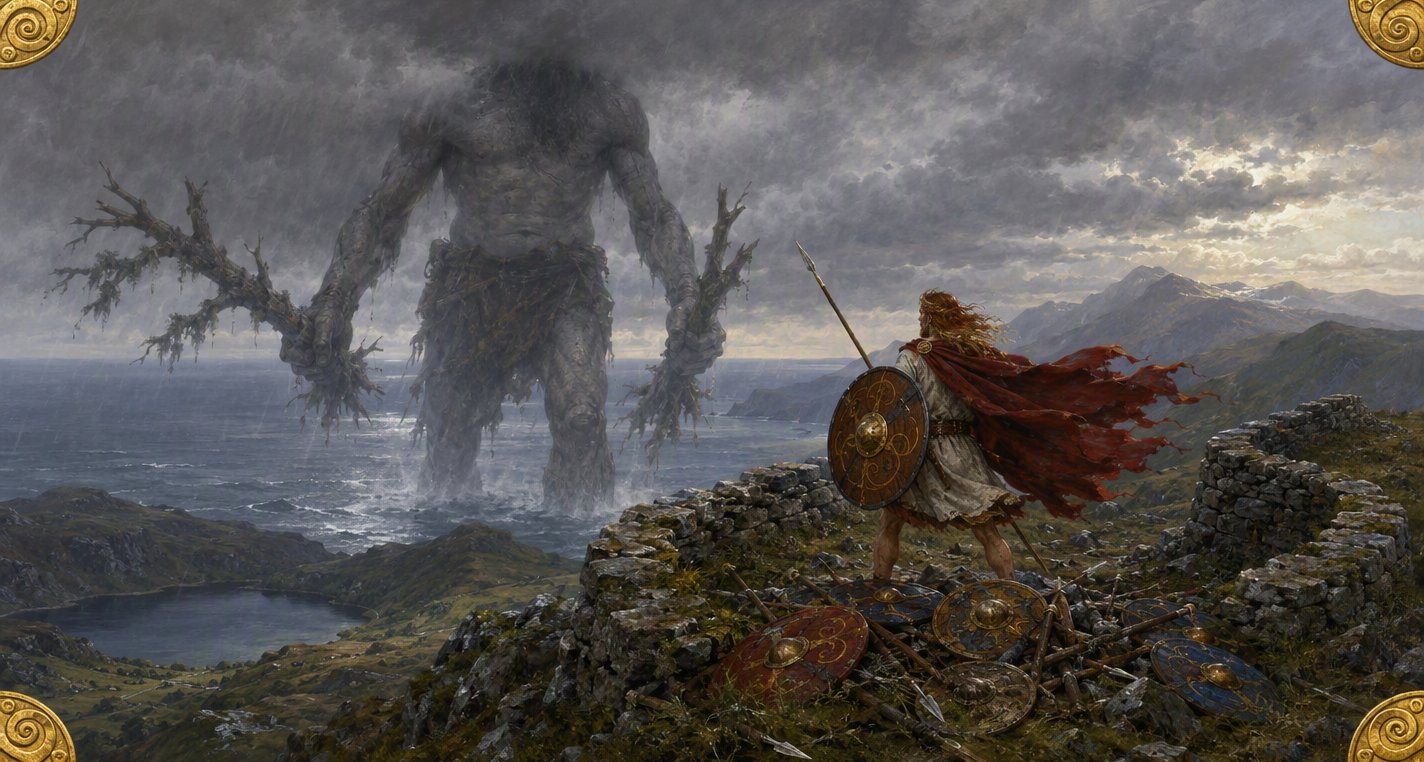
The first night Lóegaire kept watch. Before dawn a giant came at him out of the western sea, so tall that he seemed to reach the sky, and the shine of the sea showed between his legs. He threw a stripped oak at Lóegaire, then caught him up like a year-old child, ground him in his fist, and threw him out over the wall into the mire of the ditch. The people of the fort thought he had leapt the wall, as a dare to the others. The second night the same thing happened to Conall.
The third night was Cú Chulainn’s. Three bands of raiders came to plunder the fort, and he killed them all. A beast rose out of the lake beside the fort with a mouth wide enough to swallow a house; he sprang onto its neck, reached down its throat and tore out its heart. Then the giant came in from the sea, and Cú Chulainn leapt and whirled about him until his head spun.
Life for life, Cú Chulainn! said the giant.
Then give me my three wishes, said Cú Chulainn: the sovereignty of the heroes of Ireland, the champion’s portion without dispute, and the first place for my wife before the women of Ulster for ever.
The giant granted them, and was gone.
At dawn, thinking the other two had leapt the wall, Cú Chulainn tried it, and failed twice. Then the fury came on him, and he leapt, and came down inside at the door of the house. 6 When Cú Roí came home, he gave him the champion’s portion.
But back at Emain, even then, it was not settled.
VIII The Churl with the Axe
One evening, tired after the gathering and the games, Conchobar and Fergus and the nobles of Ulster sat in the Red Branch at Emain. Cú Chulainn was not there that night, nor Conall, nor Lóegaire.
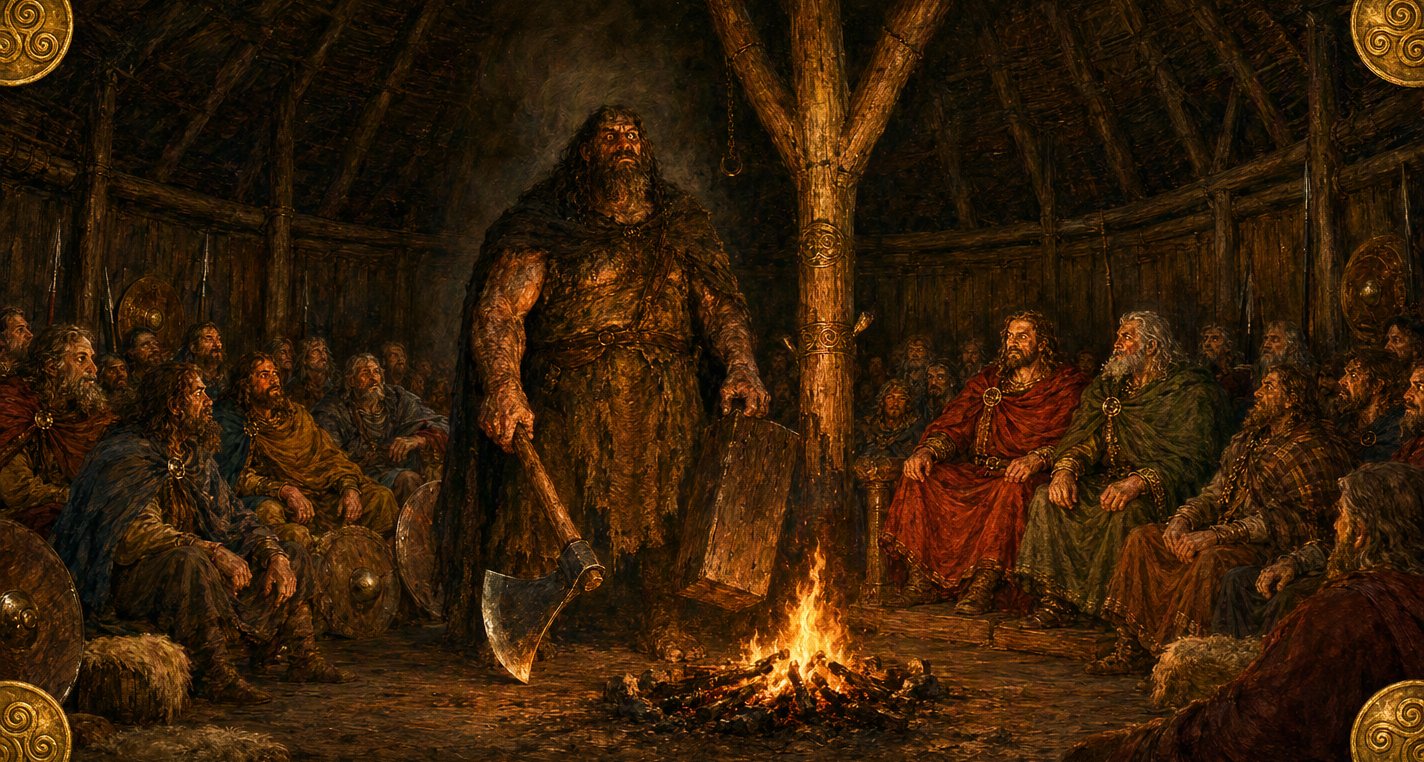
As the day was closing, a churl came in to them, huge and hideous. He wore an old hide next to his skin and a dark dun cloak over it. His eyes were yellow and ravenous, bulging out of his head, each as big as an ox-vat. In his left hand was a chopping-block, a load for twenty yoke of oxen. In his right was an axe with a handle it would take a plough-team to move, and an edge that would cut the hairs the wind blew against it. He went and stood by the fork-beam beside the fire.
Is the house so short of room, said Dubthach Chafer-Tongue, that you must stand by the fork-beam? You’ll set the house on fire before you give it any light.
I have searched the whole world, said the churl, for a man who will play fair with me, and found none. Conchobar I leave aside, and Fergus too. Let any other man of you come: I cut off his head tonight, and he cuts off mine tomorrow night.
Up sprang Muinremur, Fat-Neck son of Short-Head. Bend down, churl, he said, and I will cut off your head tonight, and you can cut off mine tomorrow night.
If that were what I wanted, said the churl, I could have had it anywhere. But he did as they all agreed in the end, and put his neck across the block. 7 Fat-Neck brought the axe down through it into the wood, and the head rolled to the foot of the fork-beam. The churl got up, gathered his head and his block and his axe to his breast, and walked out with the blood streaming from his neck.
The next night he was back, and Fat-Neck kept out of his way. Then Lóegaire made the same bargain, and Conall after him, and neither of them kept his tryst.
On the fourth night Cú Chulainn was there. Men of Ulster, said the churl, your valour and your prowess are gone. Where is that poor madman they call Cú Chulainn? I’d like to know if his word is better than the others’.
I want no bargain with you, said Cú Chulainn.
Likely enough, you wretched fly, said the churl. You are afraid to die.
Cú Chulainn sprang at him and struck with the axe, and the head flew up to the top rafter of the Red Branch until the whole house shook. He took it up again and smashed it with the axe.
And the churl rose up.

IX The Blow
All the next day the men of Ulster watched Cú Chulainn. He was sick at heart, and they might as well have been singing his dirge, for they were sure his life would last only until the churl came. He told Conchobar that he would keep his pledge to the churl. Death was waiting for him, he said, and he would rather have death with honour.
As the day was closing, the churl came in. Where is Cú Chulainn? he said.
Here I am, said Cú Chulainn.
You are dull of speech tonight, said the churl. You are very much afraid to die. But for all your fear, you have not run from it.
Cú Chulainn laid his neck on the block. The block was so big that his neck reached only halfway across it.
Stretch out your neck, you wretch, said the churl.
You keep me in torment, said Cú Chulainn. Be quick about it. Last night, by my word, I didn’t torment you.
Then he stretched himself until his neck reached the far side of the block, and a warrior’s foot would have fitted between any two of his ribs.
The churl raised his axe until it touched the roof-tree. The creak of the old hide on him and the rush of the axe, with both his arms up and all his strength in them, were like a wood in a night of storm. 8 Down it came on Cú Chulainn’s neck, its blunt side down, and all the nobles of Ulster watching.
Rise, Cú Chulainn, said the churl. Of all the warriors of Ulster and of Ireland, there is none to compare with you. The sovereignty of the heroes of Ireland is yours from this day, and the champion’s portion without dispute, and for your wife the first place before all the women of Ulster.
Then the churl was gone. It was Cú Roí mac Dáiri, who had come in that shape to keep the promise he had given Cú Chulainn.

What the tale keeps
A feast is meant to bind a people together: one roof, one fire, meat and ale for all. Bricriu built his to break them, and it cost him his house knocked askew and a tumble into the ditch among the dogs.
Pride in this tale is loud and very funny: champions hacking at each other over a boar, their wives hitching up their dresses to be first through a door, two heroes asleep in the rafters while a cat sits down to their supper. But in the end the champion’s portion went neither to the strongest arm nor to the loudest wife. It went to the man who kept his word and laid his neck on the block. And the old book says the prints of his two feet are still in the flagstone at Cú Roí’s door.
Notes
- “Windows of glass were placed on each side of it, and one of these was above Bricriu’s couch, so that he could view the hall from his seat, as he knew the Ulster men would not suffer him within.” (George Henderson, The Feast of Bricriu, 1899) ↩
- The Irish is curadmír, the champion’s portion. The beast that goes with the boar is a “cow-lord” in George Henderson’s translation (The Feast of Bricriu, 1899), where the Leiden copy of the Irish has botuir, and a “bullock” in Lady Gregory’s retelling (Cuchulain of Muirthemne, 1902); this retelling follows her. The same quarrel over the best cut drives another Ulster tale, The Story of Mac Dá Thó’s Pig. The Greek writer Posidonius, quoted by Athenaeus, says it was once the custom among the Celts for the bravest man to claim the hind quarter of pork, and for any dispute over it to be settled by single combat to the death. ↩
- George Henderson’s translation (The Feast of Bricriu, 1899) calls her “Fedelm-of-the-fresh-heart”; the Leiden copy of the Irish names her “Fedilm Nocridi”. Lady Gregory’s retelling (Cuchulain of Muirthemne, 1902) calls Bricriu “of the Bitter Tongue”, and Emer “of the Beautiful Hair”. ↩
- In this tale it is Lóegaire, not Cú Chulainn, whom Findabair sees coming to Cruachan with hair of three colours: “brown at the skin, blood-red at the middle”, and gold at the tips. Cú Chulainn has “dark-yellow curls”, and in his chariot sits “a sad, melancholy man, comeliest of the men of Erin.” (George Henderson, The Feast of Bricriu, 1899) ↩
- “One night as their portion was assigned them, three cats from the Cave of Cruachan were let loose to attack them, i.e. three beasts of magic.” (George Henderson, The Feast of Bricriu, 1899). The cave is still there near Rathcroghan: Uaimh na gCat, the Cave of the Cats. ↩
- “His two footprints are in the flag on the floor of the hold at the spot where was the royal entrance.” (George Henderson, The Feast of Bricriu, 1899). Henderson never says where Cú Roí’s fort stood. Lady Gregory, in Cuchulain of Muirthemne (1902), sends the heroes “to Curoi, son of Daire, at Slieve Mis, in Munster”, and on Sliabh Mis in Kerry the ruin of Caherconree keeps his name. ↩
- Here, in the middle of the churl’s bargain, the Book of the Dun Cow breaks off. George Henderson finished the tale from a later manuscript in Edinburgh, Gaelic MS XL, which keeps only this last episode: Cennach ind Rúanada, the Champion’s Bargain. ↩
- “The creaking of the old hide that was about the fellow and the crashing of the axe ... were as the loud noise of a wood tempest-tossed in a night of storm.” (George Henderson, The Feast of Bricriu, 1899) ↩
Where the tale comes from
Medieval manuscript. An early Irish prose saga, dated to the 8th century. The oldest copy is in Lebor na hUidre, the Book of the Dun Cow, written about 1100; its ending is lost there, and the last episode, the Champion’s Bargain, survives in later manuscripts.
- Fled Bricrenn is dated to the 8th century. Its oldest copy is in Lebor na hUidre, the Book of the Dun Cow, written about 1100; the title page of George Henderson’s edition names its scribe as “Moelmuiri Mac Mic Cuinn na m-Bocht of the community of the Culdees at Clonmacnois”. That copy has lost its end, and Henderson finished the tale from a manuscript of the fifteenth or sixteenth century in Edinburgh, which holds only the last episode, the Champion’s Bargain. Other copies, some of them fragments, survive in London, Leiden and Dublin.
- Like nearly all these tales, it was written down by Christian scholars, and its heroes still swear: “By the god of my tribe.” (George Henderson, The Feast of Bricriu, 1899)
- The Book of the Dun Cow tells more tests than this retelling does. Before Cruachan, a giant in a mist sends Lóegaire and Conall running home to Emain, and Cú Chulainn comes back in triumph with their horses, their charioteers and their arms. After Cruachan the three are tested by Samera and by Ercol, and Cú Chulainn comes off best at each: the Grey of Macha kills Ercol’s horse, and Cú Chulainn brings Ercol back tied behind his chariot.
- After the cups, Sencha sends them to Budi, Yellow son of Fair, and Budi sends them to Uath mac Imomain, Terror son of Great Fear, a shape-shifter by a lake, who offers the first beheading bargain. Lóegaire and Conall will not take it. Cú Chulainn cuts off his head, and when Uath comes back he draws the axe three times down on Cú Chulainn’s neck with its edge turned away, and gives him the championship. Still the other two will not give it up.
- Lady Gregory retold the whole saga in Cuchulain of Muirthemne (1902), in two chapters, “Bricriu’s Feast, and the War of Words of the Women of Ulster” and “The Championship of Ulster”. She leaves out Budi and Uath’s lake, gives Conall a cup of silver, and makes the churl at Emain Uath himself: “Uath, the Stranger, is my name,” he says, until the men of Ulster see “that it was no strange clown was in it, but Curoi, son of Daire.”
- The beheading bargain turns up again in medieval romance, most famously in the late fourteenth-century English poem Sir Gawain and the Green Knight, and Bricriu’s Feast is its earliest known ancestor.
- Ernst Windisch printed the Irish of the Book of the Dun Cow in 1880. George Henderson edited and translated the whole tale for the Irish Texts Society in 1899, and Ludwig Christian Stern printed the Leiden text in 1903.
Sources
- Fled Bricrend: The Feast of Bricriu · ed. and tr. George Henderson (Irish Texts Society 2, London: David Nutt, 1899)
- Fled Bricrend: Irish text · CELT, University College Cork, from the edition of Ludwig Christian Stern, Zeitschrift für celtische Philologie 4 (1903), from the Leiden manuscript
- Cuchulain of Muirthemne: "Bricriu's Feast, and the War of Words of the Women of Ulster" and "The Championship of Ulster" · Lady Gregory (London, 1902)
- Fled Bricrenn: manuscripts and editions · CODECS: Online Database and e-Resources for Celtic Studies
- Bricriu's Feast · Encyclopaedia Britannica
- Fled Bricrenn · Wikipedia
- Curadmír · Wikipedia
- Beheading game · Wikipedia
- Cú Roí · Wikipedia
- Dundrum, County Down · Wikipedia
- Dundrum Castle · Wikipedia