Voyages and Otherworld Adventures
The Voyage of Máel Dúin
Immram Curaig Maíle Dúin
He set out to avenge his father and found the killers’ island in the dark. Then a wind took him, and for three years and seven months the ocean showed him wonders.
I Whose Kindred No One Knows
Ailill of the Edge of Battle was a famous fighting man of the Eoganacht of Ninuss, who are the Eoganacht of the Arans, and a lord among his own people.
Once the king of the Eoganacht went raiding into another province, and Ailill went with him. They camped on an upland, and near it stood a church of nuns. At midnight, when nothing stirred in the camp, Ailill went down to the church. It was the hour when the young prioress came out to strike the bell for nocturne. He caught her by the hand, and threw her down, and lay with her.
There is no blessing on us in this, she said. It is my time to conceive. Tell me your people, and your name.
Ailill of the Edge of Battle, he said, of the Eoganacht of Ninuss. 1
Not long after he reached home, the raiders of Laois killed him, and burned the church of Dubcluain over him.
At the end of nine months the nun bore a son, and called him Máel Dúin. He was taken in secret to a friend of hers, the king’s queen, and she reared him with the king’s three sons, in one cradle, at one breast and on one lap, and gave out that he was her own.
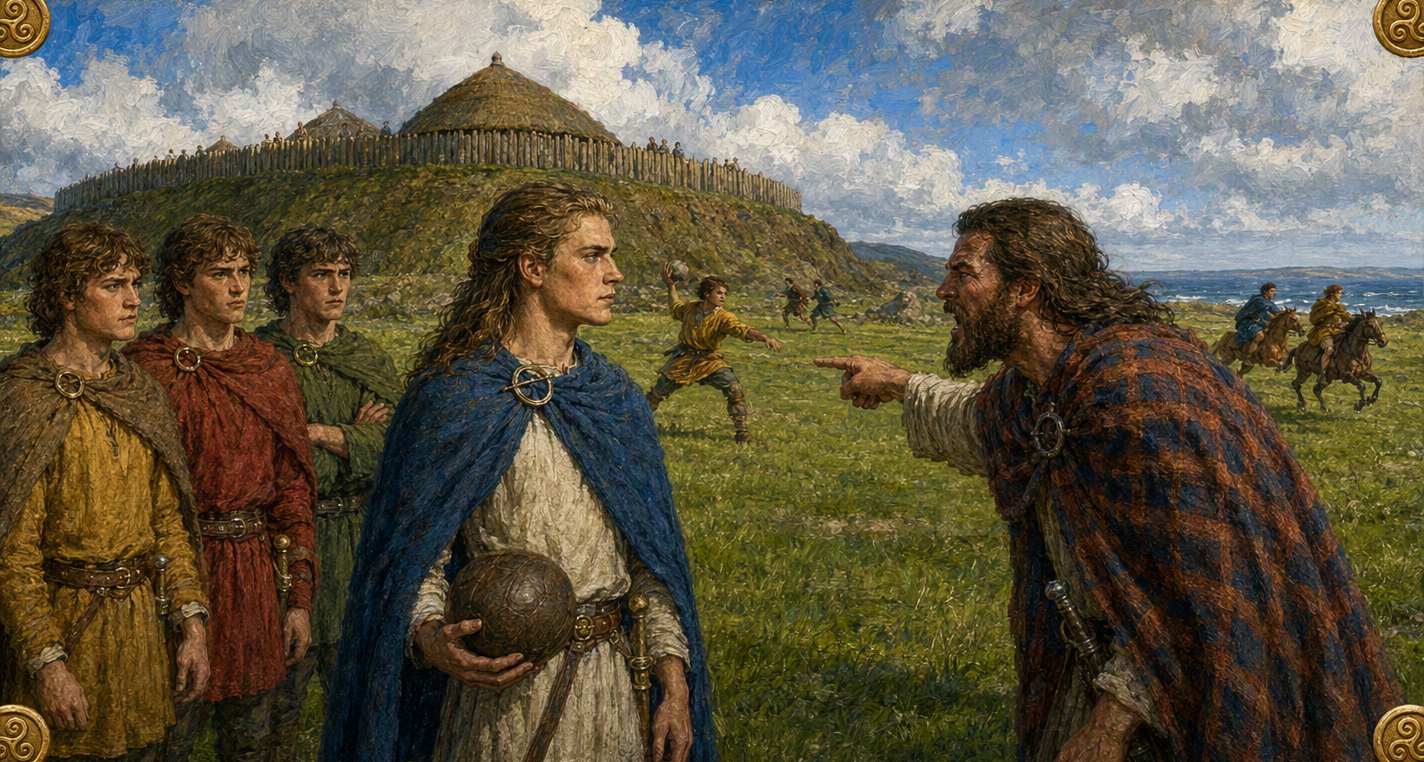
There may never have been anyone in the flesh so beautiful. At every game he beat the rest: at the ball, at running and leaping, at putting the stone, at racing horses. Then one day a warrior who envied him flared up.
You, he said, whose clan and kindred nobody knows, whose mother and father nobody knows, you beat us at everything, on land and on water and over the board!
Máel Dúin said nothing. Until that day he had thought he was the son of the king and the queen.

II Bare Burnt Bones
He went to his foster-mother. I will not eat and I will not drink, Máel Dúin told her, until you tell me who my mother and my father are.
Why ask after that? she said. Pay no heed to what proud warriors say. I am your mother, and no one on earth loves a son more than I love you.
That may be, he said. Even so, tell me who my parents are.
So she took him to his own mother, and he begged her to name his father. This is a foolish thing you are doing, she said. If you knew your father, you would have no good of him.
I would sooner know it, he said.
Ailill of the Edge of Battle was your father, she said, of the Eoganacht of Ninuss.
So Máel Dúin went to his father’s country and his own inheritance, and his three foster-brothers went with him, warriors he loved. His father’s people made him welcome.
Some while after, young warriors were putting the stone in the graveyard of Dubcluain, and Máel Dúin stood with one foot on the scorched ruin of the church, throwing over it. Then a man of the church community spoke to him, Briccne, who had a poisoned tongue. You would do better, he said, to avenge the man who was burnt here than to throw stones over his bare burnt bones. 2
Who was that? said Máel Dúin.
Ailill, your own father.
Who killed him?
The raiders of Laois, said Briccne, and they killed him on this very spot.
Máel Dúin let the stone drop. He drew his mantle round him and put on his armour, and grief was on him. He asked the way to Laois, and the guides told him there was no way there but by sea.

III The Foster-Brothers
So Máel Dúin went into Corcomroe, to the druid who lived there, for a charm and a blessing on the boat he meant to build. The druid’s name was Nuca, and Boirenn Nuca is called after him. He told Máel Dúin the day to begin the boat and the day to put to sea, and how many should sail in her: seventeen men, no more and no fewer. 3
Máel Dúin built a currach three hides thick, and his crew made ready, Germán among them, and Diurán the Rhymer.
On the day the druid had named, they hoisted the sail and put to sea. They were a little way out when his three foster-brothers came down to the harbour, calling to them to come back for them.
Go home, said Máel Dúin. Even if we turned back, no more would sail with me than these.
Then we will go into the sea after you and drown, they said, unless you come back for us. And the three of them threw themselves into the sea and swam far out from the land. When Máel Dúin saw that, he turned back for them, so that they would not drown, and took them in.
They rowed that day until vespers, and the night after until midnight, and came on two small bare islands with a fort on each. Out of the forts came the din of drink and of warriors, and one voice rose over the rest. Stand off from me, it said. I am a better man than you. It was I who killed Ailill of the Edge of Battle and burned Dubcluain over him, and his kin have never done me harm for it.
We have the victory in our hands, said Germán.
God has brought us straight here, said Diurán, and God has steered our boat. Let us go and wreck these two forts, since God has shown us our enemies in them.
As they spoke, a great wind came on them and drove them out over the sea all night, and in the morning they could see no land, and did not know where they were.
You did this to us, Máel Dúin said to his foster-brothers, throwing yourselves into the boat against the druid’s word.
They had no answer but silence.
Leave the boat be, said Máel Dúin. Don’t row. Let God take her wherever he pleases.

IV The Little Cat
For three days and three nights they found no land. Then the islands began. On one, a great host raced horses swifter than the wind, and the voyagers fled, sure it was a gathering of demons. On a fiery island, where the ground was too hot to stand on, red beasts like pigs kicked the apple trees with their hind legs until the apples fell, and the men filled the boat with those apples; while they lasted, no one was hungry or thirsty.
When the apples were gone, they came, hungry and thirsty, with the stink of the sea in their mouths and noses, to an island with a fort. Its rampart was white and high, as if it were built of burnt lime or were all one rock of chalk, and it rose from the sea until it nearly touched the clouds. The fort stood wide open, and inside the rampart were great snow-white houses.
They went into the biggest. There was no one there but a little cat, playing on four stone pillars in the middle of the house, leaping from one to the next. It looked at the men a little, and did not stop its play.
Round the walls ran three rows of treasure: brooches of gold and silver with their pins stuck in the wall; neck-torcs of gold and silver, each as big as the hoop of a vat; and great swords with hilts of gold and silver. In the middle of the floor were a roasted ox, a flitch of bacon and great vessels of strong drink.
Has this been left for us? Máel Dúin asked the cat. It looked at him suddenly, and went back to its play.
So they ate and drank and slept. When they were ready to go, one of the foster-brothers said: Shall I take one of these necklaces with me?
No, said Máel Dúin. This house is not unguarded.
He took it all the same, as far as the middle of the enclosure. The cat came after them and leapt through him like a fiery arrow, and he was burnt to ashes; and it went back to its pillar. 4
Máel Dúin soothed the cat with words. He set the necklace back in its place, and swept the ashes from the floor of the enclosure, and scattered them on the shore of the sea.
V Black and White
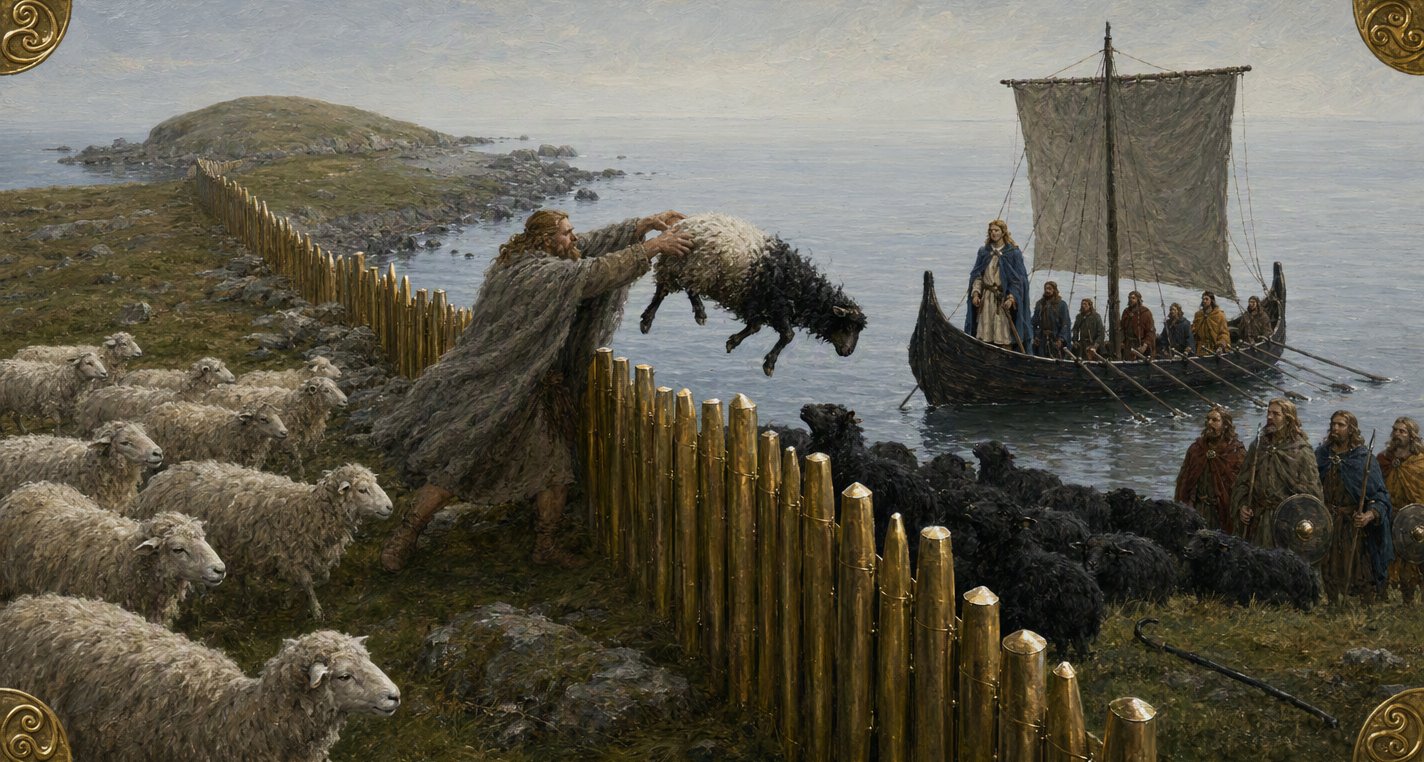
Three days later, early in the morning, they saw an island with a palisade of brass across the middle, dividing it in two. Black sheep were on one side and white sheep on the other, and a big man was sorting them, throwing them over the palisade. When he threw a white sheep among the black, it was black at once; when he threw a black one among the white, it was white at once.
The men tried it. A rod with its black bark on, thrown among the white sheep, turned white; a peeled white rod, thrown among the black, turned black.
That was no lucky trial, said Máel Dúin. We will not land. Our own colour would have fared no better than the rods. And they went from that island in fear.
Later they came to an island of people black in body and in clothing, with fillets round their heads, who never stopped wailing. The lot was cast to see who should go ashore, and it fell, unluckily, on one of Máel Dúin’s two foster-brothers. The moment he reached them, he was one of them, and wept with them. Two men were sent to bring him back. They could not tell him from the others, and soon they were wailing too.
Let four of you go, said Máel Dúin, with your weapons, and bring the men back by force. Don’t look at the land, or at the sky. Wrap your clothes round your noses and mouths, and don’t breathe the air of that island, and keep your eyes on your own men.
The four went, and dragged the two back by force. The foster-brother did not come back with them.
Asked what they had seen there, the two said: We don’t know. We did what we saw the others doing.
And the boat went quickly from that place.

VI The Silver Net
Then they found a great pillar of silver standing in the sea. It had four sides, and each side was two strokes of the boat’s oars across, so that it was eight strokes all the way round. Not a sod of earth was anywhere about it, only the boundless ocean, and they could not see how its foot stood, below, or for its height where its top was, above. From its top a net of silver stretched far out from it, and the boat passed under sail through one of its meshes.
Diurán struck at the mesh with the edge of his spear.
Don’t destroy the net, said Máel Dúin. What we see is the work of mighty men.
I do it for the praise of God’s name, said Diurán, and so that my story will be believed. If I reach Ireland, this piece of the mesh will be laid on the altar of Armagh.
Weighed afterwards in Armagh, it came to two ounces and a half. 5
Then they heard a voice from the top of the pillar, loud and clear and distinct. But they did not know what tongue it spoke, or what it said.
VII The Ball of Thread
Then they came to an island with a great plain, and on the plain a smooth, grassy tableland; and near the sea stood a great, strong fortress. Seventeen grown girls were there, making a bath ready.
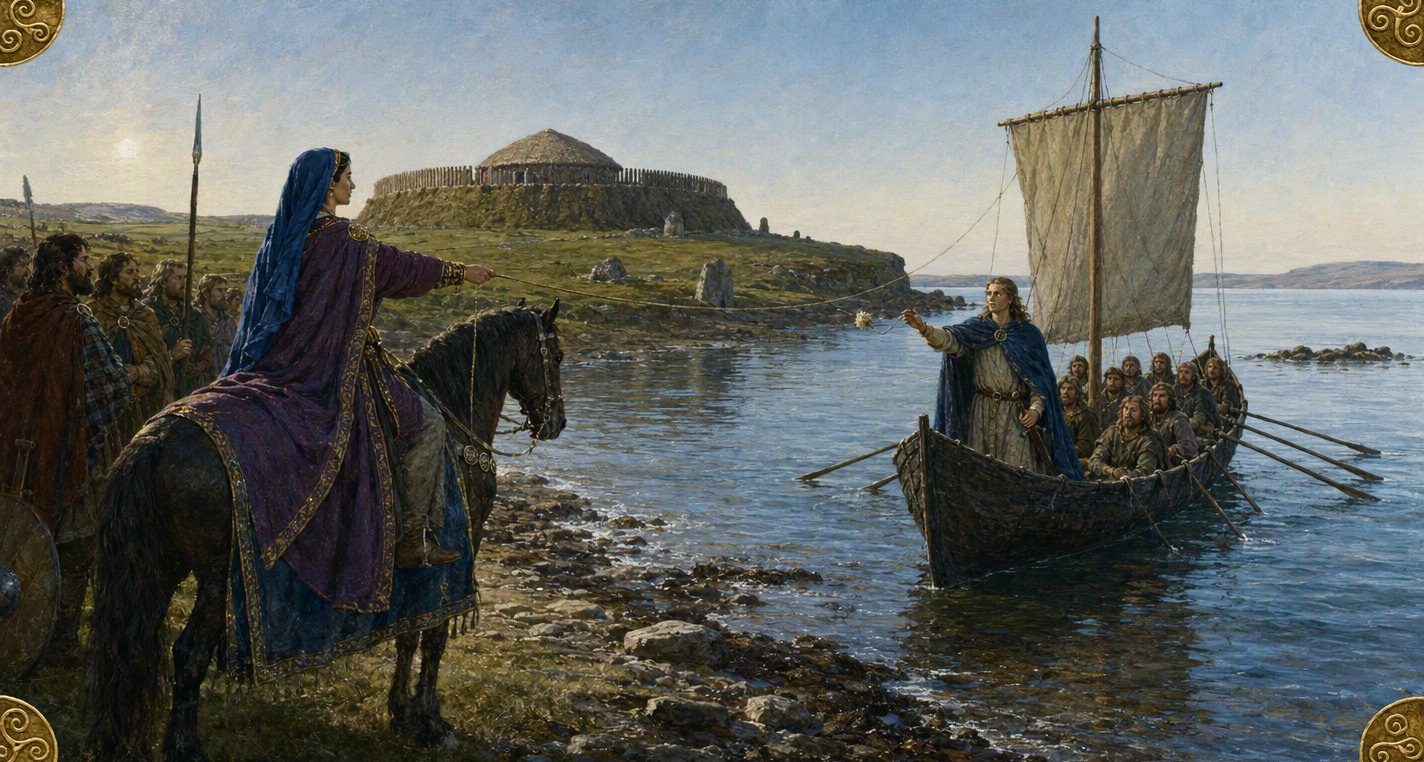
At the ninth hour a rider came to the fortress on a racehorse: a woman in a blue hood and a bordered purple mantle, with gloves worked with gold on her hands and fine sandals on her feet. A girl came out from her to the men. Come into the fort, she said. The queen invites you.
They went in and bathed, and were given good food, and drink in vessels of glass. Each man took the girl over against him into a chamber, and Máel Dúin slept with the queen.
Stay here, the queen told them, and age will not come on you. You will have life lasting for ever, and what came to you last night will come to you every night, without labour. Wander no more from island to island over the ocean.
Every day she went out to the plain to judge her people. They stayed the three months of winter, and the three months seemed to them three years. Then one of the men said: We have been here a long time. Why don’t we go home?
We will find nothing better at home than this, said Máel Dúin.
Let him stay with her, then, said the others. We will go home.
I will not stay behind you, said Máel Dúin.
One day, when the queen had gone to her judging, they went on board. She came after them on her horse and threw a ball of thread, and Máel Dúin caught it, and it stuck to his hand. She held the end of the thread, and by it she drew the boat back to the harbour.
They stayed three times three months more. He catches that ball on purpose, the men said: he loves his woman. Let someone else catch it, said Máel Dúin, and if it sticks to his hand, cut the hand off. Again they put to sea, and again she threw the ball, and another man caught it, and it stuck. Diurán cut off the hand, and it fell into the sea with the ball of thread.
The queen began to wail and shriek, until the whole land was one cry. And so they escaped her.

VIII The Old Man on the Rock
They came to an island where a great crowd were playing and laughing on a plain, without ever stopping. They cast lots for who should go and see it, and the lot fell on the last of Máel Dúin’s foster-brothers. The moment he was among them he was playing and laughing with the rest, as if he had been with them all his life. His comrades waited a long, long while, and he did not come back to them. So they left him there.
Not long after, far off among the waves, they saw something like a white bird. They rowed towards it, and saw it was a man, clothed in nothing but the white hair of his own body, throwing himself down in prayer on a broad rock.
They asked his blessing, and where he had come from. From Tory, he said. I was reared on Tory, and I was the cook there, and a bad cook: I sold the church’s food for treasures for myself, and dug under the church’s houses and carried treasures out. Then, out on the sea, a man sitting on a wave told me to throw all my wealth into the sea, and I threw it all in but one little cup. My boat brought me to this rock, and when I set foot on it the boat went from me. Seven years I lived on seven cakes and a cup of whey-water, and seven years more on a salmon that an otter brought me every day out of the sea, while another otter brought burning wood to cook it. And the rock has grown under me, until now it is large.
At the ninth hour, food came for every one of them, half a cake and a piece of fish, and the old man’s cup held their fill of good drink.
You will all reach your own country, the old man told them. And the man who killed your father, Máel Dúin, you will find in a fortress before you. Do not kill him. Forgive him, because God has saved you from many great dangers, and you too are men who deserve death. 6
They bade the old man farewell, and went on their way.
IX The Falcon of Ireland
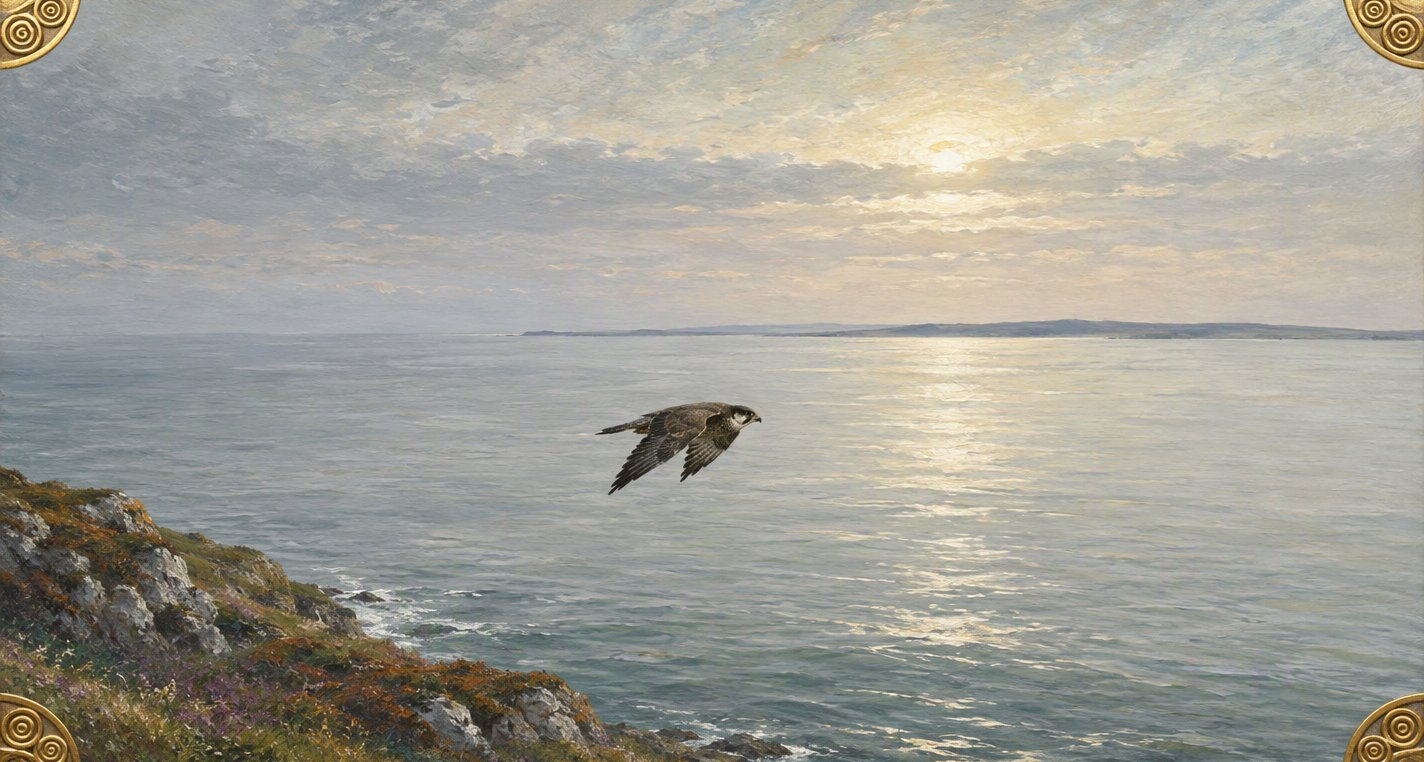
Then they came to an island full of cattle and sheep, with no house or fort on it, and they ate the sheep. Some of the men saw a big falcon there.
That falcon is like the falcons of Ireland, they said. It is, said the others.
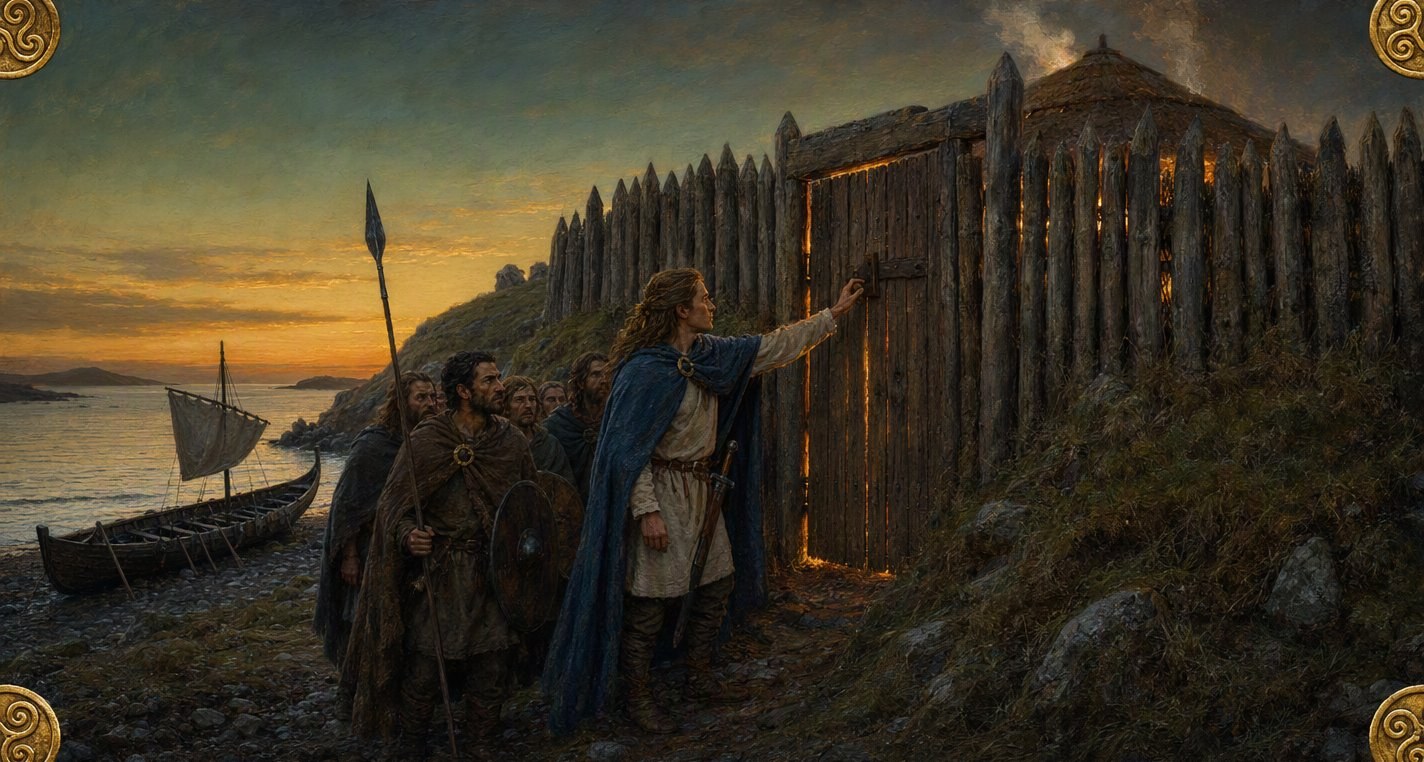
It flew away from them to the south-east, and they rowed after it the way it had gone until vespers. At nightfall they saw land like the land of Ireland. It was the very island from which the wind had carried them out into the ocean.
They ran the prow ashore, went up to the fortress and listened. The people inside were at dinner.
It would be well for us, one of them said, never to see Máel Dúin again.
Máel Dúin has been drowned, said another.
Maybe he is the one who will wake you out of your sleep, said a third.
And if he came now, said a fourth, what would we do?
That is easily answered, said the chief of the house. He would have a great welcome, for he has been a long while in great hardship.
Máel Dúin struck the clapper against the door.
Who is there? said the doorkeeper.
Máel Dúin is here.
Open, then, said the chief. You are welcome.
They were given a great welcome, and new clothes, and they told all the wonders that God had shown them. 7 Then Máel Dúin went home to his own country, and Diurán the Rhymer took the five half-ounces of silver he had brought from the net and laid them on the altar of Armagh, rejoicing at the wonders God had worked for them.
Aed the Fair, chief sage of Ireland, set this story in order, the book says, to delight the mind, and for the people of Ireland after him. 8 It is the immram, the rowing-about, of Máel Dúin’s currach.
What the tale keeps
Máel Dúin put to sea to kill a man, and the wind would not let him. It gave him islands instead: a cat that guards what is not yours, a fence that turns white to black, shores where grief and laughter are catching, so that whoever lands becomes one of them. The three who would not be left behind were left behind, one by one.
The old dream is here: the island where no one grows old, and a queen who draws the boat back by a thread, as Bran was drawn in to the Land of Women in an older voyage. But the Christian scholars who wrote it down steered it home by a hermit’s word: forgive, for you too deserve death. So it ends at a fortress door, where the hermit said the killer would be found, with a knock, and a welcome, and new clothes.
Notes
- “Unblessed is our state,” she says, and “(for) this is the time for my conceiving.” The text calls her “a young nun, the prioress of a church of nuns”. (Whitley Stokes, The Voyage of Mael Duin, 1888) ↩
- “It were better,” saith he, “to avenge the man who was burnt there than to cast stones over his bare burnt bones.” Briccne is “a certain poison-tongued man of the community of the church”. (Whitley Stokes, The Voyage of Mael Duin, 1888) ↩
- The druid told him “the number of the crew that should go in her, to wit, seventeen men, or sixty according to others” (Whitley Stokes, The Voyage of Mael Duin, 1888). The writer kept both counts. Later, on the queen’s island, there are seventeen girls for seventeen men. ↩
- “The cat followed them, and leapt through him (the foster-brother) like a fiery arrow, and burnt him so that he became ashes.” (Whitley Stokes, The Voyage of Mael Duin, 1888–89). Stokes’s English calls the man who took the necklace “Máel Dúin’s third foster-brother”, and the one lost on the laughing island “the third of Máel Dúin’s foster-brothers” too. ↩
- Diurán cut the mesh “so that my tidings may be the more believed”. “Two ounces and a half was its weight when measured (afterwards) in Armagh”, and at the end he lays “the five half-ounces” on the altar. (Whitley Stokes, The Voyage of Mael Duin, 1888–89) ↩
- “Slay him not, but forgive him because God hath saved you from manifold great perils, and ye too are men deserving of death.” (Whitley Stokes, The Voyage of Mael Duin, 1888–89) ↩
- “Then they declare all the marvels which God had revealed to them according to the word of the sacred poet who saith Haec olim meminisse iuuabit.” (Whitley Stokes, The Voyage of Mael Duin, 1888–89). The poet is Virgil: in the first book of the Aeneid, Aeneas tells his shipwrecked men that one day it may be a joy to remember even this. ↩
- “Now Aed the Fair, chief sage of Ireland, arranged this story as it standeth here; and he did (so), for delighting the mind and for the folks of Ireland after him.” (Whitley Stokes, The Voyage of Mael Duin, 1888–89) ↩
Where the tale comes from
Medieval manuscript. An Irish voyage tale in prose, set in order, it says itself, by Aed the Fair, “chief sage of Ireland”. Its oldest copy, in Lebor na hUidre (about 1100), has lost its beginning and its end.
- The tale survives in Lebor na hUidre, written about 1100, which has lost its beginning and its end; in the Yellow Book of Lecan, in Trinity College, Dublin; and in fragments in two British Museum manuscripts, Harleian 5280 and Egerton 1782. P. W. Joyce, in the preface to Old Celtic Romances, called the Yellow Book copy perfect; the Encyclopaedia Britannica of 1911 says every copy is imperfect.
- The text names the man who set it in order: Aed the Fair, “chief sage of Ireland”. The Britannica of 1911 dates his version to the eleventh century, and says that “it may be gathered from internal evidence that the tale itself dates back to the 8th century.” Joyce, following Eugene O’Curry, put the voyage itself about the year 700, and thought “it likely that Maildun did actually go on a voyage, which was afterwards made the framework of the story.”
- It is one of the immrama, the voyage tales. Joyce, citing O’Curry, counted four that survive, “all very ancient”, of which the best known is the Voyage of Saint Brendan; the Britannica of 1911 thought Brendan’s voyage “possibly a clerical imitation” of Máel Dúin’s. Several of its islands answer the Voyage of Bran: an island whose laughter keeps the man who lands there, and a queen who draws the boat in by a ball of thread.
- Like the other voyages it was written down by Christian scholars, and it wears their faith openly. Its hero is the son of a nun, begotten at the hour of the bell for nocturne; its ocean holds hermits, an ancient cleric of the community of Brénainn of Birr, and a cook from Tory praying on a rock in the ocean; the silver of the net ends on the altar of Armagh; and near the end the writer quotes Virgil, in Latin.
- Joyce made the first English translation, in Old Celtic Romances (1879), helped by a manuscript translation by J. O’Beirne Crowe; Tennyson founded his poem “The Voyage of Maeldune” on it, and the Britannica of 1911 says the poem “borrows little more than its framework.” Whitley Stokes edited the Irish with a closer translation in Revue Celtique 9 and 10 (1888–89), the version followed here. Joseph Jacobs’s retelling in The Book of Wonder Voyages (1896) leaves out the nun: “Whilst he was yet a babe, plunderers from over sea fell upon his home, burned the church of Dubhcluain, and slew his father therein.”
Sources
- The Voyage of Mael Duin (Immram Curaig Maíle Dúin) · ed. and tr. Whitley Stokes, Revue Celtique 9 (1888), pp. 447–495, and 10 (1889), pp. 50–95; reprinted in Mary Jones's Celtic Literature Collective
- Old Celtic Romances · P. W. Joyce (London, 1879)
- "Maelduin, Voyage of" · Encyclopædia Britannica, 11th edition (1911), via Wikisource
- The Book of Wonder Voyages: "The Voyage of Maelduin" · Joseph Jacobs, ed. (London, 1896), via Wikisource
- The Voyage of Bran, Son of Febal · Kuno Meyer (1895)
- Placenames Database of Ireland · logainm.ie