
Voyages and Otherworld Adventures
The Adventure of Connla
Echtrae Chonnlai
A woman only Connla can see calls him to a land without death, and throws him an apple that feeds him for a month and never grows smaller.
I The Woman on Uisneach
Connla the Red was the son of Conn of the Hundred Battles, king of Ireland. One day he was standing at his father’s side on the top of the hill of Uisneach when he saw a woman coming towards him, in clothes like none he had ever seen.
Where have you come from, woman? said Connla.
From the lands of the living, she said, where there is no death, and no sin, and no wrongdoing. We keep feasts there that never end, and we need no one to serve them. There is peace among us, and no strife. Our home is inside a great green hill, and that is why we are called the aos sí, the people of the hills.
Who are you talking to, son? said Conn. Everyone there could hear the woman. No one could see her but Connla.
She answered the king herself. He is talking to a young woman, lovely and nobly born, who looks for neither death nor old age. I have loved Connla, and I am calling him to Mag Mell, where Boadag is king for ever: a king with no weeping and no sorrow in his land since the day he took the kingship.
Come with me, Connla the Red, ruddy-faced. The yellow hair above that face will be the glory of a king. Come, and your beauty will never wither, nor your youth, until the Day of Judgement.
II The Apple
Conn was afraid. He had heard every word, and he had seen no one. He called for his druid, whose name was Corann.
Corann, he said, you of the many spells and the great skill, help me. A thing has come on me that is too much for my counsel and too much for my strength, the hardest thing since I took the kingship. I am fighting a woman I cannot see, and she would take my fair son from me. He is being carried out of the king’s hand by a woman’s spells.
So Corann rose and sang against the woman’s voice. After that no one heard her voice, and from that hour Connla could not see her. But as she went away before the druid’s chanting, she threw him an apple.
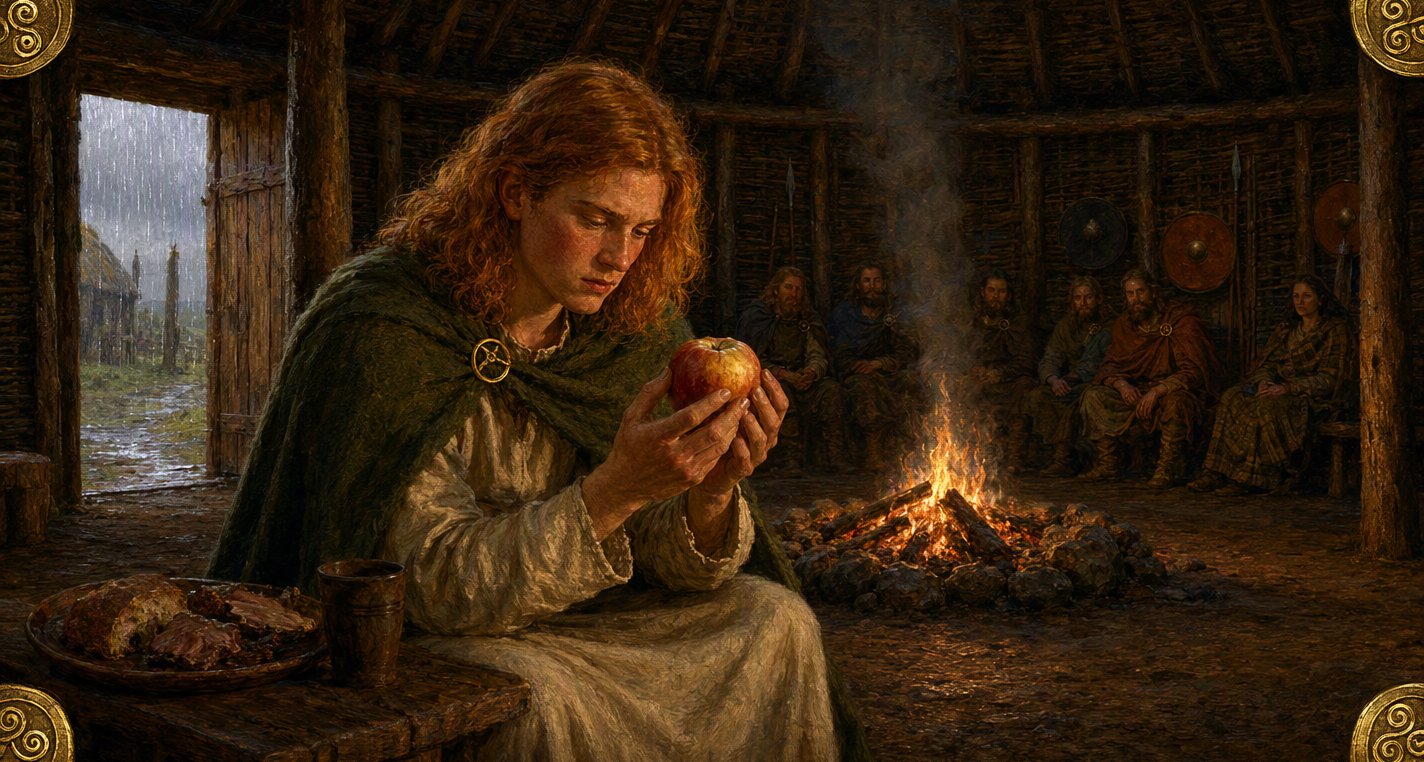
For a whole month Connla ate nothing and drank nothing but that apple. No other food seemed to him worth the eating. However much he ate of it, the apple never grew less: it was whole still.
And a longing came on him for the woman he had seen. 1
III Mag Archommin
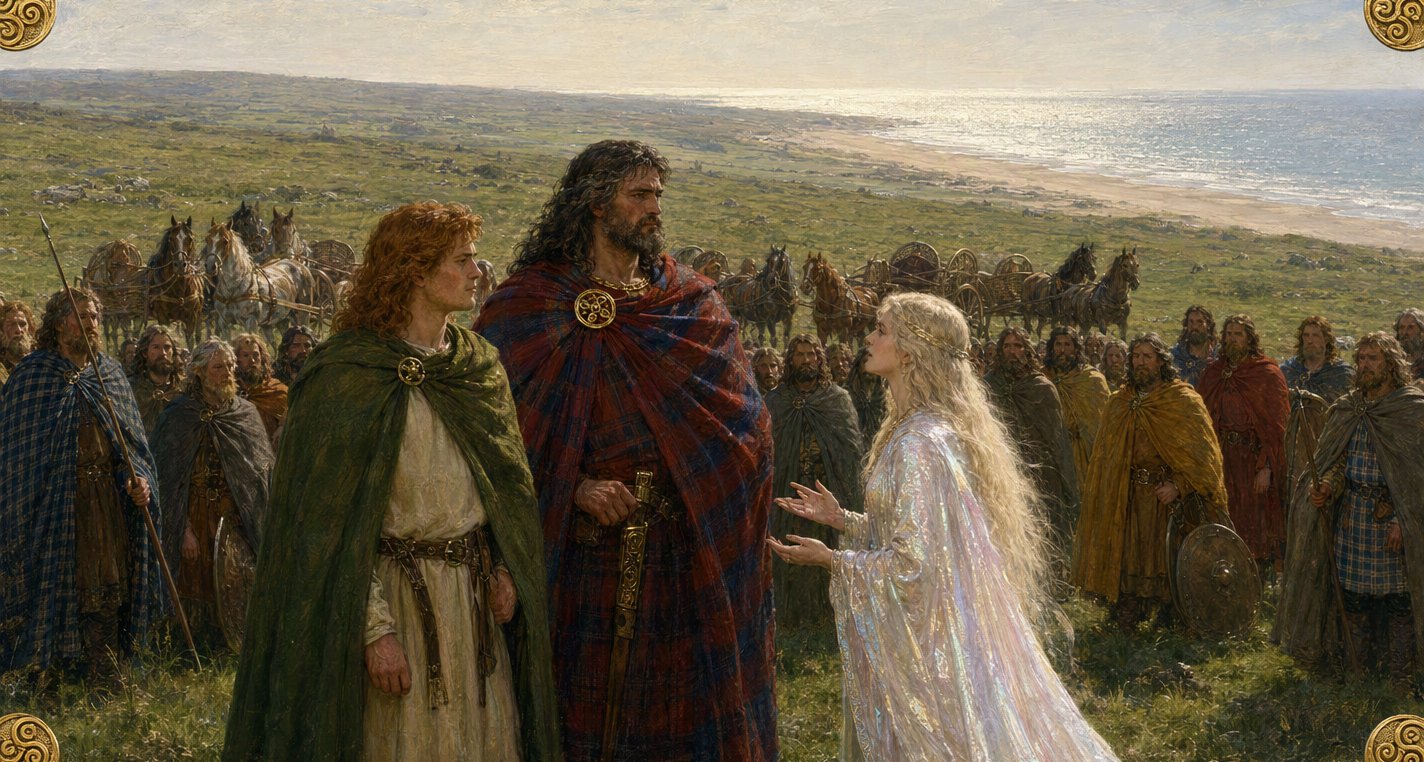
On the day the month was out, Connla was at his father’s side again, among the king’s people on Mag Archommin, and he saw the same woman coming towards him.
A fine seat Connla has, she said, among the short-lived, waiting for dreadful death. The living, the ever-living, are calling you. They know you: they have watched you at home, among the people you love.
When Conn heard her voice, he said to his people: Call my druid. I see her tongue has been loosed again today.
Conn of the Hundred Battles, said the woman, druidry is little loved. A Law is coming that will break the spells of the druids, the spells that come from the lips of the false black demon. 2
Conn had marked a strange thing. Connla would answer no one who spoke to him, except when the woman came. Does what the woman says move you, son? Conn asked him.
It is hard on me, said Connla. I love my own people above everything. And yet a longing for the woman has taken hold of me.
IV The Boat of Crystal
The woman answered. The sea is not as strong as the waves of your longing, she said. Come with me in my boat of crystal, and we will soon reach Boadag’s country.
And there is another land, she said, no worse to go to. I can see the bright sun going down, but far as it is, we will reach it before night. It is a land that gladdens everyone who comes there. No one lives in it but women and girls. 3
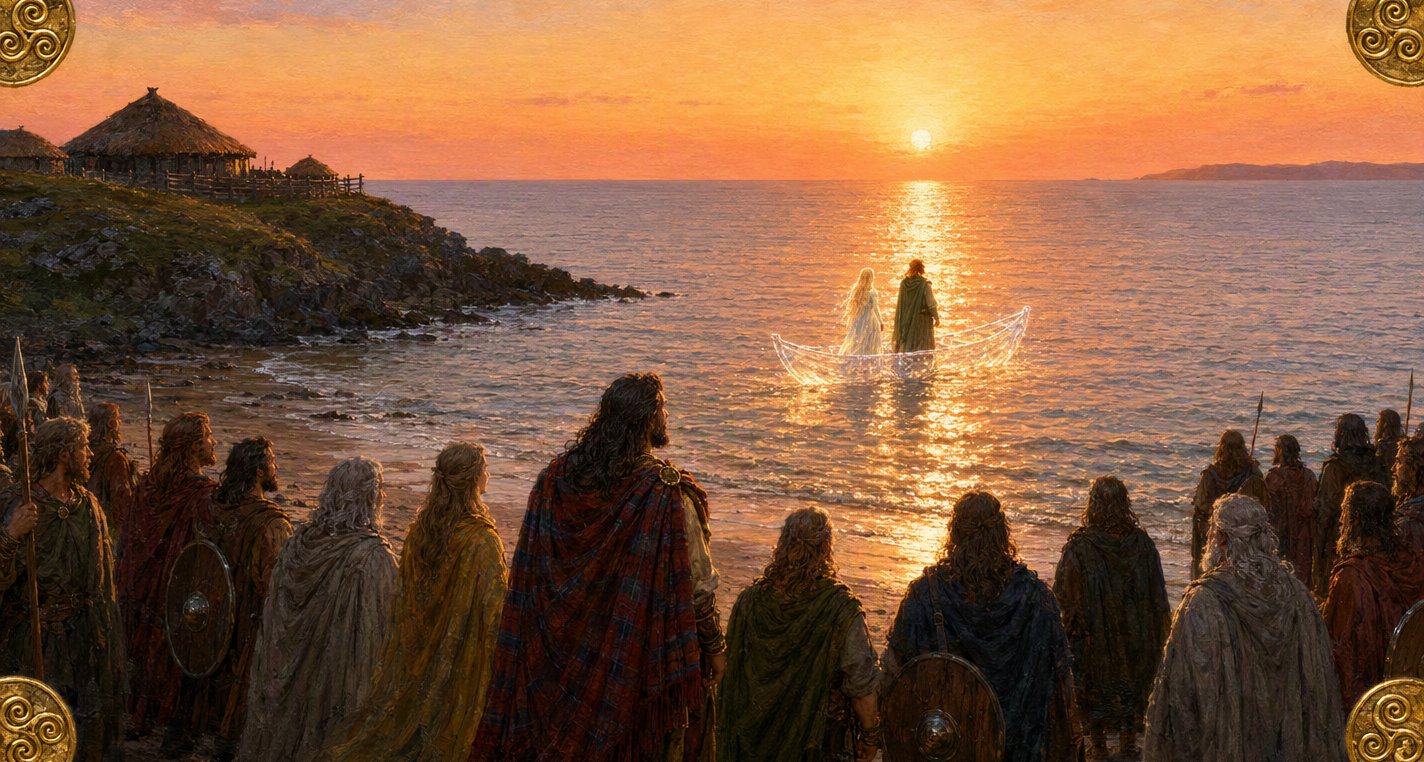
When she had finished speaking, Connla gave one leap away from his people, and he was in the boat of crystal, a currach that shone like glass.
Conn and all his people watched it go out over the bright sea, towards the setting sun, until their eyes could follow it no farther.
They have not been seen from that day to this, and no one knows where they went.
What the tale keeps
The old books call a tale like this an echtra, an outing into the other world. This one does not follow him there. One leap, and he is gone.
It is the tale of a voice. Everyone on the hill heard it; only one of them saw who spoke. The druid could still the voice, but not the apple, and the apple never grew less. Neither did the longing. The Irish word for it is eólchaire. In the Voyage of Bran it is the homesickness that draws Nechtan home. Here it draws Connla away.
She called her country the lands of the living, and his a seat among the short-lived. The monks who wrote the tale down gave her a prophecy against the druids, but they did not bring Connla back.
Notes
- The Irish word is eólchaire. Kuno Meyer quoted this very line as one where the word has “the general sense of ‘longing,’” though “it seems originally to have denoted ‘longing for home, home-sickness’” (Kuno Meyer, The Voyage of Bran, 1895). ↩
- Joseph Jacobs thought this a Christian touch: “It has clearly been touched up by a Christian hand who introduced the reference to the day of judgment and to the waning power of the Druids.” (Joseph Jacobs, Celtic Fairy Tales, 1892) Jacobs and Joyce both go on to say that druidry has little honour among “the upright” people of the land; this retelling leaves that out. Read today, the Irish foretells a righteous one who will come with many wonderful companies: perhaps Patrick. ↩
- Jacobs’s telling gives her one sentence more: “If thou wilt, we can seek it and live there alone together in joy.” He owned up to it in his notes: “I have neither extenuated nor added aught but the last sentence of the Fairy Maiden’s last speech.” (Joseph Jacobs, Celtic Fairy Tales, 1892) ↩
Where the tale comes from
Medieval manuscript. An Old Irish tale in prose and verse, probably first written down in the 7th or 8th century, and copied by Christian scribes into eight manuscripts. The oldest copy is in Lebor na hUidre, written about 1100.
- The tale survives in eight manuscripts, in two versions. The oldest copy is in Lebor na hUidre, the Book of the Dun Cow, which Joseph Jacobs noted in Celtic Fairy Tales (1892) “must have been written before 1106, when its scribe Maelmori (‘Servant of Mary’) was murdered.” Heinrich Zimmer put the tale’s present form in the seventh century. Kim McCone, whose edition of 2000 gives it the title Echtrae Chonnlai, argued from its language for an eighth-century original.
- In the Irish of Lebor na hUidre the whole tale answers a question, put at its start: why was Conn’s son Art called Óenfer, the Solitary? The answer comes at its end. With Connla gone, Art had no brother left. Conn said so when he saw Art coming towards the gathering, and Corann the druid said that would be his name for ever. Joyce and Jacobs leave out the question and its answer, and so does this retelling.
- The Irish calls him Condla Rúad, Connla the Red, and the heading over the tale calls him Condla Cáem, which Joyce put into English as Connla the Comely. Joyce named him Connla of the Golden Hair, and Jacobs Connla of the Fiery Hair.
- John O’Beirne Crowe printed the Irish with a literal English translation, as “The Adventures of Condla Ruad”, in the Journal of the Royal Historical and Archaeological Association of Ireland in 1874. P. W. Joyce retold the tale freely as “Connla of the Golden Hair, and the Fairy Maiden” in Old Celtic Romances (1879). In his telling the woman promises that on the day Connla comes with her “he shall be made king, and he shall reign for ever in Fairyland”; in Jacobs, as in the Irish, Boadag is king there for ever.
- Joseph Jacobs made it the first tale in his Celtic Fairy Tales (1892). He worked from Heinrich Zimmer’s German translation, with “a touch or two” from Joyce, and called it “the earliest fairy tale of modern Europe”.
- Bran’s tale and Connla’s are close kin. In both, a woman in strange clothes comes out of the other world with a token of it, a silver branch for Bran and an apple for Connla, and calls a man away over the sea to a country without death. Both speak of a land where only women live, and at the end of both, no one knows where he went.
Sources
- Celtic Fairy Tales · Joseph Jacobs (1892)
- Old Celtic Romances · P. W. Joyce (London, 1879)
- The Voyage of Bran, Son of Febal: Notes · Kuno Meyer (London, 1895)
- Irish Sagas Online: Echtra Chondla · University College Cork; Irish text from Best and Bergin, Lebor na hUidre (Dublin, 1929)
- Echtra Condla · Wikipedia
- Conn of the Hundred Battles · Wikipedia