Folklore of the Aos Sí
The Lone Thorn
An Sceach
Nobody would cut a lone old thorn in a field: it was the Good People’s. One man cut a thorn in a thicket, and heard a voice he took for one of them, mourning for it.
I The Good People’s Bush
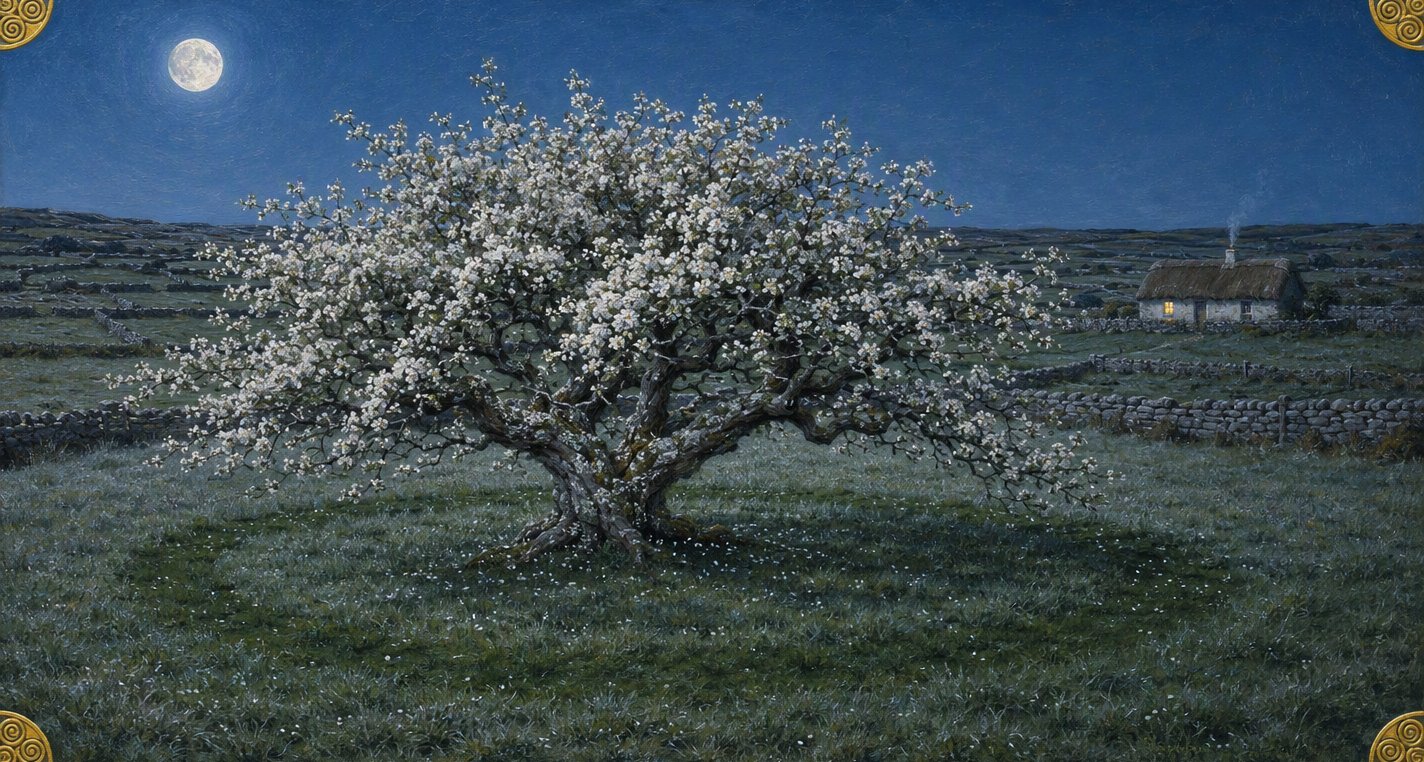
There was one tree the country people would not cut. It was the hawthorn, the whitethorn, the sceach: not every thorn, but the big old one that grows by itself, alone in a field or beside an old well. A tree like that was holy, and nobody would dare lay a blade to it. 1
It belonged to the Good People. They make their camp under it and take their rest there, Lady Wilde wrote, and at night they dance under its branches. As a rule it stands in the middle of a fairy ring. Meddle with it, and they would take it badly. A countryman would sooner die than cut one down.
On May Eve they are in the best of humours, and all night long the music of their pipes is heard on the hills. In May, people wreathed whitethorn and rowan round the door, for luck.
But a thorn that isn’t standing by itself, now. An old one, in a thicket, half-rotten. Where would be the harm in cutting that?

II A Thorn in a Thicket
J. Doheny thought there was none. He told Lady Gregory what came of it. 2
He was cutting bushes one day up near the river, and he cut a big thorn. He thought no harm in it. It wasn’t standing by itself, only in a thicket, and it was old and half-rotten.
When he had it cut, he heard someone talking very loud to his wife. She was down in the field on the other side of the wall, gathering kippeens, little sticks. So down he went, to know who it was.
No, she said, it was to yourself someone was talking. I heard his voice up where you were, and I saw no one.
So Doheny said: Surely it’s one of them, mourning for the bush I cut. For the sound of that voice was as if he was mad vexed.
A thorn in a thicket, old and half-rotten, that nobody would miss.
Somebody missed it.

III Old Hanrahan’s Wig
A bush in a forth was another thing again.
The forths, as the people of the west called them, are the old ring-forts, the lios: a round green bank in a field. The Good People meet in them at night. A priest in the west knew of an old fort near Ballinrobe that was still the fairies’ preserve, and the land round it too. The soil was very fine, and no one would dare to till it, and the farmers would not cut a tree or a bush on it for anything. 3
Old Hanrahan had a forth in front of his house. One day he went out and cut a bush in it, and he a fresh man enough. The next morning he hadn’t a blade of hair on his head. Not a blade.
He had to buy a wig, and he wore it for the rest of his life. John Mangan, who told Lady Gregory, remembered him and the wig well.
That was not the last anyone heard of the fairies of that forth.
IV John Hanrahan’s Fairies
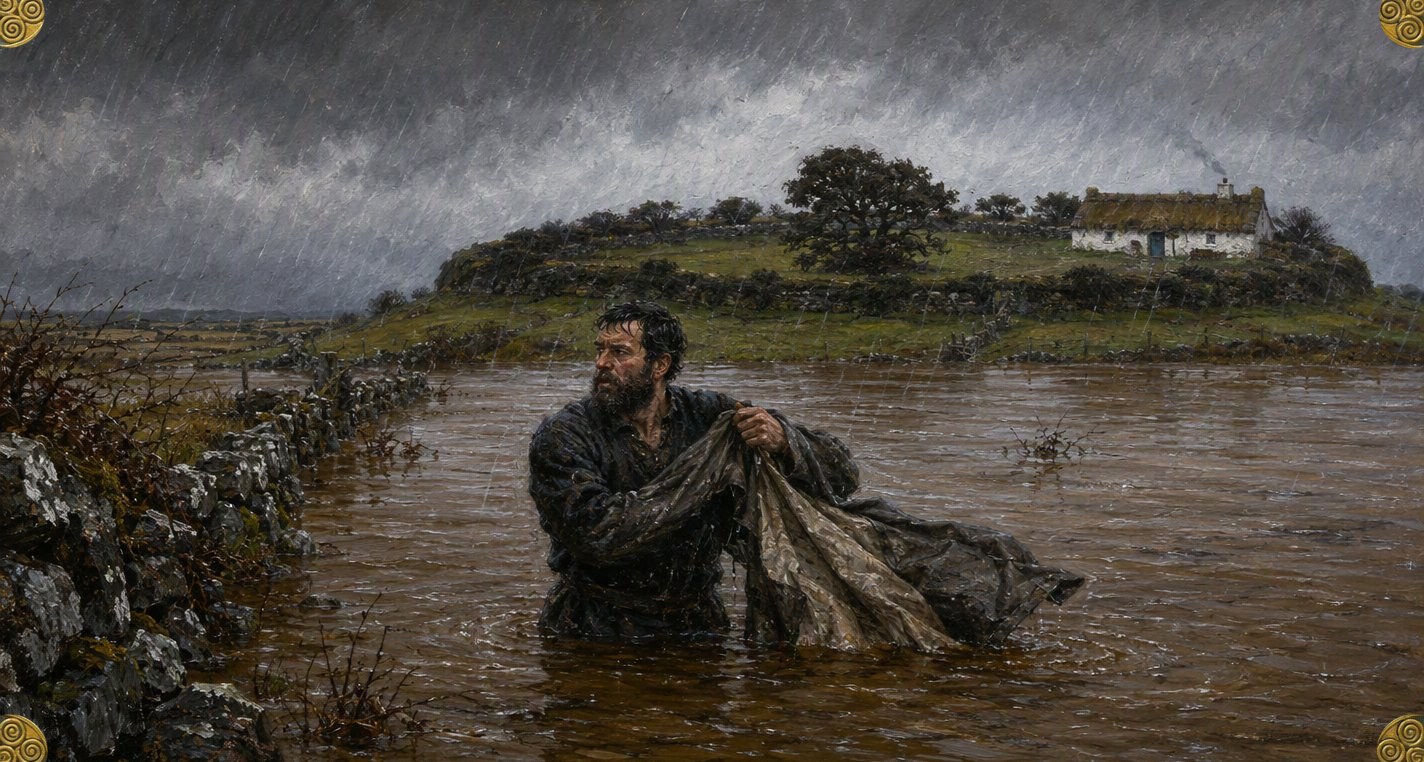
Some years after, the water was up in that place, and Delane, the father of the great cricketer, was passing that way. He strayed off the road into the flood. The farther in he went the deeper it got, till it was up past his waist, and he heard what was like his wife’s voice, crying: Go on, John, go on farther.
These are John Hanrahan’s fairies, he called out, that took the hair off him.
And what did you do then? they asked him, when he was safe in the house and telling it.
I turned my coat inside out, said Delane, and after that they troubled me no more, and so I got safe to the road again.
No one ever had luck that meddled with a forth, said Mangan. So it’s always said.
An old army man asked Lady Gregory did she know the forth where the old man lost his hair. There’s a big bush left in it, he said. A man called Waters has the second sight, and when he goes there he sees a woman sitting under that bush, and she lighting a fire.

What the tale keeps
In these stories the Good People are hardly ever seen. They are heard: a voice in a field, mad vexed over an old thorn; a wife’s voice, or something like it, out of a flood, calling a man farther in; pipes on the hills all night on May Eve.
What anyone could see was the bush, in a field or by an old well or in an old fort, and the people left it standing. It showed where the field was not theirs alone.
And in the forth where the old man lost his hair, for anyone with the sight, a woman sits under the big bush and lights her fire, as if she were at home.
Notes
- “The large old hawthorns, growing singly in a field or by an ancient well, are considered very sacred.” Under a hawthorn, she says, is the fairies’ “favourite camp and resting-place”. (Lady Wilde, Ancient Legends, Mystic Charms, and Superstitions of Ireland, 1887) ↩
- “I thought it no harm to do it when it wasn’t standing by itself.” (J. Doheny, in Lady Gregory, Visions and Beliefs in the West of Ireland, 1920) Lady Gregory prints each of these accounts under the name, or a description, of the person who told it. ↩
- “The soil is very fine, and yet no one would dare to till it. … The farmers wouldn’t cut down a tree or bush growing on the hill or preserve for anything.” (An Irish priest, in W. Y. Evans-Wentz, The Fairy-Faith in Celtic Countries, 1911) ↩
Where the tale comes from
Collected folklore. Accounts told to Lady Gregory in the west of Ireland and printed in her Visions and Beliefs in the West of Ireland (1920), with the lore of the thorn from Lady Wilde (1887) and W. Y. Evans-Wentz (1911).
- Lady Gregory printed the accounts of J. Doheny and John Mangan, and the old army man’s, in the chapter “Forths and Sheoguey Places” of Visions and Beliefs in the West of Ireland (1920), each under the teller’s name or a description of him, and the speeches in this retelling keep the tellers’ words as she printed them. She signed her preface at Coole in February 1916.
- The same chapter has more. Doheny knew of a man who cut a bush not far from the Kinvara road: at the first stroke a cough or a groan came from under it, and he would not leave off, and his mouth was drawn to one side, and in two days he was dead. Mangan told how, as boys, he and two of his brothers pelted a bush by Inchy Weir, and music came out of it like a band playing. Years later, when Sir William had the bushes there cut down, a thorn ran into a young beater’s eye and blinded him.
- In Meath, John Boylin of Kilmessan, near Tara, told W. Y. Evans-Wentz of a man named Caffney who cut some of the old bushes the fairies pass round, to boil his pot of potatoes. The wood spat fire and sparks, but it would not burn. Caffney pined away and was dead in six months; before he died he told his brother, and his brother told Boylin (The Fairy-Faith in Celtic Countries, 1911).
- A priest who taught in a Catholic college in the west told Evans-Wentz: “Ghosts and apparitions are commonly said to live in isolated thorn-bushes, or thorn-trees. Many lonely bushes of this kind have their ghosts.” (The Fairy-Faith in Celtic Countries, 1911)
- Lady Wilde’s Ancient Legends (1887) has a darker tale, “The Fairies’ Revenge”. A farmer from the north built his house on a fairy rath, though his neighbours warned him, and cut down the hawthorn where the fairies held their revels when the moon was full. His best cow sickened and died, his only child wasted away and died, and before a year and a day were out he was in his grave himself. After that no one would plant on the rath, and the fairies danced there again.
- Samuel Ferguson’s ballad “The Fairy Thorn” is a poet’s own work, not collected lore, and nothing in this retelling is taken from it.
Sources
- Visions and Beliefs in the West of Ireland, Second Series: "Forths and Sheoguey Places" · collected and arranged by Lady Gregory, with two essays and notes by W. B. Yeats (New York and London: G. P. Putnam's Sons, 1920)
- Ancient Legends, Mystic Charms, and Superstitions of Ireland: "The Fairy Race", "The Fairies' Revenge", "The May Festival" and "Sacred Trees" · Lady Wilde (London, 1887)
- The Fairy-Faith in Celtic Countries, chapter II: "Taking of Evidence: In Ireland" · W. Y. Evans-Wentz (London: Henry Frowde, Oxford University Press, 1911)