Voyages and Otherworld Adventures
The Adventure of Nera
Echtra Nerai
On Samhain night a man goes out in the dark to tie a withe round a hanged man’s foot, and follows the host of the sídhe into the cave of Cruachan.
I Ailill’s Prize
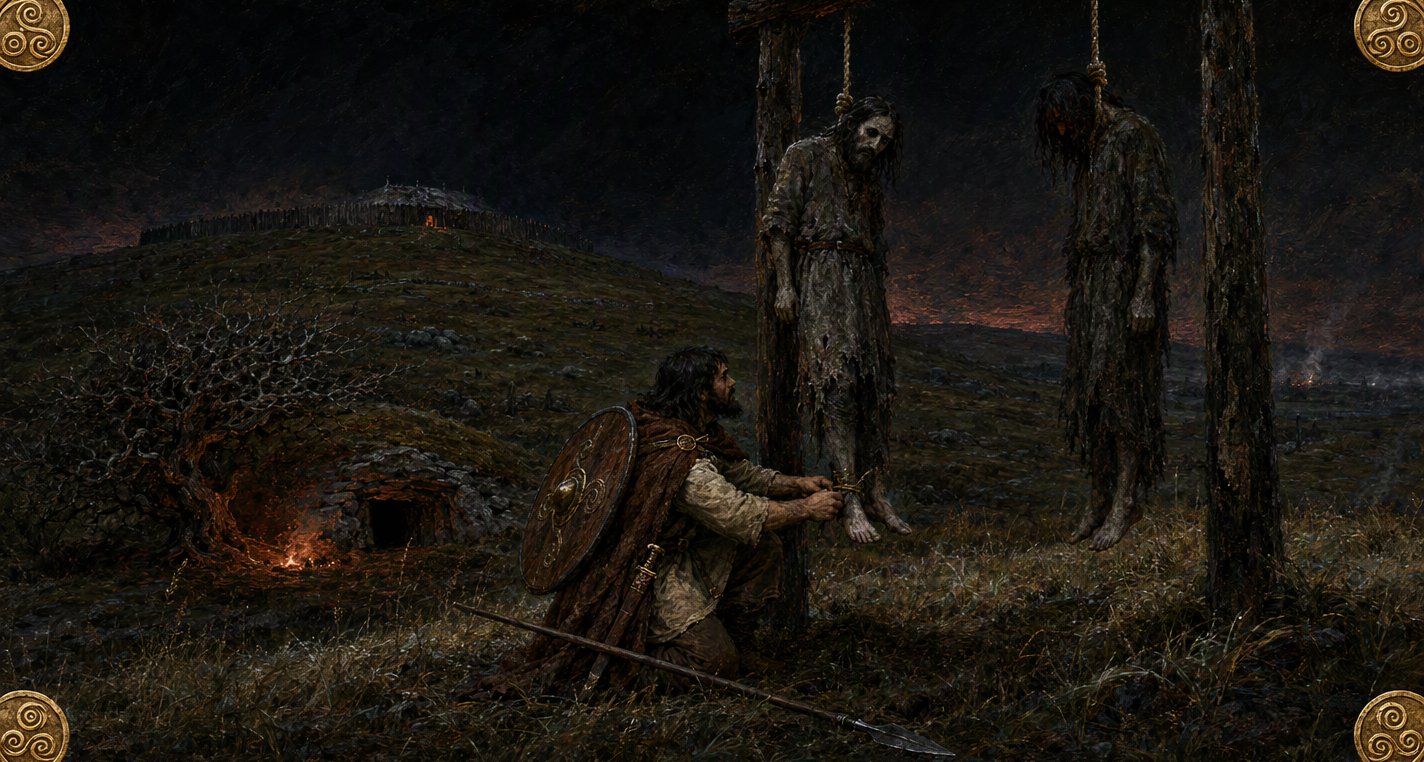
It was Samhain night, and Ailill and Medb were in Ráth Cruachan with their whole household, and the food was cooking. Two captives had been hanged the day before. They were out on the gallows still.
Then Ailill spoke. Whoever puts a withe round the foot of either of the two men on the gallows, he said, will have a prize from me, whatever he chooses.
It was a night of great darkness and great dread, and on that night, always, the demons showed themselves. 1 One after another the men went out to try it, and one after another they were soon back in the house.
I will have your prize, said Nera. I will go out.
Then you will have this gold-hilted sword of mine, said Ailill.
So Nera armed himself well and went out into the dark, to the captives. He put a withe round the foot of one of them, and it sprang off. Three times it sprang off.
Then the hanged man spoke to him from the gallows. Unless you put a proper peg in it, he said, you could be at it till morning and it would never hold.
So Nera put a proper peg in it, and it held.
That is manly, Nera, said the man on the gallows.
Manly indeed, said Nera.
By the truth of your valour, said the hanged man, take me up on your neck, and let me get a drink with you. I was very thirsty when I was hanged.
Come up on my neck, then, said Nera.

II Three Houses
Nera took the hanged man up on his back. Where will I carry you? he said.
To the house that is nearest us, said the hanged man.
They went to that house, and they saw something. There was a lake of fire all round it.
There is no drink for us in this house, said the hanged man. Its fire is never left unraked. Let us go on to the next house, the one nearest us.
They went to it, and there was a lake of water all round it.
Do not go to that house, said the hanged man. There is never a tub for washing or bathing in it at night after sleeping, and never a slop-pail. Let us go on to the other house.
They came to the third house. Now, said the hanged man, there is my drink in this house.
Nera set him down, and he went into the house. There were tubs in it for washing and bathing, with a drink in each of them, and a slop-pail on the floor. He drank a draught from each tub. Then he scattered the last sip from his lips into the faces of the people of the house, and every one of them died.
That is why it is not good to have a tub for washing or bathing in a house after sleeping, or a fire unraked, or a slop-pail. 2
Then Nera carried him back to his torment on the gallows, and turned for home to Cruachan.
III The Cave of Cruachan
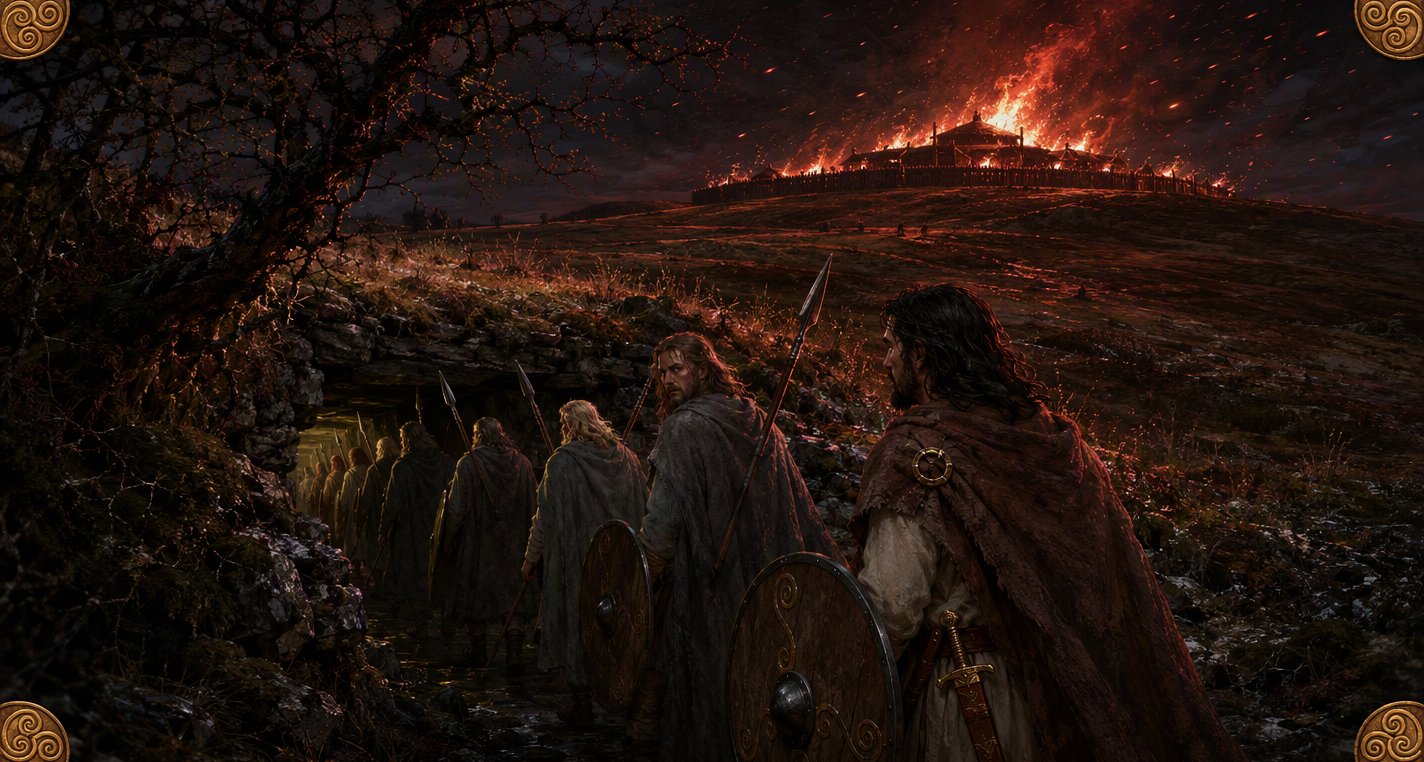
When he came back to Cruachan, he saw something. The dún was burning in front of him, and there was a heap of heads on the ground, the heads of his own people, that the warriors had cut off.
He went after the host of warriors, into the cave of Cruachan.
There is a man on our track, said the last man of the host.
The track is the heavier, said the man in front of him. And each man said it to the man ahead, from the last man to the first.
So they came to the síd of Cruachan, and they went into it.
The heads were shown to the king in the síd. What shall be done with the man who came in with you? said one of the host.
Let him come here, said the king, so that I can speak with him.
So Nera came before him, and the king said: What brought you into the síd with the warriors?
I came in the company of your host, said Nera.
Go now to that house over there, said the king. There is a woman living there on her own, and she will make you welcome. Tell her it was I who sent you. And come to this house every day with a load of firewood.
IV The Blind Man and the Lame Man
Nera did as he was told, and the woman made him welcome. You are welcome, she said, if it is the king who sent you.
It is, said Nera.
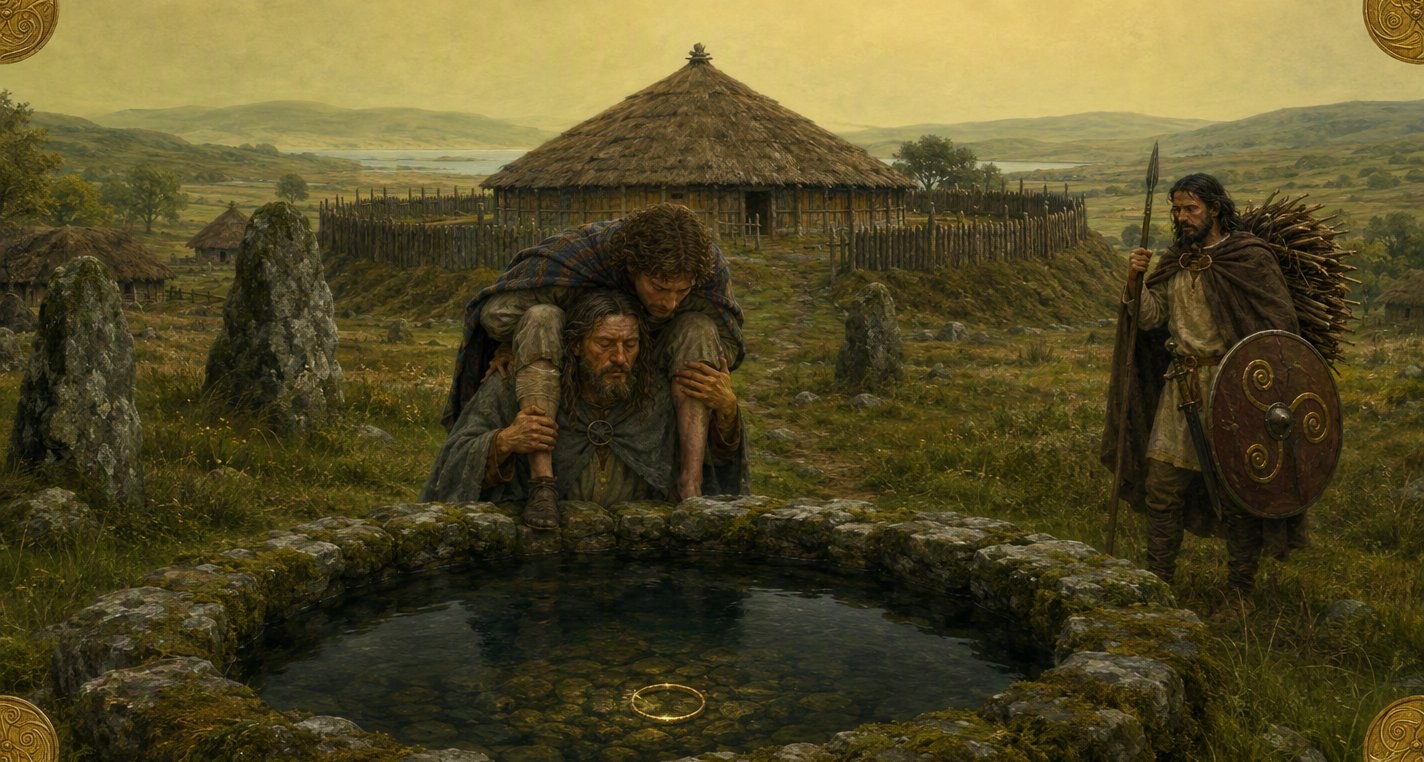
Every day after that he went up to the king’s dún with a load of firewood. And every day, as he came, he saw a blind man come out of the dún ahead of him, with a lame man up on his neck. On they went until they stood at the brink of a well in front of the dún.
Is it there? said the blind man.
It is, indeed, said the lame man.
Let us go away, then, said the lame man.
Nera asked the woman about it. Why do the blind man and the lame man go to the well?
They go to see the crown that is in the well, said the woman. It is a diadem of gold, which the king wears on his head, and that is where it is kept.
Why those two? said Nera.
That is not hard to tell, said she. They are the ones the king trusts to go and see the crown. One of them was blinded, and the other was lamed.

V The Fruits of Summer
Come here a while, said Nera to the woman, his wife now, and tell me about my adventures. As I was coming into the síd, it seemed to me that Ráth Cruachan was destroyed, and that Ailill and Medb had fallen in it with their whole household.
That is not true, said the woman. It was an elfin host that came to you. But it will come true, she said, unless you tell it to your friends.
How can I warn my people? said Nera.
Rise and go to them, said she. They are still sitting round the same cauldron, and it has not yet been lifted off the fire.
And yet it had seemed to Nera that he had been three days and three nights in the síd.
Tell them to be on their guard at the coming Samhain, she said, unless they come to destroy the síd. For I promise them this: the síd will be destroyed by Ailill and Medb, and the crown of Brión carried off by them.
How will anyone believe that I have been in the síd? said Nera.
Take the fruits of summer with you, said the woman.
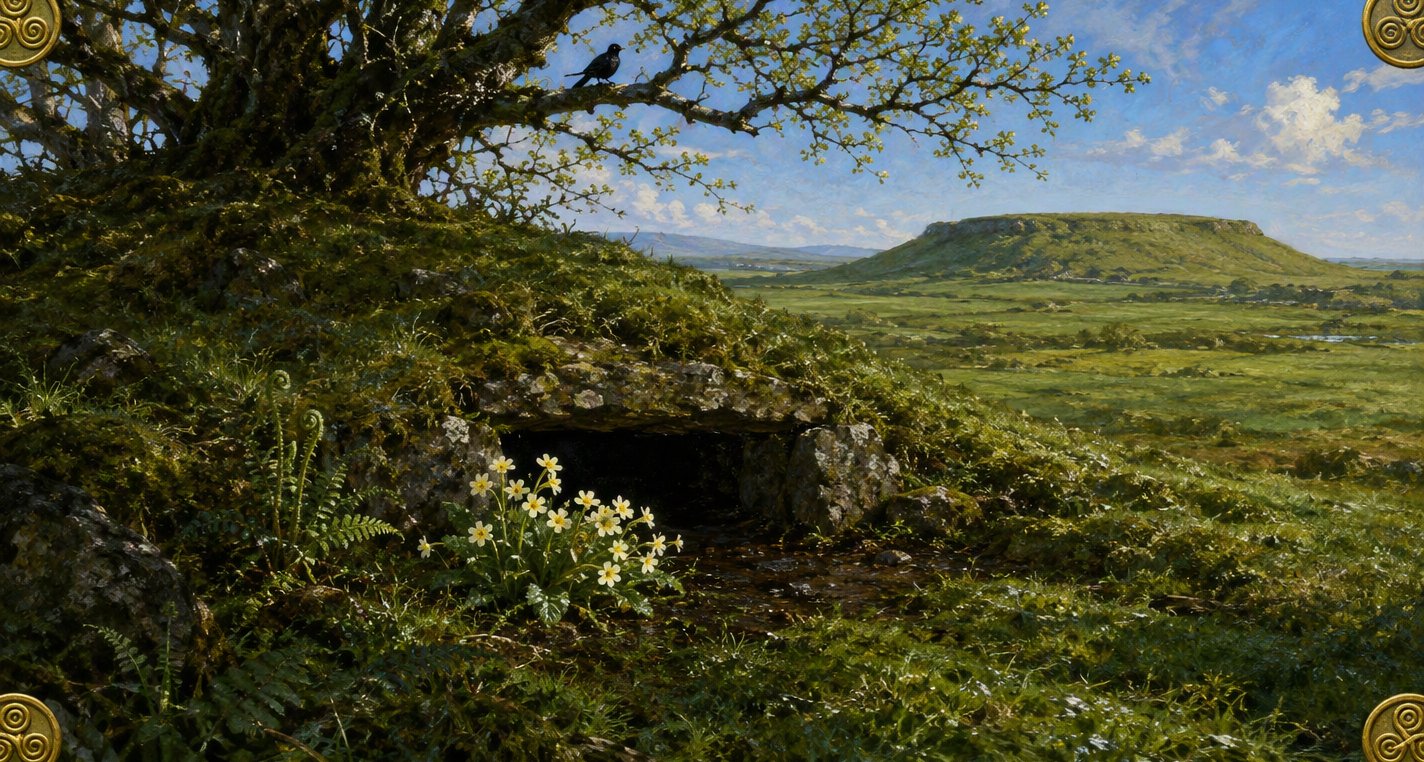
So he took the fruits of summer with him out of the síd: wild garlic, and primrose, and golden fern. 3
And I will be with child by you, she said, and I will bear you a son. When your people come to destroy the síd, send word into the síd, so that you can bring your family and your cattle out of it.
Then Nera went back to his people. He found them round the same cauldron, and he told them all that had happened to him. And the gold-hilted sword was given to him.
VI The Morrígan
Nera stayed with his people until the end of a year. That was the very year that Fergus mac Róich came out of Ulster into exile, to Ailill and Medb at Cruachan.
Your time has come, Nera, said Ailill. Go and bring your people and your cattle out of the síd, so that we can go and destroy it.
So Nera went back into the síd, to his wife, and she made him welcome. Go up to the dún now, she said, and take a load of firewood with you. I have gone up every day for a whole year with a load of firewood on my neck in your place, and I told the king you were sick. And there is your son.
He went up to the dún with a load of firewood on his neck. Welcome alive from the sickness you were in! said the king. I am displeased that the woman should sleep with you without asking.
Your will shall be done about that, said Nera.
It will not be hard for you, said the king.
Nera went back to the house. Tend your cattle today, said his wife. I gave one of the cows to your son as soon as he was born.
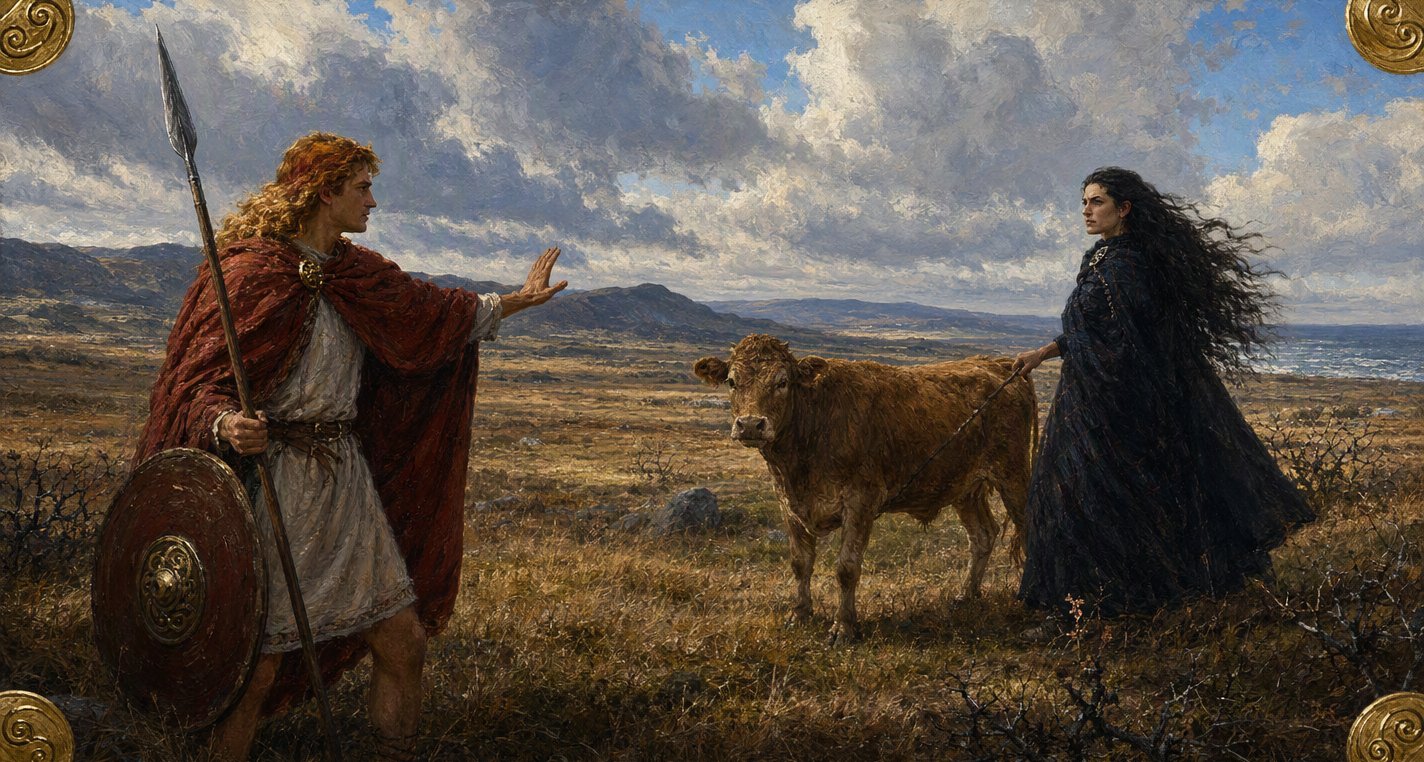
So Nera went out with the cattle that day, and while he was asleep, the Morrígan took his son’s cow. The Donn of Cúailnge bulled her in the east, in Cúailnge, and the Morrígan drove her west again. Cú Chulainn overtook them as they crossed the plain of Muirthemne: for it was one of his geasa that not even a woman should leave his land without his knowing.
This cow must not be taken, said Cú Chulainn.

VII The Bull Calf
The tale says no more of that meeting. In the evening Nera came home to his house with the cattle.
The cow of my son is missing, he said.
I did not deserve that you should tend the cattle like that, said his wife.
At that, in came the cow.
A wonder! Where has this cow come from?
She has come from Cúailnge, said the woman, after being bulled by the Donn of Cúailnge. Go out now, before your warriors come. The host cannot go out for a year, until Samhain comes again. At Samhain they will come: for the sídhe of Ireland are always open at Samhain. 4
Nera went to his people. Where have you come from? said Ailill and Medb. And where have you been since you went from us?
I was in fair lands, said Nera, with great treasures and precious things, with plenty of clothes and food, and wonderful treasures. They will come to kill you at the coming Samhain, unless you have been warned.
We will surely go against them, said Ailill.
So they stayed there until the end of the year. Now, said Ailill to Nera, if you have anything in the síd, bring it away.
Three days before Samhain Nera went in and brought the herd out of the síd. As the bull calf came out, the calf of the cow of Aingene, for Aingene was the name of Nera’s son, it bellowed three times.
At that very hour Ailill and Fergus were at the fidchell board, and they heard it: the bellowing of a bull calf on the plain.
I do not like that calf bellowing on the plain of Cruachan, said Fergus: the son of the black bull of Cúailnge. There will be calves without cows on Bairche in Cúailnge. 5
VIII The Whitehorn
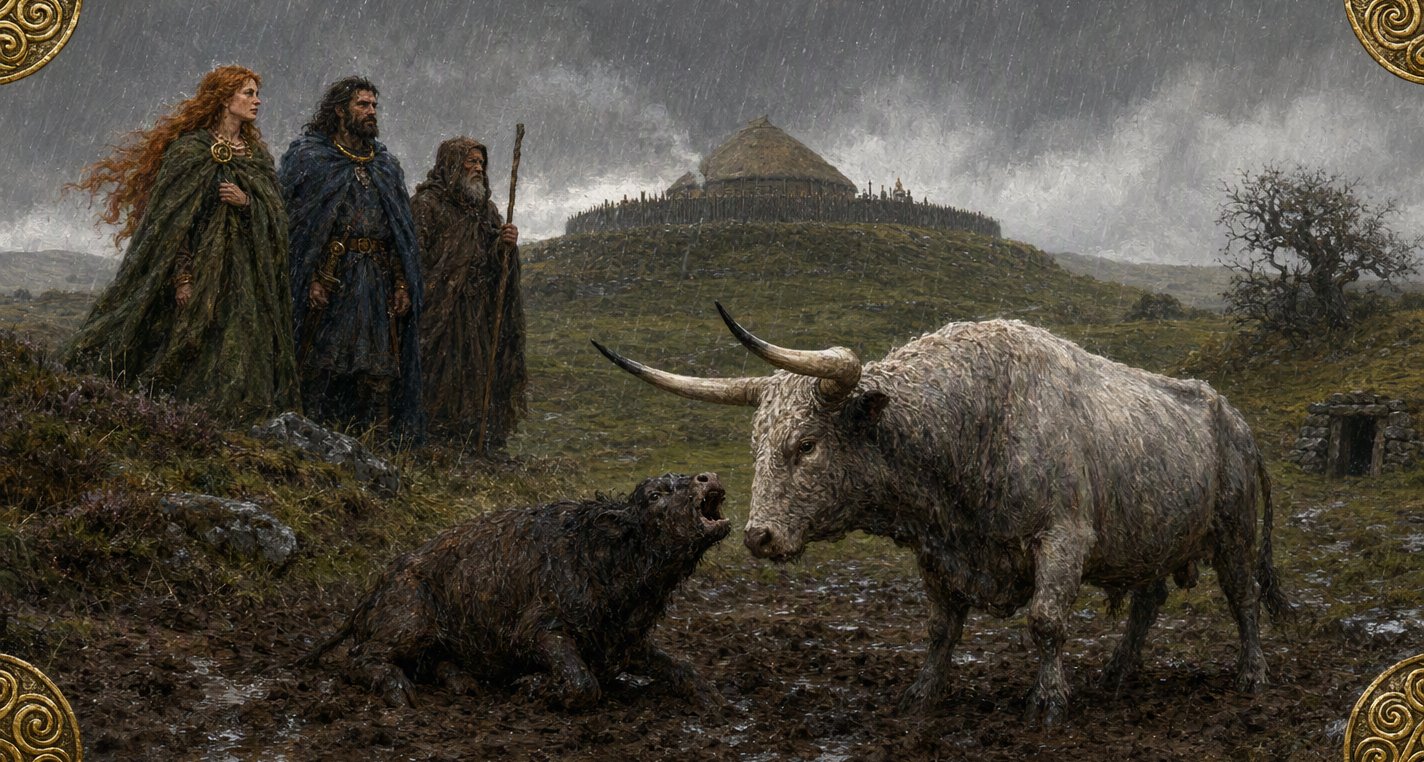
Then the bull calf and the Whitehorn met on the plain of Cruachan. A night and a day they fought there, until at last the bull calf was beaten; and when it was beaten, it bellowed.
What did the calf bellow? said Medb to her cowherd, whose name was Buaigle.
I know that, my good father Fergus, said Bricriu. It is the strain you sang in the morning.
At that Fergus turned and struck Bricriu on the head with his fist, and the five fidchell-men that were in his hand went into Bricriu’s head. It was a lasting hurt to him. 6
Tell me, Buaigle, said Medb, what did the bull say?
Truly, said Buaigle, it said that if its father came to fight, the Donn of Cúailnge, the Whitehorn would not be seen in Aí. It would be beaten over the whole plain of Aí, on every side.
IX Till Doom
Then Medb swore by the gods her people swore by. She would not lie down, she said, nor sleep on down or on flock; she would drink no buttermilk, and no ale, red or white; and she would taste no food, until she saw those two bulls fight before her face.
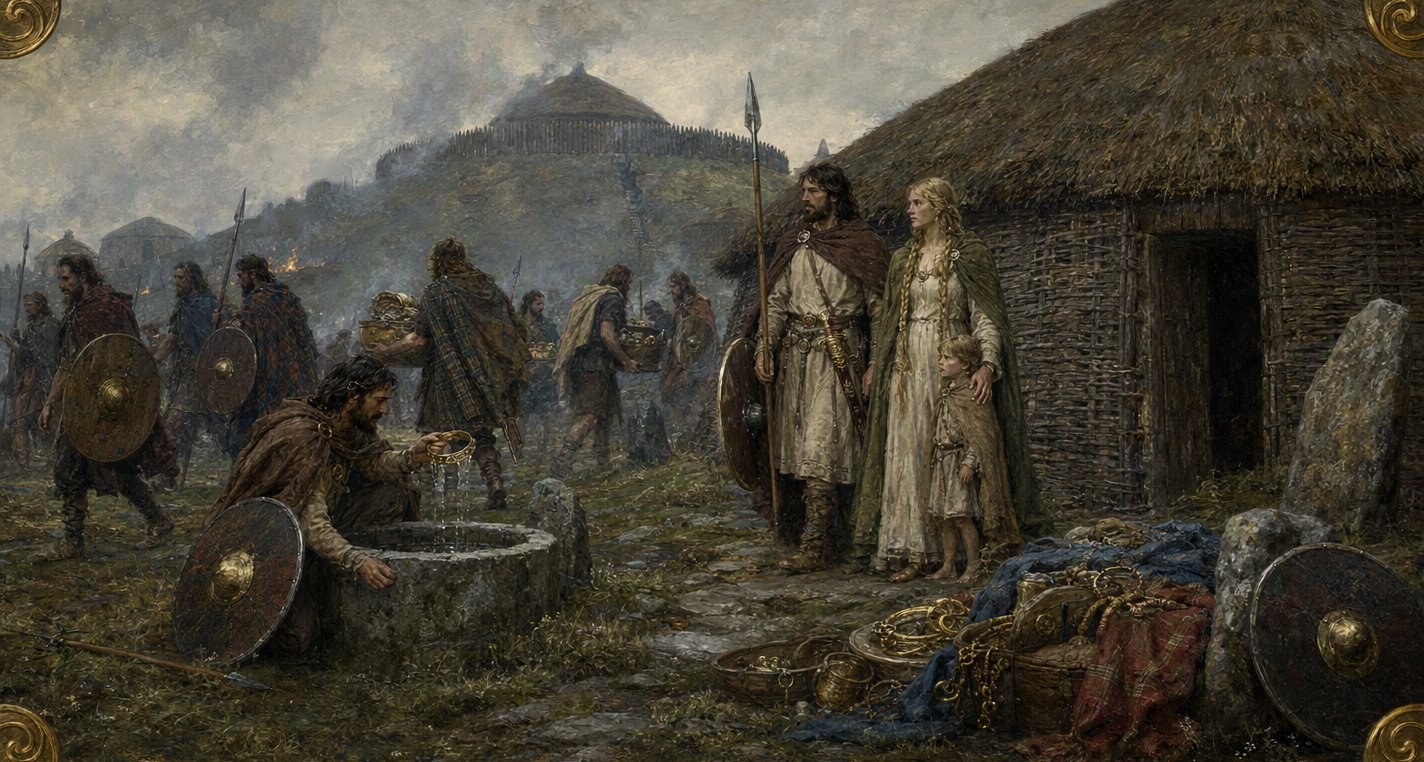
After that the men of Connacht went into the síd, and the black host of the exiles with them. They destroyed the síd, and they carried off everything that was in it, and they brought away the crown of Brión, as the woman of the síd had promised. That crown is one of the three wonders of Ireland: the others are the mantle of Lóegaire in Armagh, and the shirt of Dúnlang in Kildare. 7
But Nera was left in the síd, with his people there. He has not come out until now, and he will not come out till Doom. 8
What the tale keeps
Rake the fire before you sleep. Empty the tubs, and put out the slop-pail. The tale keeps these small household rules beside the great war it leads to, because on Samhain night a hanged man is thirsty, and the dark outside the door is full, and the sídhe of Ireland stand open.
It keeps the strangeness of the crossing, too: three days and three nights under the hill, and at home the cauldron still on the fire. A man walks into the hall on Samhain night with primroses in his arms.
Nera followed the host of the síd into the hill, and in the end he stayed there with his people. He will not come out, the tale says, till Doom. And every Samhain the door he went through stands open.
Notes
- “Great was the darkness of that night and its horror, and demons would appear on that night always.” (Kuno Meyer, The Adventures of Nera, 1889) Meyer’s English calls the night Halloween; the Irish says Samain. ↩
- “Henceforth it is not good (to have) either a tub for washing or bathing, or a fire without sparing, or a slop-pail in a house after sleeping.” (Kuno Meyer, The Adventures of Nera, 1889) His “sparing” is cogluid in the Irish: the raking of a fire for the night. Irish still says coigil an tine, “rake the fire”. ↩
- “Then he took wild garlic with him and primrose and golden fern.” (Kuno Meyer, The Adventures of Nera, 1889) In his notes Meyer takes the Irish buiderath to be buide-raith, literally “yellow fern”. ↩
- “They will come on Halloween next: for the fairy-mounds of Erinn are always opened about Halloween.” (Kuno Meyer, The Adventures of Nera, 1889) ↩
- “I like not the calf bellowing in the plain of Cruachan, the son of the black bull of Cualgne, which approaches, the young son of the bull from Loch Laig.” (Kuno Meyer, The Adventures of Nera, 1889) His English goes on, “There will be calves without cows on Bairche in Cualgne”, and the last line has a gap in it. ↩
- Meyer’s notes add what the Book of Leinster Táin tells of Bricriu. He had come from Ulster to beg gifts of Fergus, and Fergus kept him waiting. “From the wound he received from Fergus he lay ill at Cruachan during the whole war of the Táin.” (Kuno Meyer, The Adventures of Nera, 1889) And he paid for his taunt with his life: made to watch the fight of the Whitehorn and the Donn of Cúailnge, he was killed by the maddened bulls. ↩
- Meyer’s English keeps the Irish genitive: “the crown of Briun”, in barr Briuin. When the woman first gives her warning, the text breaks off in square brackets to name “the three things, which were found in it”: the mantle of Loegaire, the crown of Briun and the shirt of Dunlaing. (Kuno Meyer, The Adventures of Nera, 1889) ↩
- The Irish says co brath: till Doom, the Day of Judgement. Irish still says go brách, “for ever”. ↩
Where the tale comes from
Medieval manuscript. An early Irish prose tale, one of the fore-tales of the Táin, perhaps of the tenth century. It survives in two copies: in the Yellow Book of Lecan, and in British Library MS Egerton 1782, written about 1517.
- Kuno Meyer printed the tale for the first time in the Revue Celtique in 1889, with an English translation, from British Library MS Egerton 1782, written about 1517, where it has no heading. The other copy, in the Yellow Book of Lecan (Trinity College Dublin, H. 2. 16), calls it Táin Bó Aingen, the Cattle-raid of Aingen. Meyer judged that the two copies go back to one lost original, and that neither was copied from the other. This retelling follows his translation.
- The twelfth-century Book of Leinster lists Echtra Nera fifth among ten remscéla, the fore-tales of the Táin Bó Cúailnge, between the Táin Bó Regamna and the Conception of Conchobar; The Dream of Aengus is second in the same list. Rudolf Thurneysen dated the tale to the tenth century, and later, Patricia Ronan reports, did not rule out the eighth.
- In the Book of Leinster the Táin itself begins with Medb and Ailill in their bed at Cruachan, counting their wealth. This fore-tale runs another thread to the same war: a cow of the síd, the Morrígan, and a bull calf beaten on the plain of Cruachan, whose bellowing makes Medb swear to see the two bulls fight.
- Meyer thought the Táin Bó Regamna, the Cattle-raid of Regamna, “may be regarded as an episode” of this tale. A gloss in square brackets in the text names a man, Aingene, and a woman, Be Aingeni, and says that what Nera saw of them was the same as what Cú Chulainn saw in the Táin Bó Regamna. Meyer’s translation also sets in square brackets a list of Cú Chulainn’s geasa, among them: “It was one of his gessa that birds should feed on his land, unless they left something with him.”
- Before Meyer, Eugene O’Curry had summarised part of the tale in his lectures On the Manners and Customs of the Ancient Irish, and Hennessy had quoted from it in the first volume of the Revue Celtique.
- Like nearly all early Irish literature, it was written down and copied by Christian scribes. The things abroad on Samhain night are demons in Meyer’s English, and Nera is to stay in the síd until Doom, the Day of Judgement.
Sources
- The Adventures of Nera · ed. and tr. Kuno Meyer, Revue Celtique 10 (1889), pp. 212–228
- The Adventures of Nera · tr. Kuno Meyer (1889), reprinted by Mary Jones, Celtic Literature Collective
- Aspects of Echtra Nerai · Patricia Ronan, Tionól 2000 (School of Celtic Studies, Dublin Institute for Advanced Studies)