
The Cycles of the Kings
Niall and the Hag at the Well
Echtra mac nEchach Mugmedóin
Five brothers go looking for water. Only Niall comes back with it. The hag who guards the well is Sovereignty.
I Beside the Pail
There was a king over Ireland once, a wondrous and a noble king, and his name was Eochaid Mugmedón. Five sons he had. Brian, Ailill, Fiachra and Fergus were the sons of his queen, Mongfind, daughter of Fidach. The fifth was Niall, and Niall’s mother was Cairenn of the curling black hair, daughter of the king of the Saxons. 1
Mongfind hated Niall, because it was on Cairenn the king had got him, and not on her, and she made his mother suffer for it. She put Cairenn to drawing the water of Tara, and kept her at it while she was heavy with the child, so that the child would die in her womb.
Cairenn’s time came, and still she was not let off the work. On the green of Tara, beside her pail, she gave birth to a son. She dared not lift him off the ground. She left him there on the grass, and the birds came down on him.
Not one of the men of Ireland dared carry him away, for dread of Mongfind. Great was her magic, and they were all afraid of her.
Then Torna the poet came across the green, and saw the child lying alone with the birds at him. He took the boy up into his breast, and as he held him, all that would ever come after was shown to him.

II Welcome, Little Guest
Welcome, little guest, said Torna. He will be Niall of the Nine Hostages. In his time he will redden many. Plains will be made great, hostages will be overthrown, battles will be fought. Long-side of Tara, host-leader of Mag Femin, veteran of the Liffey, white-knee of Codal: seven and twenty years he will rule Ireland, and Ireland will be his children’s after him for ever.
And so it was. Good was his beginning and good his end, manly and rough-haired, until a Saturday afternoon by the sea of Wight, when he fell at the hand of Eochaid son of Énna Cennselach. 2
Torna fostered the boy, and neither the poet nor his foster-son came near Tara until Niall was fit to be king.
Then they came, and they met Cairenn carrying water.
Leave that work alone, said Niall.
I dare not, she said, because of the queen.
My mother will not be a servant, said Niall, and I the son of the king of Ireland.
He took her into Tara with him, and he dressed her in purple.
Anger seized Mongfind, for it seemed an evil thing to her. And the men of Ireland wanted Niall for their king after his father.
Then Mongfind said to Eochaid: Judge between your sons, and say which of them will have your heritage.
I will not judge it, said the king. Sithchenn will.
III The Burning Forge
Sithchenn was a druid, and the smith who lived at Tara: a wise man, and a wondrous prophet.
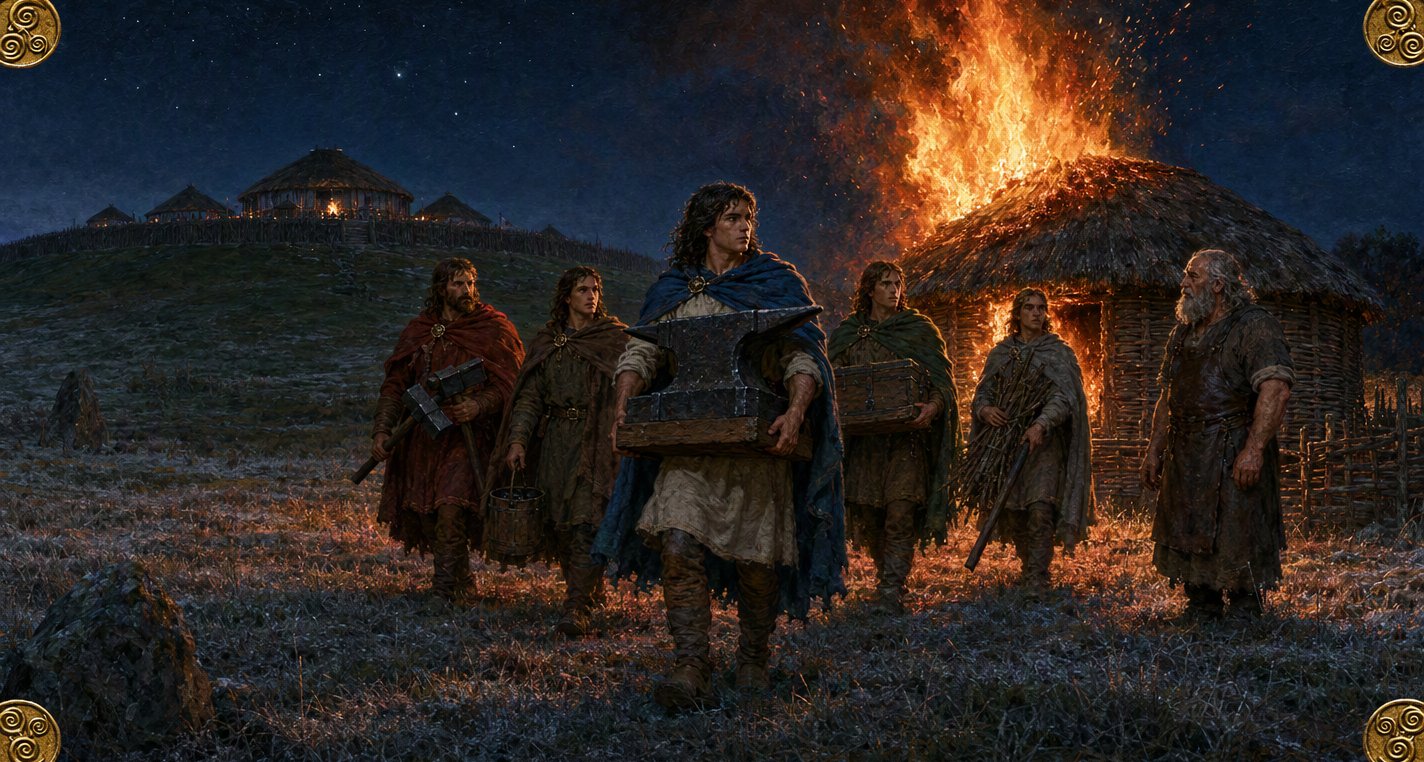
He set fire to his forge with the king’s sons inside it, and one by one they came out through the smoke.
Niall came out carrying the anvil, block and all.
Niall conquers, said Sithchenn. He will be a solid anvil for ever.
Brian came out with the sledgehammers.
Brian for your fighters, said the druid.
Fiachra came out with a pail of ale and the bellows.
Your beauty and your art with Fiachra, said the druid.
Ailill came out with the chest the weapons were kept in.
Ailill to avenge you, said the druid.
Last of all came Fergus, with a bundle of withered sticks and a bar of yew in it.
Fergus the withered, said the druid.
To bear witness to it, the seanchaí sang a verse. It names the five sons as the fire found them, and its last line is this: Niall has the reward. 3

IV Every Side Closed
That was a grievous judgment to Mongfind. She said to her four sons: Quarrel among yourselves. Niall will come between you to part you, and then you can kill him.
They quarrelled.
I would go and part them, said Niall.
No, said Torna. Let the sons of Mongfind be at peace. And that is where the proverb comes from.
Then the sons were sent to Sithchenn to ask him for arms. He made arms for them, and the finest weapon of all he put into Niall’s hand, and the rest he gave to the others.
Go and hunt now, he said, and try your arms.
So they went hunting, and they went far astray, until every side was closed against them. When at last they stopped, they kindled a fire and broiled some of what they had killed, and they ate until they were full.
Then a thirst came on them, a great drought after the cooked meat.
One of us must go and look for water, they said.
I will go, said Fergus.
V The Hag at the Well
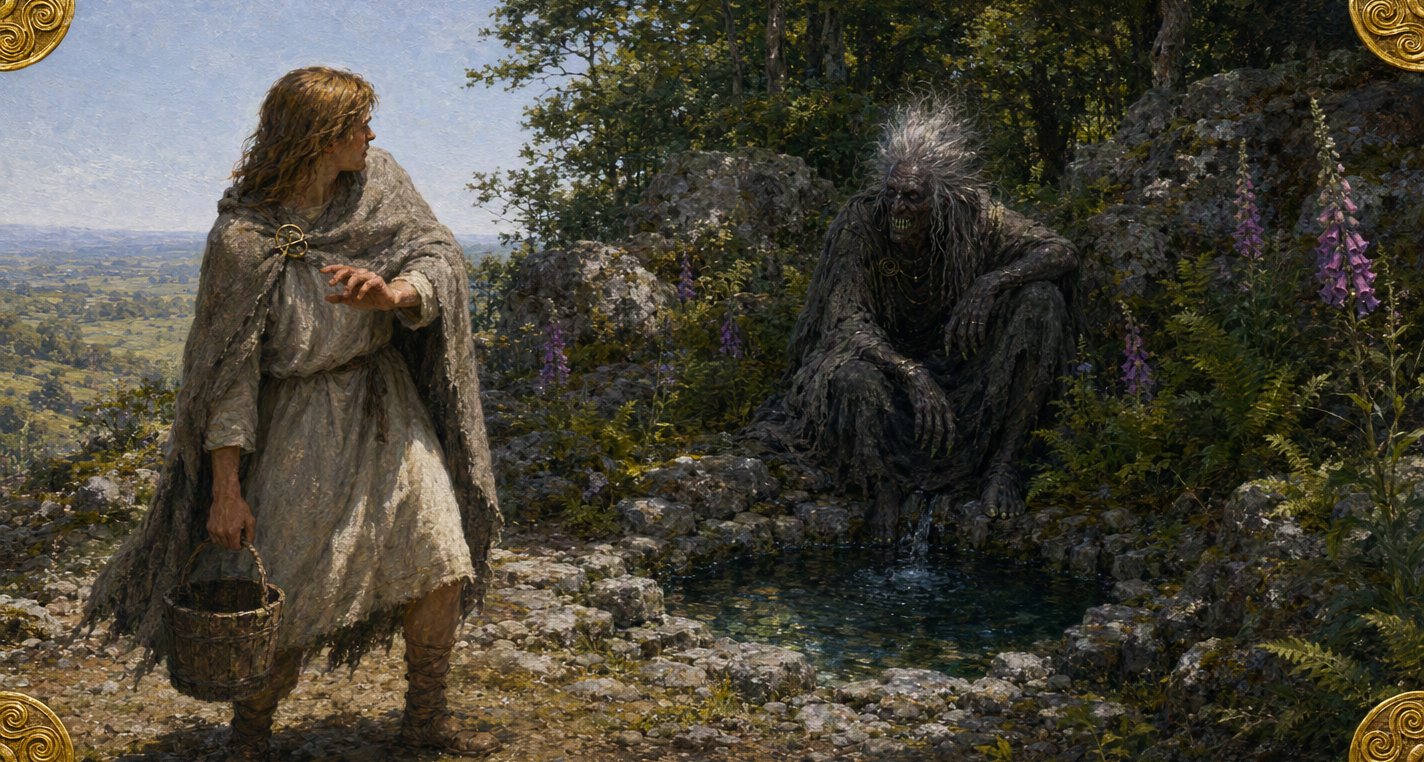
Fergus went looking for water, until he came on a well, and an old woman guarding it.
This is how she was. Every joint and limb of her, from the crown of her head to the ground, was as black as coal. Up through the top of her head came a grey, bristling mane, like the tail of a wild horse. Her teeth were green, a sickle of them that reached back to her ears, and they would have sheared through a green oak bough. 4 Her eyes were dark and smoky, her nose crooked and hollow, her shins twisted, her knees big, her nails green. Loathsome she was to look at.
Will you let me take away some of the water? said Fergus.
I will, she said, for one kiss on my cheek.
I would sooner die of thirst, said Fergus, than give you a kiss.
He went back to his brothers and told them he had found no water.
Then Ailill went. He came on the same well, and he would not kiss her either, and he came back without water; and he never told them he had found the well. Then Brian went, the eldest of the sons. He found the same well, and would not kiss the old woman, and came back dry.
Then Fiachra went, and found the well and the old woman guarding it, and asked her for water.
Give me a kiss, she said.
I would give few kisses for it, said Fiachra.
You will visit Tara, she said. 5
That came true, for two of his line took the kingship of Ireland, Dathí and Ailill Molt, and not one of the line of Brian or Ailill or Fergus ever took it. But Fiachra came back without water.
Last of all, Niall went.
VI The Kiss
Niall came on the same well, and the same old woman guarding it.
Water for me, woman, he said.
I will give it, she said, but first give me a kiss.
A kiss, said Niall, and more than a kiss: I will lie with you too.
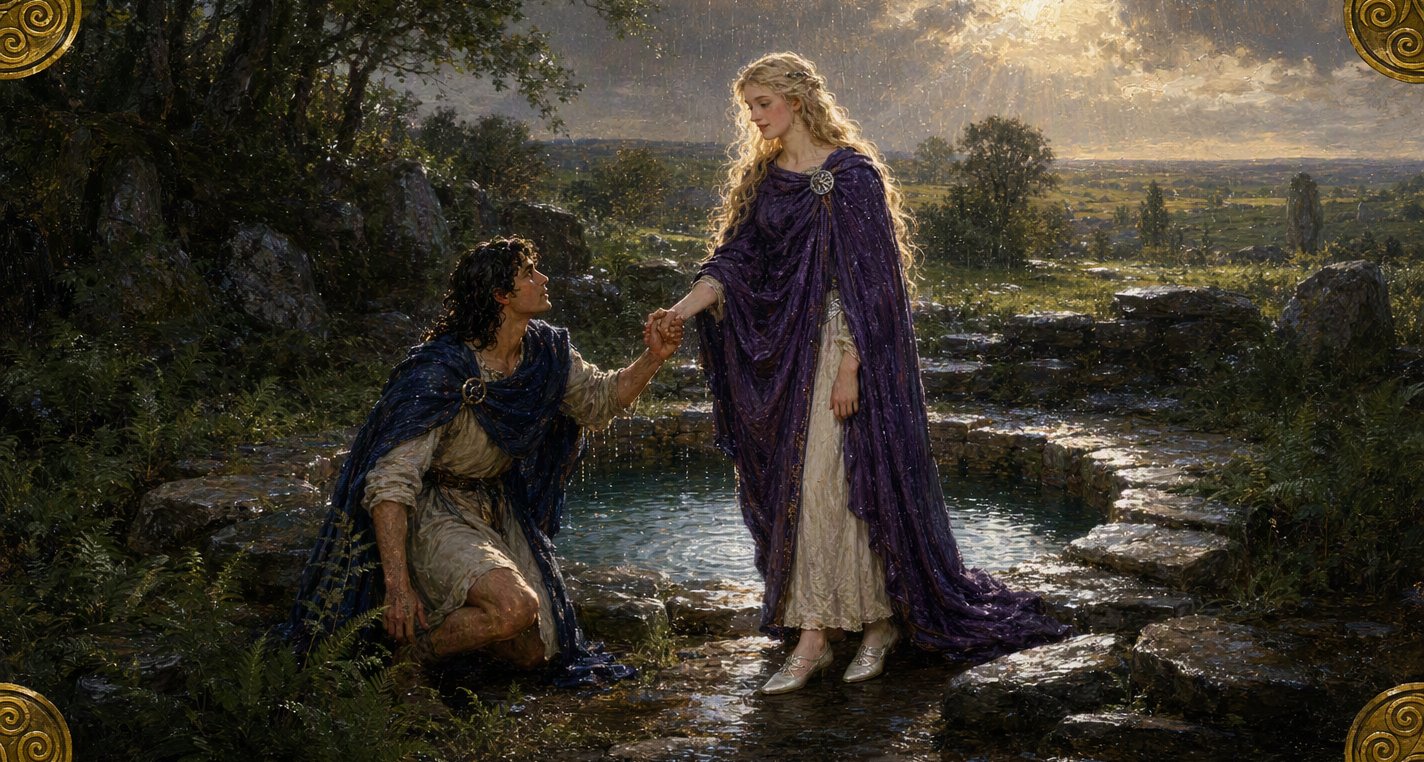
He threw himself down on her and kissed her.
And when he looked at her then, there was not a young woman in the world whose walk or whose face was lovelier than hers. She was white from her head to her feet, like the last of the snow lying in a ditch. Her forearms were round and queenly, her fingers long, her calves straight and fair. On her small, soft white feet were two blunt shoes of white bronze. She wore a costly mantle of full purple, and in it a brooch of bright silver. Her teeth shone like pearls, her eyes were large and queenly, and her lips were as red as rowan berries.
Many are your shapes, lady, said the boy.
True, she said.
Who are you? said the boy.
I am the Sovereignty, she said. King of Tara, I am the Sovereignty.
VII The Price of the Water
Go now to your brothers, said the Sovereignty, and take water with you. The kingship and the rule will stay with you and with your children for ever, all but two of the seed of Fiachra, Dathí and Ailill Molt, and one king out of Munster, Brian of the Tribute. 6
You saw me loathsome at first, she said, bestial and horrible, and beautiful at the last. The sovereignty is like that. It is seldom won without battles and conflicts, but at the last it is beautiful and good to whoever has it. 7
But do not give the water to your brothers, she said, until they make you gifts: seniority over them, and the right to raise your weapon a hand’s breadth above theirs.
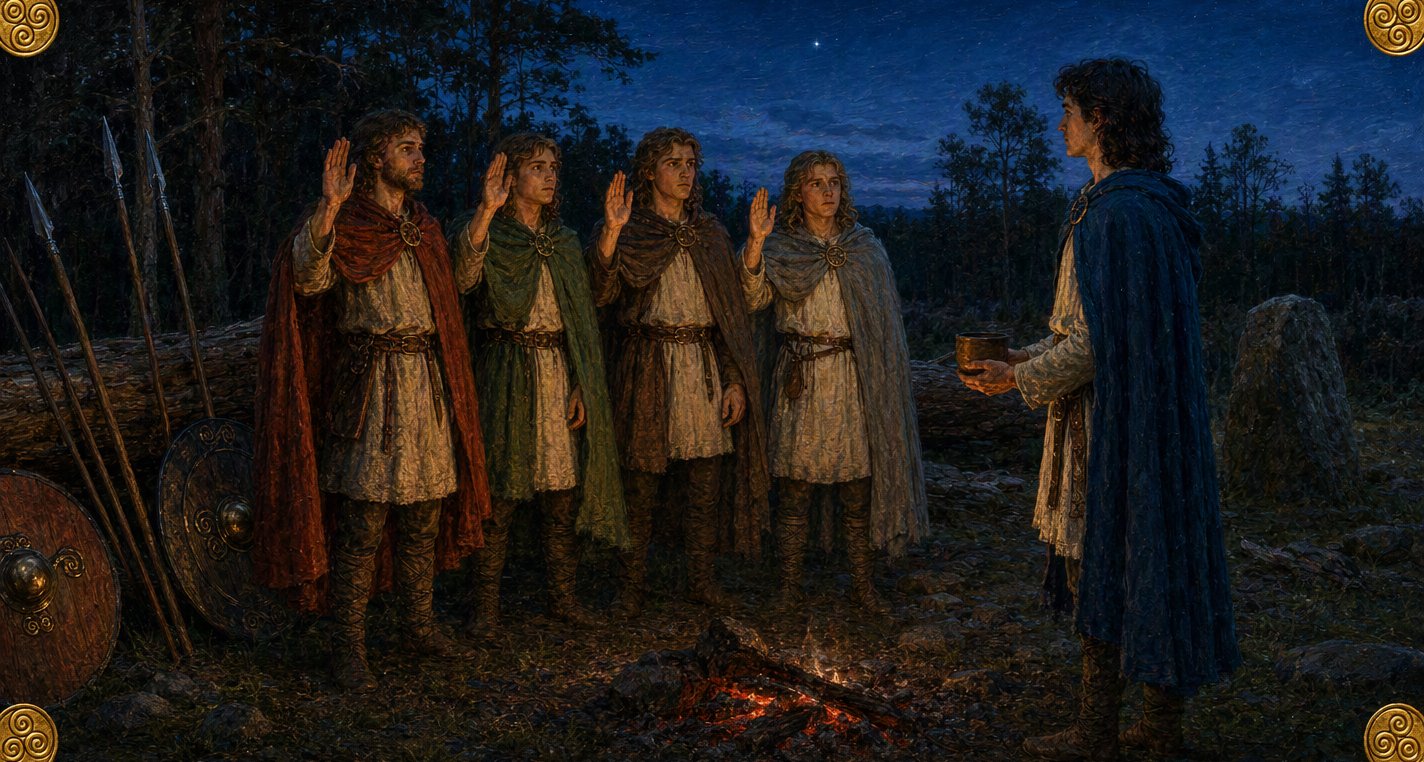
Niall bade her farewell and took the water to his brothers. He did not give it to them until they had granted him every boon he asked of them, as the woman had taught him. And he bound them by oath never to stand against him, or against his children.

VIII A Hand’s Breadth Above
Then they went to Tara. They raised their weapons, and Niall raised his a hero’s hand’s breadth above the rest. They sat down in their seats, with Niall in the midst of them.
The king asked them for their news, and it was Niall who answered. He told the whole adventure: how they went looking for water, how they came on the well, and on the woman, and what she had foretold them.
Why is it not Brian who tells these tales? said Mongfind. He is the eldest.
We gave Niall our seniority and our kingship, they said, the first time, for the water.
You gave them for good, said Sithchenn. From this day on, he and his children will have the rule and the kingship of Ireland.
And that was true. From Niall on, no one took the kingship of Ireland unopposed but his own children and their children after them, down to Máel Sechnaill son of Domnall, the Strong-Striker of Uisnech.
As for Niall himself, he was Niall of the Nine Hostages, as Torna had named him on the green, for he received nine hostages: five from the provinces of Ireland, and four from Alba. 8 And he ruled Ireland seven and twenty years, as Torna had foretold.

What the tale keeps
The tale begins with water and ends with it. A king’s daughter is made to carry the water of Tara, and her son is born beside the pail and left on the grass for the birds. Years after, lost in a wild place, the king’s sons come one by one to a well, and four of them go back without water.
The fifth is the child who was left for the birds. He gives the keeper of the well what she asks, and more, and she tells him what she is. Sovereignty comes like that: loathsome at first and lovely at last, and seldom won without battles.
The tale ends by counting the kings of Niall’s line. What it keeps is a well in a wild place, the woman who guards it, and the price of the water.
Notes
- Stokes’s English calls her Cairenn Casdub, and her father Scál the Dumb, “king of England”; the Irish has rí Saxan, king of the Saxons. Casdub means curly-black. Geoffrey Keating has “Cairionn Chasdubh, daughter of the king of Britain” (The History of Ireland, vol. 2, tr. David Comyn and Patrick S. Dinneen, 1908). The tale does not say how she came to be at Tara. ↩
- Stokes’s “sea of Wight” is Muir nIcht, the English Channel. Keating tells Niall’s death otherwise: he was in France, near the river Loor, when Eochaid, king of Leinster, whom he had banished to Alba, shot him with an arrow from an oak grove across the river. ↩
- “Eochaid’s five sons, Niall the great anvil, / Brian the sledge-hammer for true striking, / Ailill the chest of spears against a tribe, / Fiachra the blast, Fergus the withered.” (Whitley Stokes, The Adventures of the Sons of Eochaid Muigmedón, 1903) Stokes’s English has the smith set fire to “the forge in which the four sons were”, but five come out of it. ↩
- “The green branch of an oak in bearing would be severed by the sickle of green teeth that lay in her head and reached to her ears.” (Whitley Stokes, 1903) ↩
- “I would give few kisses for it.” “Thou shalt visit Tara,” quoth she. (Whitley Stokes, 1903) Stokes does not say whether Fiachra kissed her. He calls Ailill Molt “Ailill Wether”: molt means a wether, a gelded ram. ↩
- Stokes: “one king out of Munster, namely Brian of the Tribute”. This is Brian Bóruma, who took the kingship of Ireland in 1002 and fell at Clontarf in 1014. The tale was written, or last reworked, after he took the kingship. ↩
- “As thou hast seen me loathsome, bestial, horrible at first and beautiful at last, so is the sovranty; for seldom it is gained without battles and conflicts; but at last to anyone it is beautiful and goodly.” (Whitley Stokes, 1903) In the Irish she says Misi in Flaithius: I am the Sovereignty. ↩
- “Now this king is called Niall Naoighiallach, from his having received nine hostages or nine captives, five of them from the provinces of Ireland, and four from Alba” (Geoffrey Keating, The History of Ireland, vol. 2, tr. David Comyn and Patrick S. Dinneen, 1908). Keating, too, gives him twenty-seven years as king. ↩
Where the tale comes from
Medieval manuscript. Middle Irish prose with verse, telling how Niall won the kingship of Tara for his descendants. It names Brian Bóruma, so it was written, or last reworked, in the 11th century or later; the main copies are late 14th-century.
- The tale is Middle Irish prose with passages of verse. It survives in the Yellow Book of Lecan and the Book of Ballymote, both written towards the end of the 14th century, and in the Liber Flavus Fergusiorum. It names Brian Bóruma, who took the kingship of Ireland in 1002 and died in 1014, and counts the kings of Niall’s line down to Máel Sechnaill son of Domnall, who died in 1022: it was written, or last reworked, in the 11th century or later.
- Whitley Stokes edited the Yellow Book of Lecan copy, with the readings of the Book of Ballymote, and translated it in Revue Celtique 24 (1903), in the same volume as another tale of Mongfind’s family, The Death of Crimthann son of Fidach. This retelling follows his translation. Standish Hayes O’Grady had already printed the Book of Ballymote copy, with a translation, in Silva Gadelica (1892).
- Like nearly all early Irish literature, it was written down by Christian scholars, and it ends in the service of the kings descended from Niall, the Uí Néill, counting how many of them took the kingship of Ireland. There is no saint in it, and no church: only a druid, a poet, and a woman at a well.
- Geoffrey Keating’s History of Ireland, written in the 1630s, gives Niall twenty-seven years as king and explains the nine hostages. But it makes Cairionn the daughter of the king of Britain and “another wife of Eochaidh’s” (tr. David Comyn and Patrick S. Dinneen, 1908), and it has Niall killed with an arrow in France. It also tells how Mongfind poisoned her own brother, Criomhthann, to win the kingship for her son Brian, and died of the same drink.
Sources
- The Adventures of the Sons of Eochaid Muigmedón · ed. and tr. Whitley Stokes, Revue Celtique 24 (1903), pp. 190–203
- Irish Sagas Online: Echtra mac nEchach Muigmedóin · University College Cork
- Foras Feasa ar Éirinn: The History of Ireland · Geoffrey Keating, ed. and tr. David Comyn and Patrick S. Dinneen (Irish Texts Society, 4 vols, London, 1902–1914)