The Mythological Cycle
The Coming of the Tuatha Dé Danann
Cath Muige Tuired Cunga
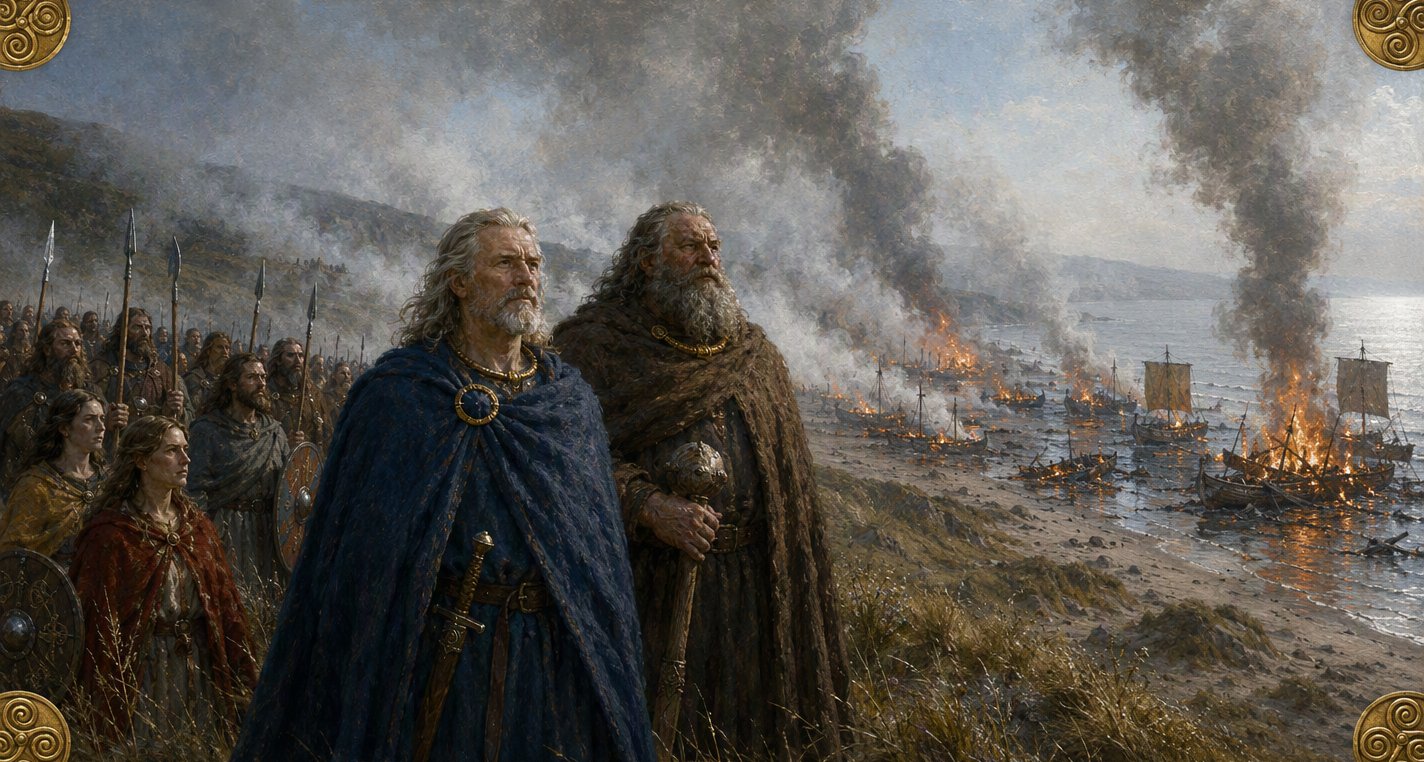
They burned their ships on the shore, and for three days a druid’s mist hid them. Then they sent word to the people who held Ireland: half the land, or a battle.
I The Four Cities
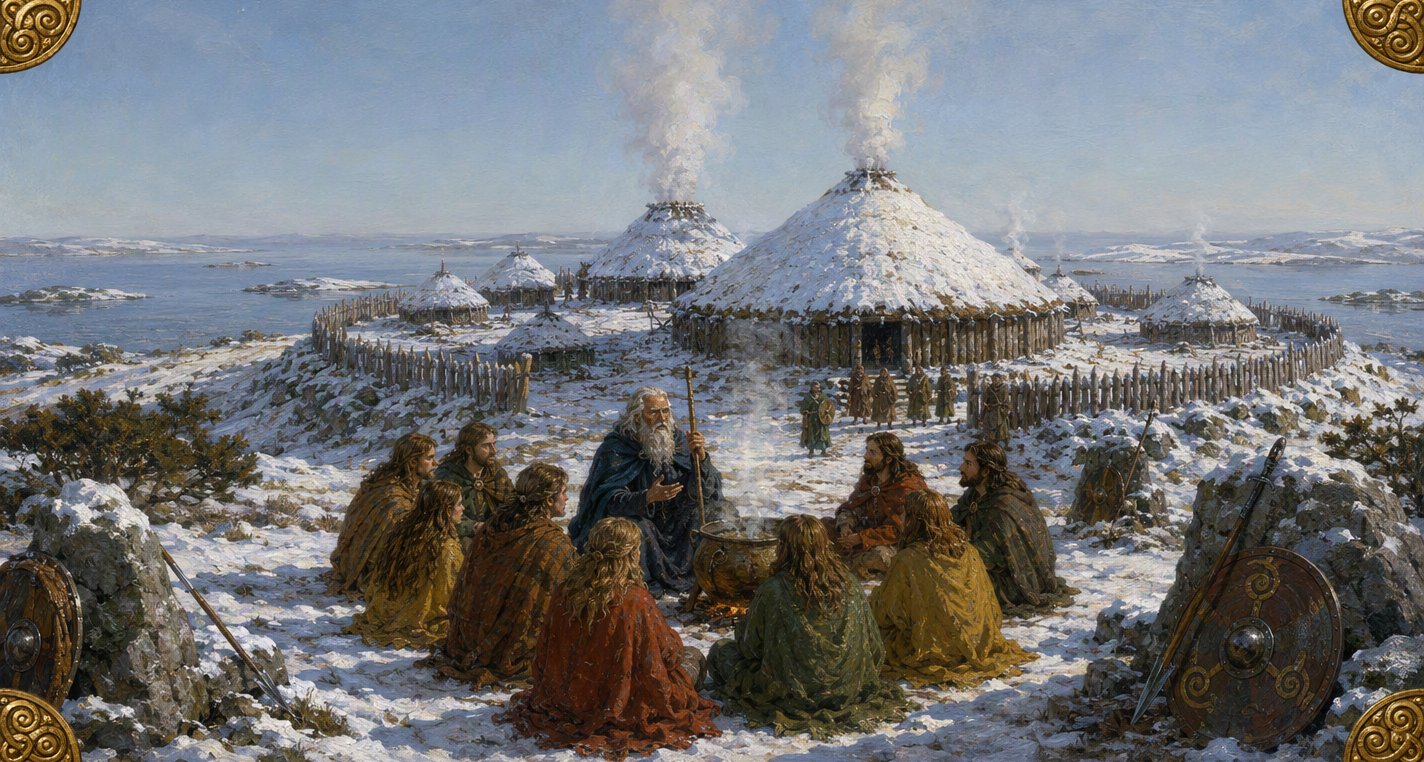
Before the Tuatha Dé Danann ever came to Ireland, they were in the northern islands of the world, learning. They learned lore and magic, druidry and wizardry and cunning, until they had outdone the sages of every heathen art.
There were four cities where they learned it: Falias and Gorias, Murias and Findias. In each city there was a sage, and those four were the poets who taught them all their lore. Morfesa was in Falias, Esras in Gorias, Uscias in Findias, and Semias in Murias.
From each city they brought a treasure. From Falias came the Stone of Fál, that would roar under every king who was to take Ireland. From Gorias came the spear that Lugh had: no battle was ever won against it, or against the man who held it. From Findias came the Sword of Nuada: once it was drawn from its sheath, no one ever escaped it. And from Murias came the cauldron of the Dagda, and no company ever went away from it unthankful. 1
They were no strangers to Ireland. Long before, the children of Nemed had lived there, paying tribute to the Fomorians, until they left it, ship after ship, and scattered over the sea. One branch went east, to Greece, where they were kept at hard labour, until they made boats of their sacks and stole away home. Another branch went into the cold north. From that branch came the Tuatha Dé Danann.
So the people who held Ireland now were their own kin: the ones who had come home from Greece, the Fir Bolg.
II The Burning of the Ships
In the north they prospered, until their fame went out over all the lands of the earth. They had bold, hardy chiefs, and men skilled in every art. They had a god of wizardry of their own, Eochaid Ollathir, the great Dagda. And their king was Nuada, son of Echtach.
They made up their minds to go to Ireland. They gathered their fleets into one place until they had three hundred ships, and they set sail, and after three years and three days and three nights they came to land at wide Tracht Mugha, in Ulster, on the Monday of the first week of May.
The moment they were ashore they broke up every ship and boat they had, and burned them. 2 They burned them, one old book says, so that none of them would ever think of turning back; and the smoke and the mist of the burning filled the land and the air around. That is why it was thought, the book says, that they had come to Ireland in clouds of mist.
Geoffrey Keating, who gathered the old books into his history in the seventeenth century, says more. When the ships were burned, they put a mist of druidry around themselves for three days, so that not one of the Fir Bolg saw them until they stood on Sliabh an Iarainn, the Iron Mountain. 3
The tale of the battle says only that they went on to the Red Hills of Rian, in Brefne in the east of Connacht, and halted there, and made their camp. And their hearts were content in them at last, for they had come to the land of their ancestors.
But the land of their ancestors was not empty.
III Black Birds out of the Ocean
In those days the king of the Fir Bolg was Eochaid mac Eirc, high king of Ireland, and his seat was the rath of the kings at Tara. In his time, Keating says, there was no rain and no foul weather, and no year without its fruit. Wrongdoing was put down in Ireland, and good laws were made.
Now, when the Tuatha Dé Danann came into Ireland, a vision came to Eochaid in a dream, and it filled him with wonder and unease. He told it to his wizard, Cesard.
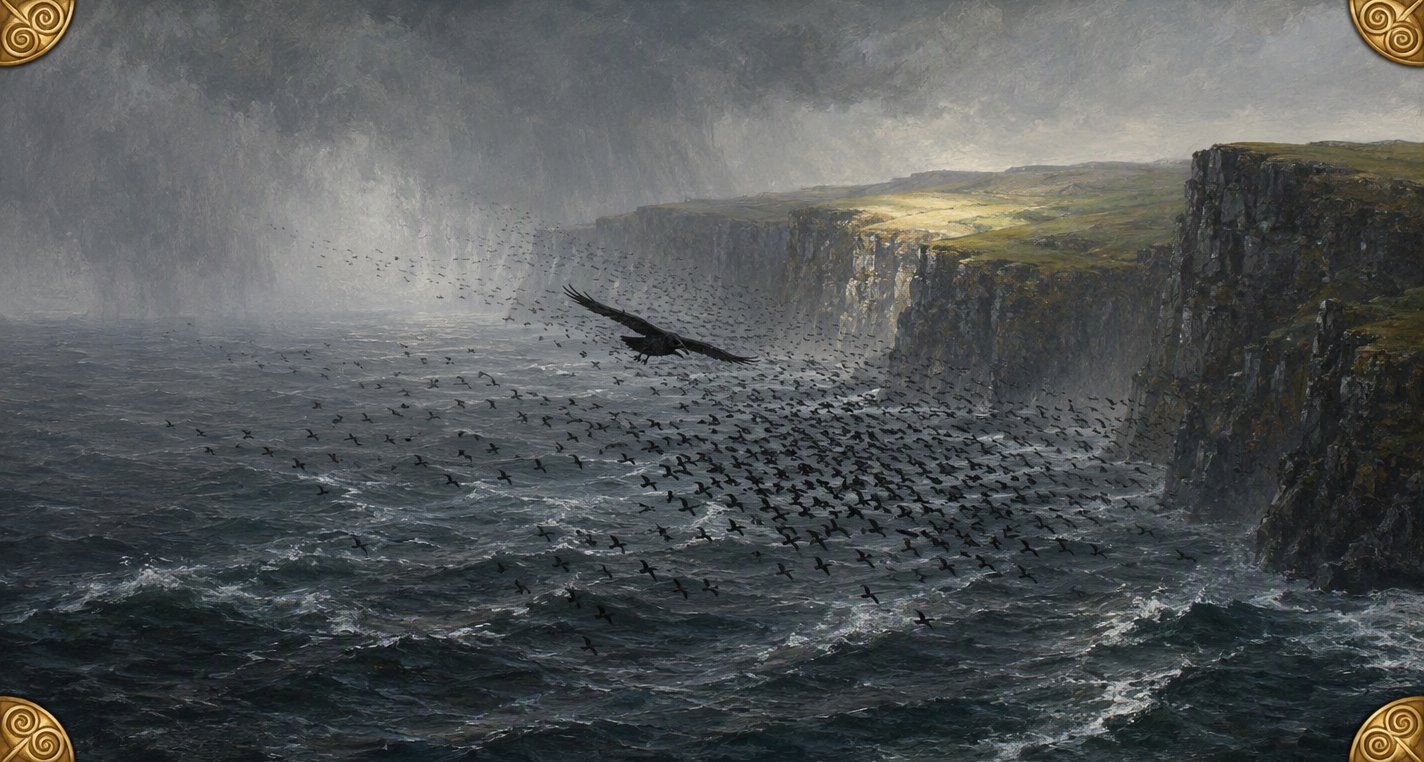
I saw a great flock of black birds, he said, coming out of the depths of the ocean. They settled over all of us and fought with the people of Ireland. They brought confusion on us, and destroyed us. And one of us, I thought, struck the noblest of the birds, and cut off one of its wings. 4
Cesard used his rites and his learning until the meaning came to him. I have news for you, he said. Warriors are coming across the sea, a thousand heroes covering the ocean. Speckled ships will press in on us. They announce every kind of death: a people skilled in every art, a magic spell. They will win in every strait.
That, said Eochaid, is a prophecy. Enemies are coming into Ireland from far countries.
Before long word came to the Fir Bolg of a company in the land: the fairest and most delightful company that ever came to Ireland, the finest in their arms and their dress, the most skilled in music and playing, the most gifted in mind and temper. It is bad for us, said the Fir Bolg, to know nothing of them, where they come from or where they mean to settle. So they chose a man to go and find out: Sreng, son of Sengann, for he was big and fierce, bold to spy on a host and to talk with strangers, and terrible to look at.

IV Sreng and Bres
Sreng rose and took his strong hooked shield of reddish-brown, his two thick-shafted javelins, his sword, his fine four-cornered helmet and his heavy iron club, and he set out to find them.
The Tuatha Dé saw a huge, fearsome man coming towards them. Here comes a man all alone, they said. It is news he is after. And Bres, son of Elatha, went out of the camp to look him over and to talk with him, with his shield and his sword and his two great spears.
The two came near each other, until they were within speaking distance, and stood looking hard at each other without a word. Sreng wondered at the great spears he saw, and rested his shield on the ground in front of him, so that it covered his face. Bres held his own shield before him, and said nothing.
Then they greeted each other, and they found they spoke the same tongue, for they were of the one stock. Each told the other who he was, and who his fathers were, back to Nemed.
Where did you spend last night? Bres asked him. At the hallowed heart of Ireland, said Sreng, in the rath of the kings at Tara. And where do you come from? From the camp on the mountain yonder, said Bres, where the Tuatha Dé are, and Nuada their king, who came out of the north of the world in a cloud of mist and a magic shower. 5
Take your shield from in front of your face, said Bres, so that I can tell my people what you look like. I will, said Sreng. It was fear of that sharp spear of yours that put it there.
He loosed his javelins to show them. Huge weapons, said Bres: broad-pointed, heavy, mighty and keen. What do you call them? Battle javelins, said Sreng.
Then tell the Fir Bolg, said Bres, that they must give my people battle, or half of Ireland. I would sooner give you half of Ireland, said Sreng, than face your weapons.
So each gave the other a spear, to show his own people what the others carried, and they parted in peace, having made a compact of friendship.
At Tara Sreng told what he had seen. Their spears are very sharp, he said, and hard in the shaft. It is hard to fight them. Better to make a fair division, and give them half of Ireland, as they ask. We will not, said the Fir Bolg. If we give them that, the whole land will be theirs.

V Three Days and Three Nights
Bres went back to the camp and told them of a big, powerful, fierce man with vast and wonderful weapons. The Tuatha Dé would not stay where they were. They went west over plains and inlets until they came to Mag Nia, under the end of the Black Hill, Sliabh Belgadain. This is a good place, they said, strong and hard to take. From here we will make our war.
Then three women of the Tuatha Dé, Badb and Macha and the Morrígan, went to Tara, to the knoll where the hostages were taken and the hill where hosts are summoned. They sent down on the Fir Bolg showers of sorcery, and close clouds of mist, and a furious rain of fire, and red blood pouring out of the air on the warriors’ heads, and for three days and three nights they gave them no rest. Our sorcerers are poor ones, said the Fir Bolg, if they cannot keep this off us. We will keep it off you, said their sorcerers, Fathach and Gnathach, Ingnathach and Cesard. And they stopped it.
Then the Fir Bolg gathered their hosts to one place, eleven battalions of them, and marched to the edge of Mag Nia; and the Tuatha Dé took their stand at the western end of the plain with seven.
The poets of the Tuatha Dé went to Eochaid’s tent and asked once more for a fair division of Ireland. Not till the day of doom, said the Fir Bolg. Then when will the battle be? We need time, they said, to ready our spears and mend our mail and sharpen our swords. So there was a truce until both hosts were armed and ready.
Eochaid sent his poet Fathach to ask how the Tuatha Dé would fight. With equal numbers on both sides, said Nuada and the Dagda and Bres. The hearts of the Fir Bolg sank at that.
Six weeks of the summer were gone, half the quarter, on the day set for the battle. The hosts rose with the first glimmer of sunlight.
VI The Healing Well
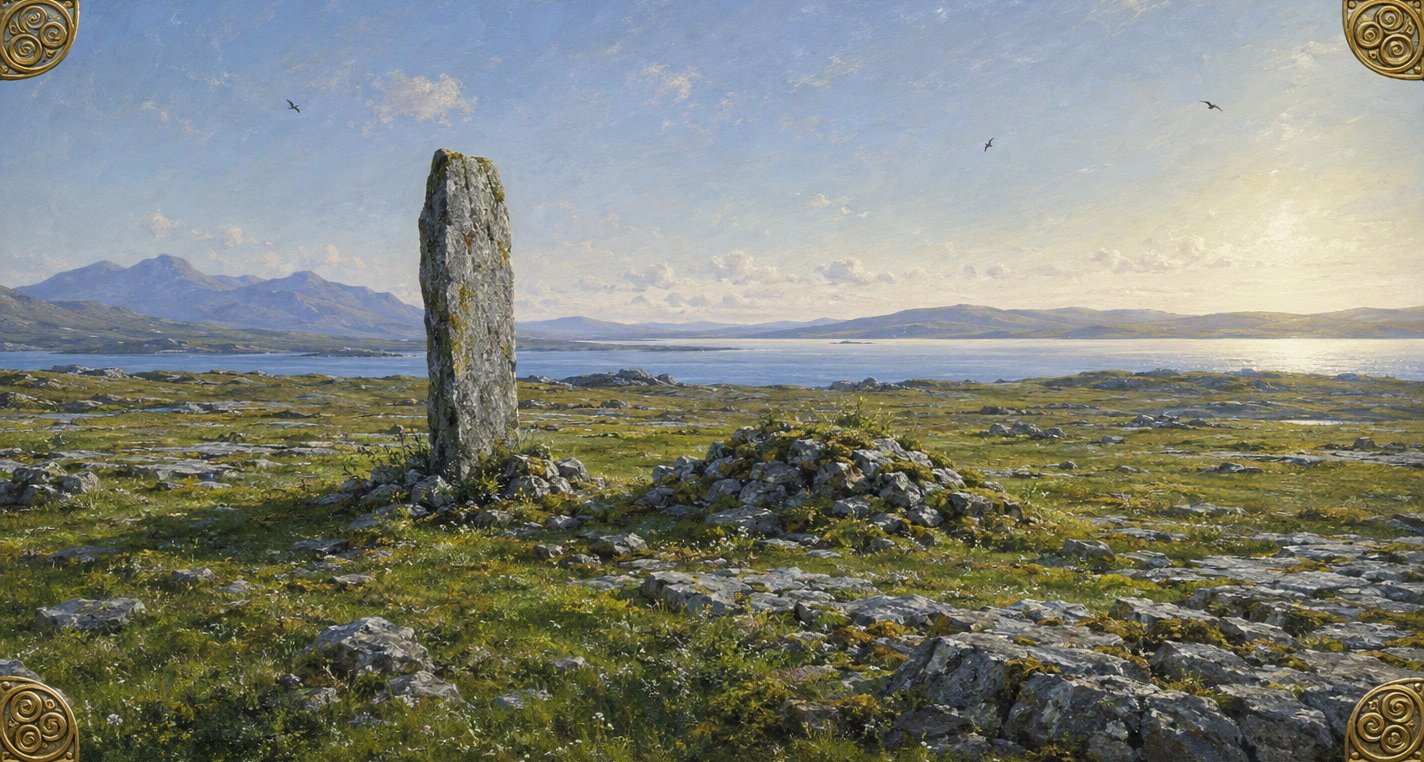
The Dagda began it. He cut his way into the Fir Bolg and cleared a path for a hundred and fifty, and on the far side Cirb of the Fir Bolg cleared as wide a path through the Tuatha Dé. All that day they fought, combat after combat and duel after duel, and great numbers fell; and when the day closed the Tuatha Dé were beaten and went back to their camp. The Fir Bolg did not follow them over the field. Every man of them brought his king a stone and a head, and they made a great cairn of them. The Tuatha Dé raised a pillar stone for Aidleo, the first of them to fall.
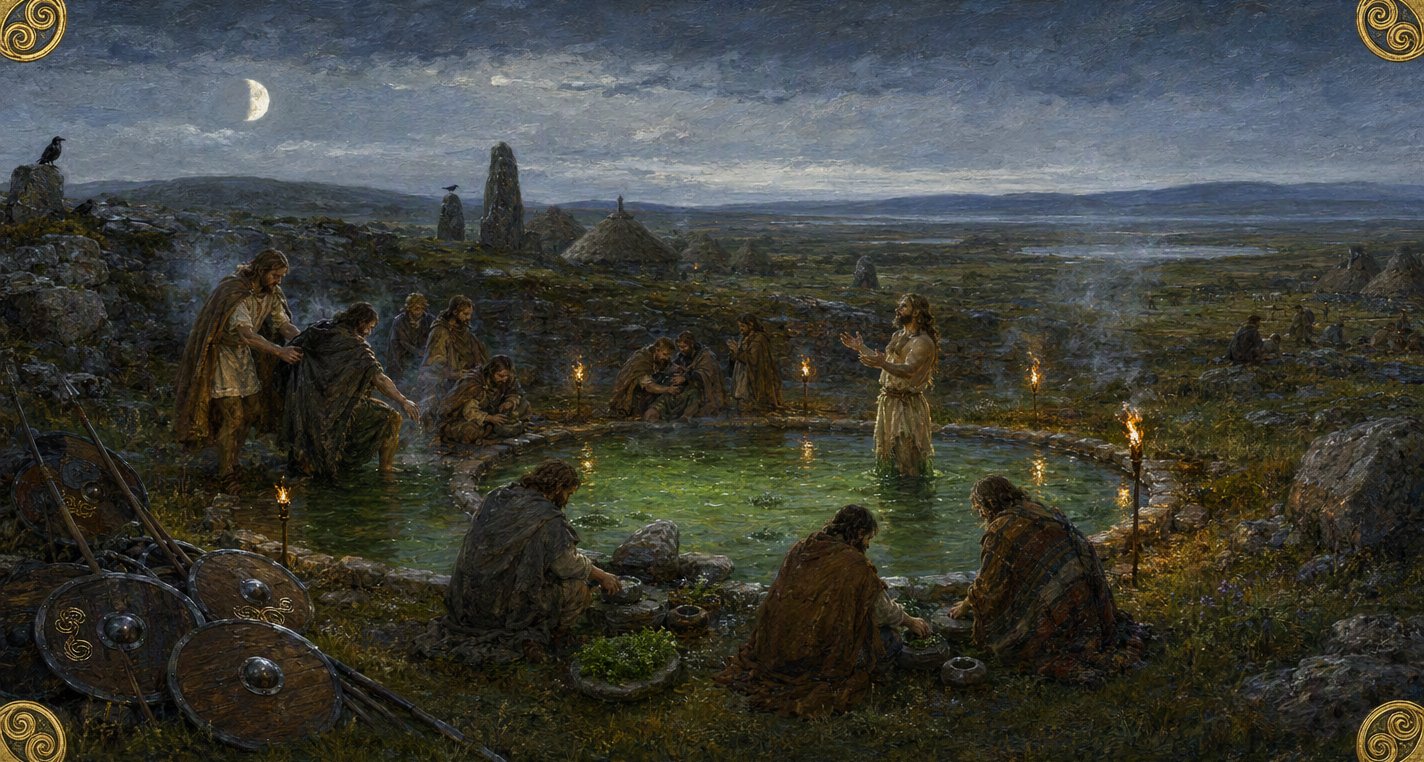
Each host had dug a well of healing. Then the physicians came together, and healing herbs were crushed and scattered on the water, until the precious water was thick and green. The wounded were put into the wells, and they came out whole.
Early next morning Eochaid went alone to the well to wash. Three armed men came and stood over him and called on him to fight. Let me get my weapons, he said, but they would not wait. Then a young, active man stood between the king and them. You will have your fight from me, he said, in place of the king. The four of them fought until all four fell. The three were Oll and Forus and Fir, physicians, brothers of Dian Cécht, who had come to spy on the physicians of the Fir Bolg.
Day after day the fighting went on. On one of those mornings the Fir Bolg came across the plain from the east with a flashing roof of shields over them and a thick forest of javelins. With what pomp, said the Tuatha Dé, those battle-props come into the plain! And that is how the plain got the name it has: Mag Tuired, the Plain of Props. 6 That day the Dagda went out against them with his sons and his brothers, and Cirb fell before his battering blows.
That night there was no joy in either camp.
VII The King’s Arm
In the morning the furies and monsters and hags of doom cried out, so that their voices were heard in the rocks and the waterfalls and the hollows of the earth.
In the front of the Tuatha Dé came the Dagda and Ogma, and Nuada the high king, and Dian Cécht the physician and Credne the craftsman, and the three queens, Ériu and Fódla and Banba, and the three sorceresses, Badb and Macha and the Morrígan. Against them the Fir Bolg came on round their king, with his son Slainge the Fair and the sons of Sengann.
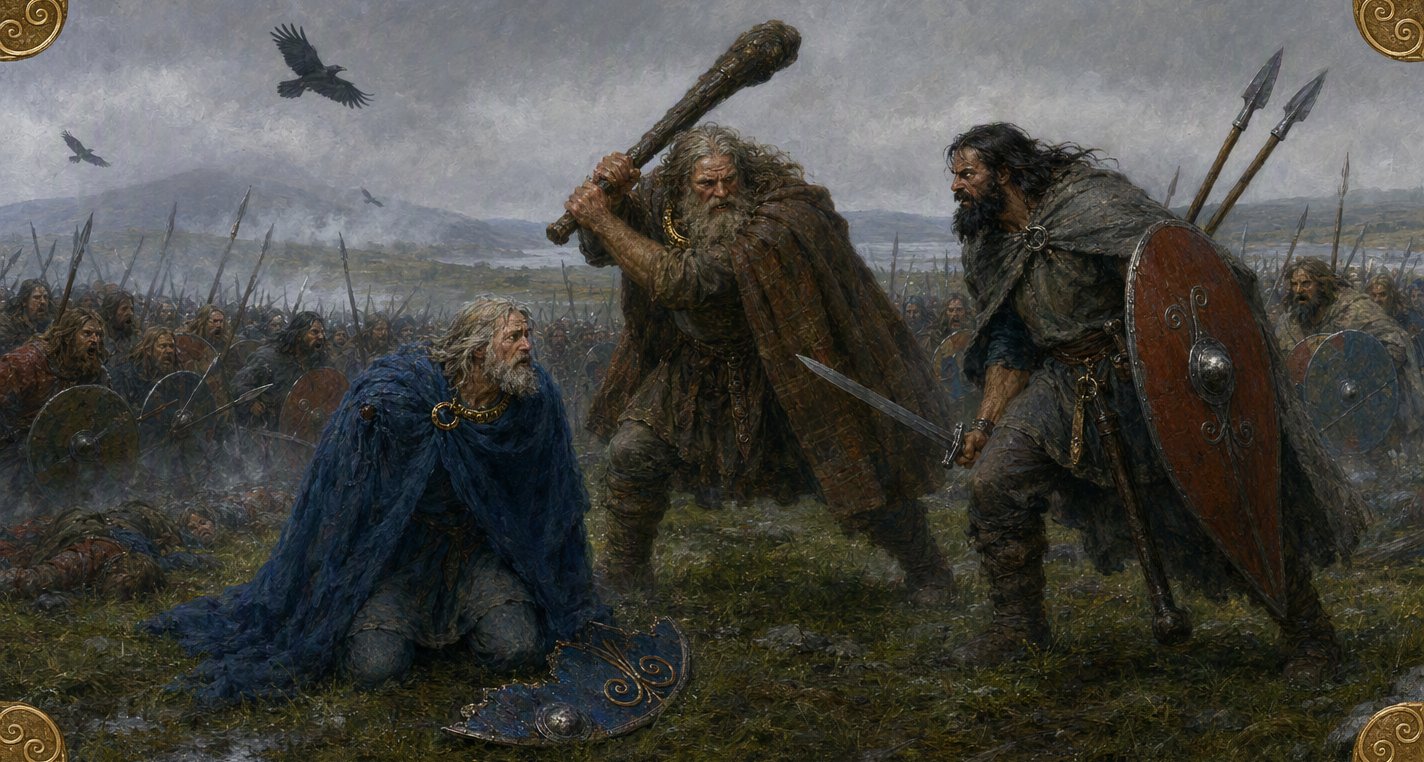
In the thick of it Sreng struck at Nuada with his sword. The blow cut away the rim of Nuada’s shield and took off his right arm at the shoulder, and the king’s arm fell to the ground with a third of his shield. 7
The king called aloud for help. Aengaba of Norway heard him and came to shield him, and he and Sreng fought hard. When the Dagda heard the music of the swords he came with deliberate bounds, like the rush of a great waterfall, and Sreng would not fight the two of them. The Dagda stood over Nuada, and he brought fifty soldiers with their physicians, and they carried the king from the field.
Then a great weariness came on Eochaid, and a burning thirst. He went out of the battle with a hundred of his men to look for water, and the wizards of the Tuatha Dé hid every stream and every river in Ireland from him, until he came to the strand of Eothail. Three sons of Nemed son of Badrai followed him there with a hundred and fifty men, and they fought on the strand until Eochaid and the three sons of Nemed fell together. The cairn they buried him in is Eochaid’s Cairn, that is also called the Cairn of Eothail.
So the Fir Bolg had lost their king, and the Tuatha Dé had a king with one arm.
VIII Sreng’s Portion
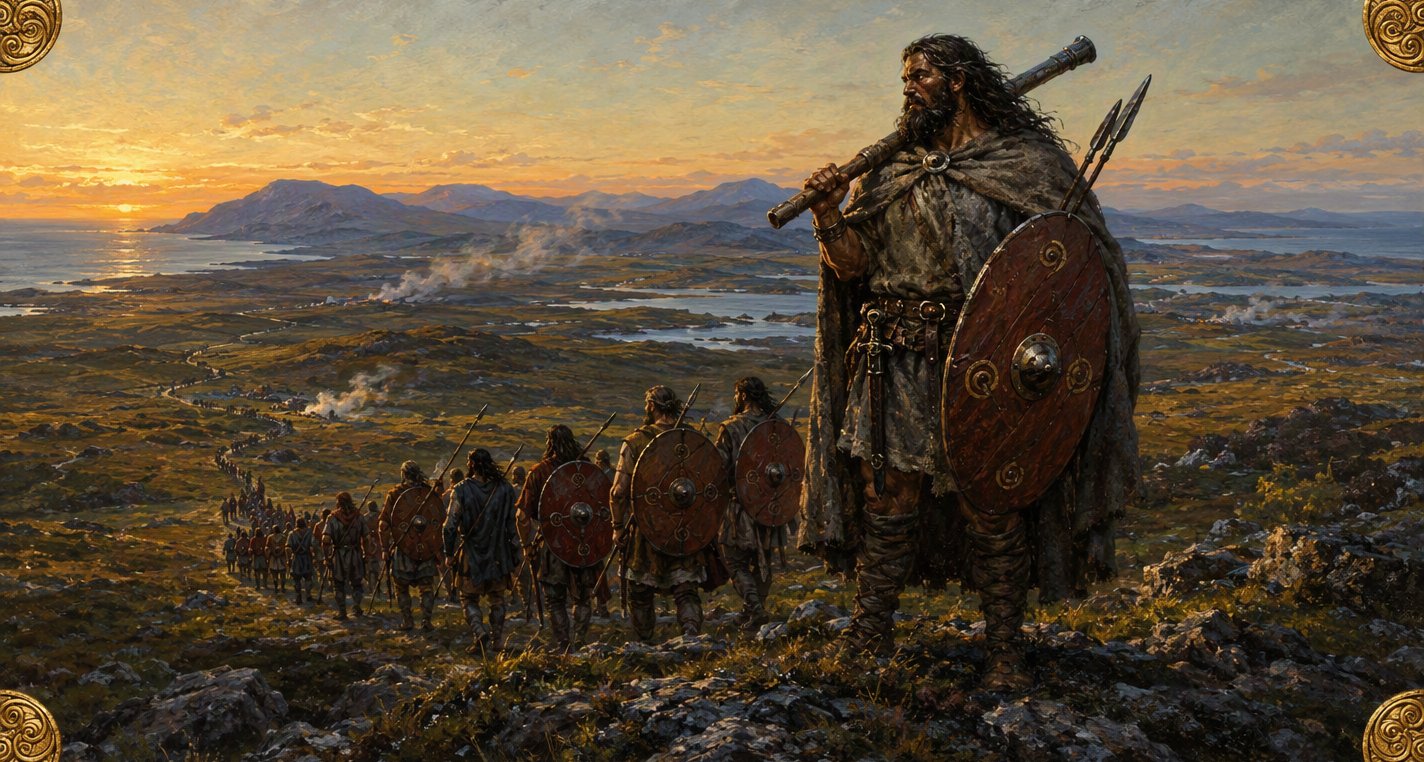
Sreng son of Sengann fought on for a day and a night after the rest, until neither host could strike the other any more. Their blows had grown feeble with the slaughter and their courage faint with all they had lost, and so they parted. The Tuatha Dé drew back to the fastness of Cenn Slébe, and the sloping Glen of Blood, and the Mound of Tears.
Sad and weary and wounded were the Fir Bolg that night. Sreng and his brothers, Semne and Sithbrug, called a council, and three hundred came to it. Should they leave Ireland, or give battle again, or share the land with the Tuatha Dé? They chose battle. They took up their strong hooked shields, their venomous spears and their sharp blue-bladed swords, and came on again, a wild and fiery company.
Then Sreng challenged Nuada to single combat, as they had fought before.
If it is a fair fight you want, said Nuada, tie up your right hand, as I have lost mine. Only so can our fight be fair.
If you have lost your hand, said Sreng, that lays no obligation on me. Our first fight was fair.
The Tuatha Dé took counsel. They offered Sreng his choice of the provinces of Ireland, if a compact of peace and goodwill and friendship were made between the two peoples. So they made peace, and Sreng chose the province of Connacht. The Fir Bolg gathered to him from every side, and took it, stubborn and triumphant, against the Tuatha Dé.
But the Tuatha Dé had a harder thing to settle among themselves.
IX The Hand of Silver
A hundred thousand of the Fir Bolg had fallen in that battle, the old book says, and their king Eochaid with them. Of the Tuatha Dé, Edleo son of Alla fell, and Ernmas, and Fiachra, and Turill Bicreo.
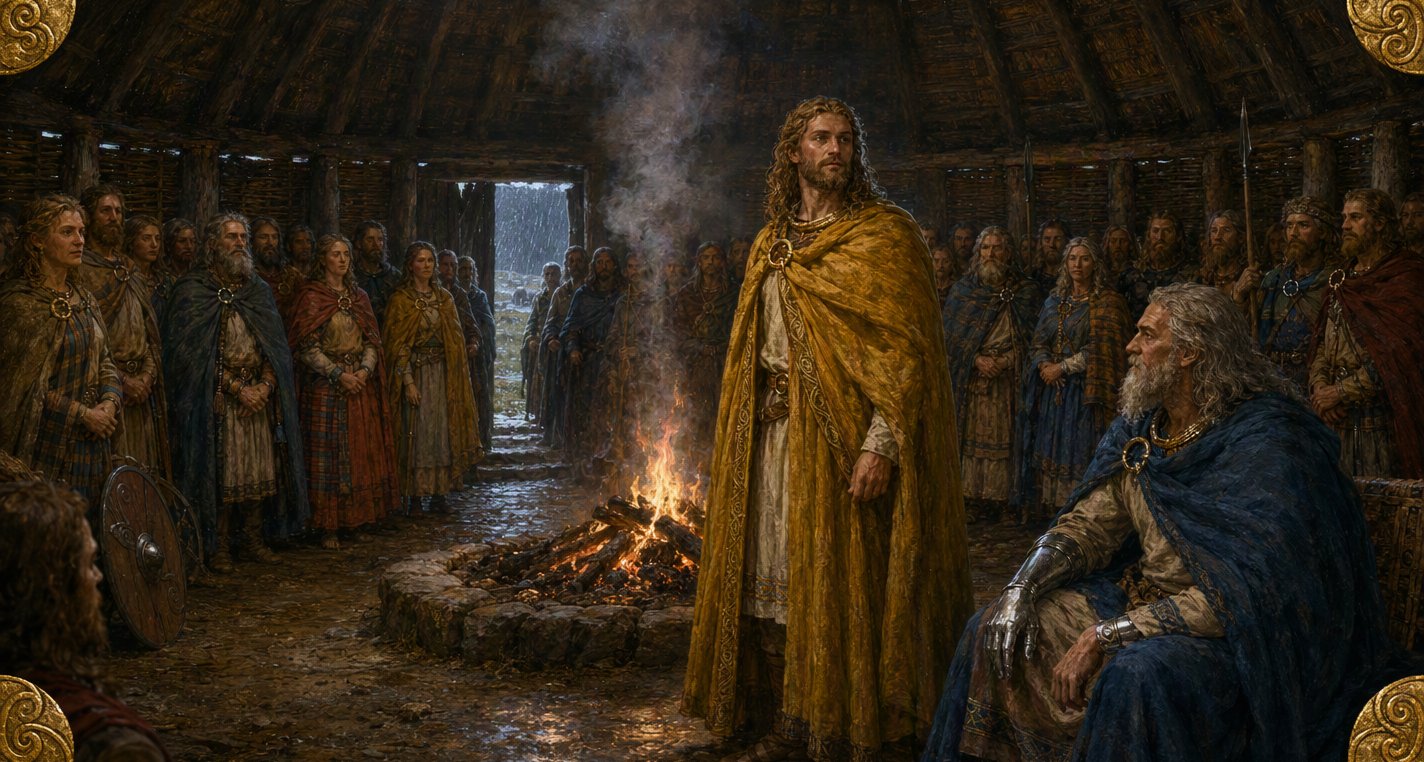
Dian Cécht the physician made Nuada a hand of silver that moved as any hand moves, and Credne the brazier helped him with it.
But a quarrel arose about the kingship of Ireland, between the Tuatha Dé and their women, for now that his hand had been struck off, Nuada was not fit to be king. 8 It would be better, they said, to give the kingship to Bres son of Elatha, their own adopted son.
His father Elatha was a king of the Fomorians, and there was an alliance already between the Tuatha Dé and the Fomorians: Balor, grandson of Nét, had given his daughter Ethne to Cian son of Dian Cécht, and she had borne the gifted child, Lugh. Make Bres king, they said, and the Fomorians will be bound to us.
So the kingship of Ireland was given to Bres. He gave seven hostages to the champions of Ireland, its chiefs, as a pledge that he would give the kingship back if ever his own misdeeds gave cause.
Nuada had a hand of silver now, and no kingdom. Bres had the kingdom, and the Fomorians had a king’s son for king of Ireland. What came of that is the tale of the second battle of Mag Tuired.
What the tale keeps
They burned their ships on the shore so that no one would think of going back, and the smoke lay so thick on the land that people said they had come in clouds of mist. They had come home. The Fir Bolg were their own kin. On a hillside Sreng and Bres found that they spoke one tongue, counted their fathers back to Nemed, changed spears and parted friends. Their peoples fought for the land all the same, and at the end of it a fifth of Ireland went to the man who would have given half at the start.
In Eochaid’s dream one of his own people struck the noblest of the black birds and cut off a wing. The winners lost their king’s arm, and with it their king.
Notes
- Keating’s verse gives Lugh both weapons, a sword from Gorias and a spear from Finias: “The sword of the hand of Lúgh the active(?), From Gorias ... From Finias far over the sea, Was brought the spear of Lúgh who was not weak” (Geoffrey Keating, The History of Ireland, tr. David Comyn, 1902). His four sages are Morias, Eurus, Arias and Semias. Stokes prints the first of the four as Mór-fesae. ↩
- Where they landed depends on the book. This tale says wide Tracht Mugha, in Ulster. Cath Maige Tuired has them burn their ships “on reaching the district of Corcu-Belgatan” (Whitley Stokes, The Second Battle of Moytura, 1891), which Stokes’s text explains as “Connemara today”: a name close to that of Sliabh Belgadain, the hill above this tale’s battlefield. Keating says only the north of Ireland. ↩
- “After that they put of mist of druidism around them for the space of three days, so that they were not manifest to any one of the Fir Bolg till they reached Sliabh-an-iarainn.” (Geoffrey Keating, The History of Ireland, tr. David Comyn, 1902; “put of mist” is as printed.) In Lebor Gabála Érenn, the Book of Invasions, they come in dark clouds, land on the mountains of Conmaicne Rein in Connacht, and bring a darkness over the sun for three days and three nights. ↩
- “One of us, methought, struck the noblest of the birds and cut off one of its wings.” (J. Fraser, The First Battle of Moytura, 1916) Neither Cath Maige Tuired nor Keating’s History has the dream. ↩
- “(However, he did not believe that it was thus they came).” (J. Fraser, The First Battle of Moytura, 1916) The translation prints this in brackets, straight after Bres’s words, and does not say whose doubt it is. Cath Maige Tuired explains the mist away as the smoke of the burning ships. ↩
- “And it was then that the plain got its name of Mag Tured, the Plain of Props.” (J. Fraser, The First Battle of Moytura, 1916) The tale ends: “And that is the story of the battle of Mag Tured Cunga”: Mag Tuired of Cong. The second battle was fought at another Mag Tuired, in Sligo. ↩
- Cath Maige Tuired says Nuada’s hand was struck off; this tale says his right arm, at the shoulder. It adds something stranger: “His hand was raised in the king’s stead on the fold of valour, a fold of stones surrounding the king, and on it the blood of Nuada’s hand trickled.” (J. Fraser, The First Battle of Moytura, 1916) ↩
- “For it was a law with the Tuatha de Danaan that no man that was not perfect in shape should be king.” (Lady Gregory, Gods and Fighting Men, 1904) Stokes’s Cath Maige Tuired (1891) says only that Nuada, “after his hand had been stricken off, was disqualified to be king”. ↩
Where the tale comes from
Medieval manuscript. Told from Cath Muige Tuired Cunga, the Irish prose tale of the First Battle of Mag Tuired, copied by Cormac Ó Cuirnín into a manuscript now in Trinity College Dublin, with the opening of the tale of the Second Battle and Geoffrey Keating’s History of Ireland (about 1634).
- This retelling follows Cath Muige Tuired Cunga, the tale of the First Battle of Mag Tuired, in J. Fraser’s edition and translation (Ériu 8, 1916), from a manuscript in Trinity College Dublin (H 2.17). Its scribe signs off at the end: “This was written in the Plain of Eithne, the Goblin’s daughter, by Cormac O’Cuirnin for his companion Sean O’Glaimhmn.”
- The four cities and their treasures, the burning of the ships, the silver hand and the choice of Bres come from the opening of Cath Maige Tuired, the tale of the Second Battle, in Whitley Stokes’s translation (1891) from the British Library manuscript Harleian 5280. There the Tuatha Dé learn “lore and science and diabolic arts”: the word of a Christian scribe, writing of the old gods.
- Geoffrey Keating, the priest who finished his History of Ireland about 1634, has the Tuatha Dé learn their magic in Greece and flee to Lochlann, where they obtain the four cities, and spend seven years at Dobhar and Iardobhar in the north of Alba. They land in the north of Ireland on a Monday at Bealtaine, burn their ships, hide in a druid’s mist for three days, and send to Eochaid mac Eirc for the kingdom of Ireland or a battle.
- Lebor Gabála Érenn, the Book of Invasions, which an unknown scholar seems to have brought together late in the eleventh century, has them come in dark clouds and land on the mountains of Conmaicne Rein in Connacht, taken to be Sliabh an Iarainn, bringing a darkness over the sun for three days and three nights. Lady Gregory’s Gods and Fighting Men (1904) brings them “through the air and the high air” in a mist, and the Firbolgs see “nothing but a mist, and it lying on the hills”.
- The books disagree about the Fir Bolg after the battle. In Cath Maige Tuired those who escaped fled to the Fomorians and settled in Arran, Islay, Man and Rathlin. Keating sends the survivors to Ára, Ilé, Reachra, Inse Gall and many other islands, and says they held forts and islands in Ireland too, until Cú Chulainn, Conall Cernach and the Ulstermen drove them out. In the First Battle, Sreng takes Connacht.
- The First Battle tangles its Breses. Bres son of Elatha meets Sreng, and in the last battle he is killed by Eochaid; the same list of the Tuatha Dé names another, “Bres, grandson of Net, the Fomorian”; and at the end “The Tuatha De made Bres their king, and he was High-king for seven years”, until he died “after taking a drink while hunting in Sliab Gam”, and Nuada, his hand replaced, was king again. This retelling follows Cath Maige Tuired, where the new king is Bres son of Elatha, and leaves his reign to the tale of the second battle.
Sources
- Cath Muige Tuired Cunga: The First Battle of Moytura · ed. and tr. J. Fraser, Ériu 8 (1916), pp. 1–63, as reprinted in Mary Jones's Celtic Literature Collective
- "The Second Battle of Moytura", Revue Celtique 12 (1891) · Whitley Stokes
- Foras Feasa ar Éirinn: The History of Ireland · Geoffrey Keating, ed. and tr. David Comyn and Patrick S. Dinneen (Irish Texts Society, 4 vols, London, 1902–1914)
- Gods and Fighting Men, Part I, Book I, "The Coming of the Tuatha de Danaan", chapter I: "The Fight with the Firbolgs" · Lady Gregory (London, 1904)
- Lebor Gabála Érenn · Wikipedia
- Cath Maige Tuired · Wikipedia
- Cong, County Mayo · Wikipedia
- Sliabh an Iarainn · Wikipedia