
The Mythological Cycle
The Second Battle of Mag Tuired
Cath Maige Tuired
A beautiful king who gives nothing, a stranger with every art, an eye no army can face, and a harp that plays sorrow, laughter and sleep.
I The Beautiful King
When the Tuatha Dé Danann won Ireland from the Fir Bolg at Mag Tuired, their king Nuada lost his hand in the battle, and with it the kingship. They gave it to Bres, their own adopted son.
His father was Elatha son of Delbáeth, king of the Fomorians. One day Ériu, daughter of Delbáeth, was looking out over a sea as calm as a level board. 1 A boat of silver came in on the wave, and in it was a man with golden-yellow hair to his shoulders and five circlets of gold about his neck. They lay together, and when he rose to go, she wept. He gave her a gold ring from his finger, and told her his name, and that she would bear his son. No name was to be given the boy but Eochaid Bres, Eochaid the beautiful, for every beautiful thing seen in Ireland would be compared to him. Then he went back the way he had come.
When Bres was king, three kings of the Fomorians, Indech, Elatha and Tethra, laid their tribute on Ireland, until not a smoke rose from a roof in the country that did not pay it. The champions of the Tuatha Dé were put to the king’s service. Ogma had to carry firewood. The Dagda built Bres’s fort and dug the ditch round it, and he grew weary at the work.
And all the while Nuada lay sick, with a hand of silver that Dian Cécht the physician had made him.
II Joint to Joint
Dian Cécht’s son Miach did not like that hand of silver. He went to the king’s own hand, the one that had been struck off, and he said over it: joint to joint, and sinew to sinew. In three times three days and nights he healed the king. For the first three days he held the hand against Nuada’s side, and skin grew over it. For the next three he held it to his breast. And Nuada had his own hand again.
His father liked that cure even less. Dian Cécht struck his son on the crown of the head with a sword and cut through the skin to the flesh, and the young man healed the wound by his art. He struck again and cut to the bone, and Miach healed that. He struck a third time, to the membrane of the brain, and Miach healed that too. The fourth blow cut out the brain, and Miach died. Not even the physician himself could heal him of that blow, said Dian Cécht.
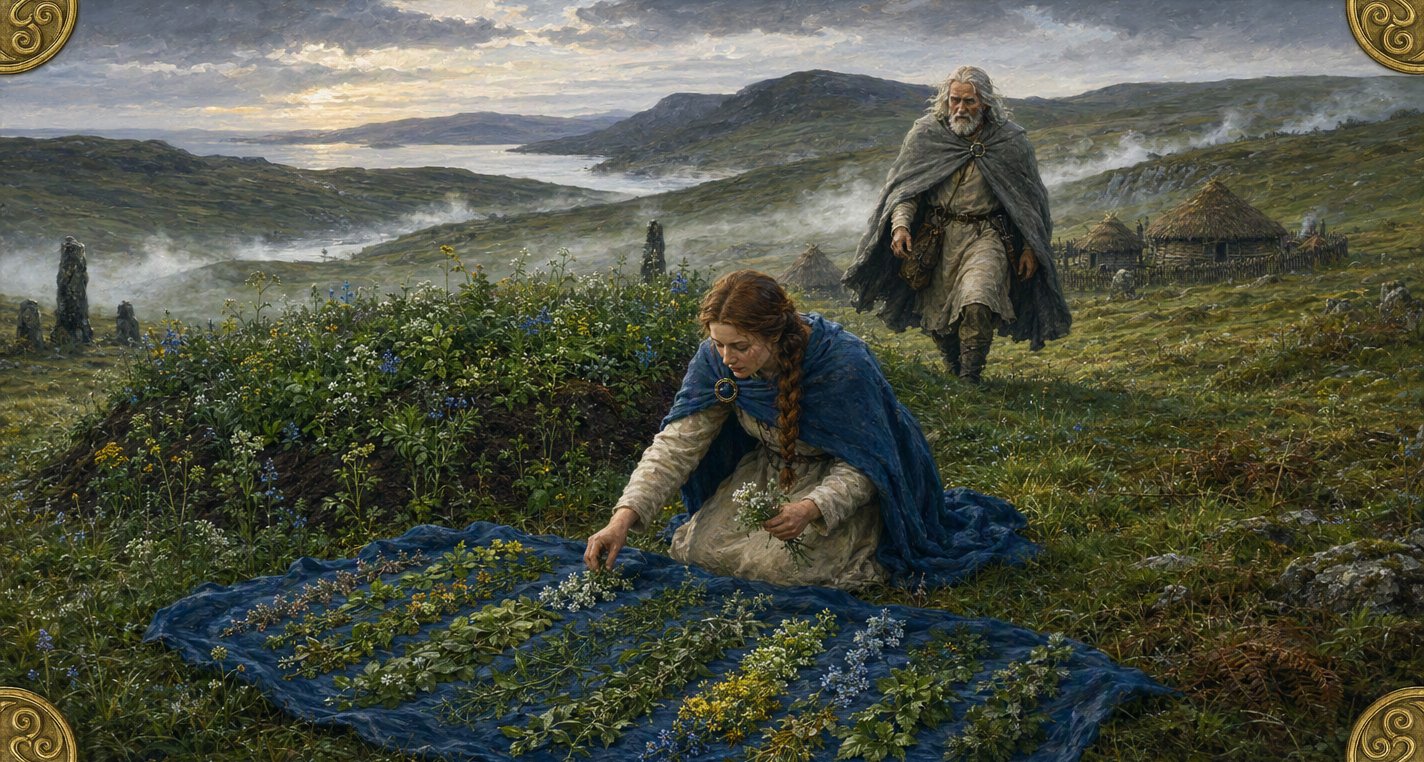
He buried his son, and up through the grave grew three hundred and sixty-five herbs, as many as the joints and sinews in Miach’s body. Airmed, his sister, opened out her cloak and sorted the herbs on it, each by its virtue. But Dian Cécht came and mixed them all together, so that no one knows their right cures now. 2
III Three Dry Cakes
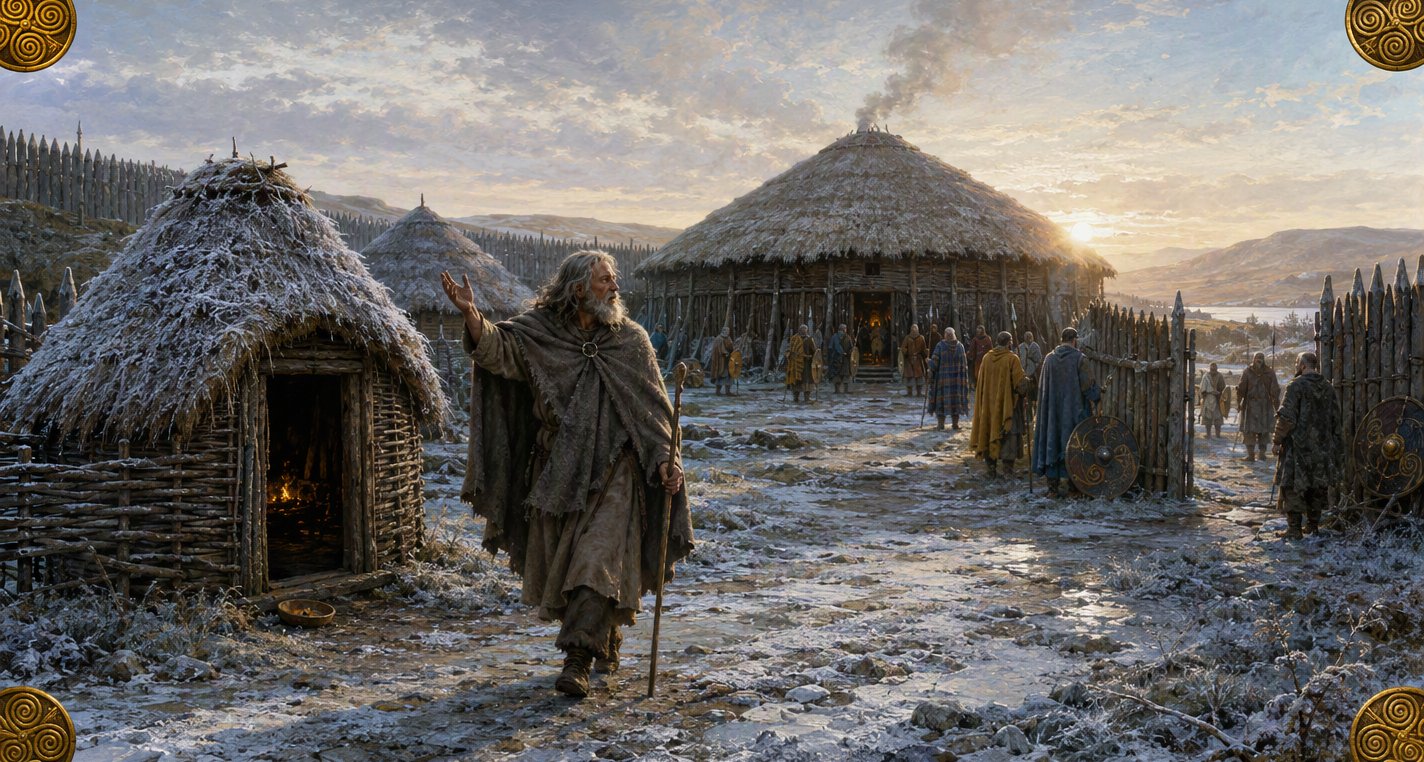
Nuada was whole, but Bres still held the kingship, and the chiefs of the Tuatha Dé muttered against him. Their knives were never greased at his table, and however often they visited him, their breath never smelt of ale. They saw no poets in his house, no harpers or pipers, no jugglers or fools. The one champion who showed his prowess there was Ogma, bringing in the fuel. Every day he carried a bundle of firewood from the islands of Clew Bay, and he was so weak from hunger that the sea swept two thirds of it away, and with the third that was left he had to supply the household.
Then Coirpre son of Étaín, the poet of the Tuatha Dé, came to Bres’s house as a guest. He was put in a narrow, black, dark hut with no fire, no furniture and no bed, and brought three small cakes on a little dish, and they were dry. In the morning he rose without a word of thanks, and as he crossed the yard he said:
Without food quickly on a dish:
without a cow’s milk whereon a calf grows:
without a man’s abode under the (gloom) of night:
without paying a company of story-tellers, let that be Bres’ condition. 3
It came true. From that hour there was nothing on Bres but decay. That was the first satire made in Ireland.
The Tuatha Dé demanded their sureties, and he gave back the kingship, but begged leave to stay until the end of seven years, and they let him: he wanted the time to gather the Fomorians. His mother gave him the gold ring his father had left with her, and it fitted his finger, and in the country of the Fomorians his father knew him by it.
Nothing has brought me here, Bres told him, but my own injustice and arrogance. I stripped them of their treasures and their very food.
Better their prosperity than their kingship, said Elatha. Better their prayers than their curses.
Bres asked him for champions, to take Ireland by force. You should not win by injustice, said his father, what you cannot win by justice. But he sent him on to Balor, king of the Isles, and to Indech, king of the Fomorians, and they gathered every fighting man from Lochlann westwards, and made one bridge of ships from the islands of the Foreigners to Ireland.

IV The Door of Tara
With Bres gone, Nuada was king again, and he held a great feast at Tara. A young warrior was on his way there, and his name was Samildánach.
One of the two doorkeepers saw a strange company coming. At its head was a young man, fair and well made, in the gear of a king.
Who is there? said the doorkeeper.
Here is Lugh, son of Cian son of Dian Cécht, and of Ethne, daughter of Balor.
What art do you practise? said the doorkeeper. No one without an art comes into Tara.
Question me, said Lugh. I am a wright.
We need you not. We have a wright already, Luchta.
Question me, doorkeeper. I am a smith.
We have a smith already.
I am a champion, said Lugh. They had a champion: Ogma. He was a harper; they had a harper. He was a hero; they had a hero. He was a poet, and a historian; they had those. He was a sorcerer; they had sorcerers in plenty, and folk of power. He was a physician; they had Dian Cécht. A cupbearer; they had nine. A good brazier; they had Credne.
Then ask the king, said Lugh, whether he has one man with all these arts. If he has, I will not come into Tara.
The doorkeeper went in to the king. There is a warrior at the gate, he said, called Samildánach, and every art your household has, he has alone. He is the man of every art.
The king had the fidchell boards of Tara brought out to Lugh, and Lugh won every stake on them. 4 Let him in, said Nuada. There was never a man like him in this fortress.
So Lugh came in and sat in the seat of the sage, for he was a sage in every art. Ogma tried him: he hurled through the house a flagstone that it took eighty yoke of oxen to move, so that it lay outside Tara. Lugh threw it back into the middle of the hall, and put back the piece of wall it had carried away, and the house was whole.
Nuada saw his many powers, and wondered whether this was the man to free them from the Fomorians. He gave Lugh his own seat, and for thirteen days the king stood before him. Then Lugh took secret counsel with the Dagda and Ogma, and with the wizards, leeches, charioteers, smiths, farmers and judges of Ireland, and for seven years they made ready for the war.
V The Dagda’s Porridge
About the Samhain of the battle, the Dagda was to meet a woman at Glenn Etin in the north. He found her washing in the river Unshin, one foot to the south of the water and the other to the north, with nine loosened tresses on her head. They talked, and they lay together, and the place has been called the Bed of the Couple ever since. The woman was the Morrígan. She told the Dagda where the Fomorians would land, and she promised to go against Indech, their king, and take from him the blood of his heart and the kidneys of his valour.
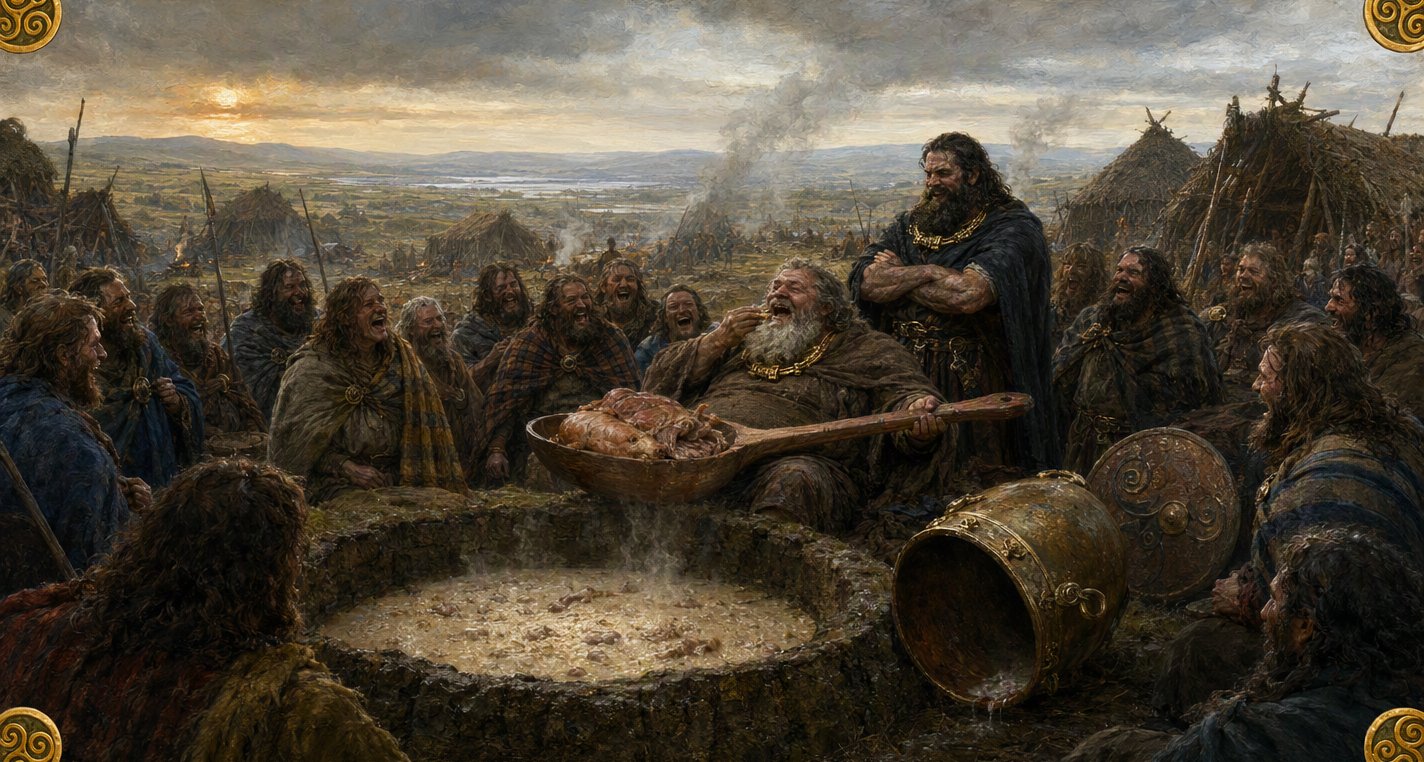
Then Lugh sent the Dagda to spy on the Fomorians and hold them back until the men of Ireland came to the battle. The Dagda went into their camp and asked for a truce, and they gave it. And because he loved porridge, they made him porridge, to mock him. They filled the king’s cauldron, five fists deep, with eighty gallons of new milk and as much meal and fat, boiled goats and sheep and pigs in it, and poured it all out for him into a hole in the ground. Eat it all, said Indech, or you will be put to death. We would not have you say the Fomorians were not hospitable.
The Dagda took up his ladle. It was big enough for a man and a woman to lie in, and what went into it were halves of salted pigs and a quarter of lard. Good food, said the Dagda, if the broth is as good as the taste. At the end he ran his bent finger round the bottom of the hole, through the earth and the gravel, and then sleep came over him. His belly was bigger than a house-cauldron, and the Fomorians laughed at it.
He went away from them slowly, for the size of his belly, in a cape to his elbows and a dun tunic to the swell of his backside. Behind him he trailed a great fork on wheels that it took eight men to carry, and its track was enough for the boundary ditch of a province. They call it the Track of the Dagda’s Club.

VI The Well of Sláine
Every day now the Fomorians and the Tuatha Dé fought, though not yet the kings and princes, and the Fomorians wondered at one thing. Their own spears and swords were blunted and broken, and their dead did not come back the next day. But the broken weapons of the Tuatha Dé were new again in the morning, for Goibniu the smith was at his forge, making each weapon in three turns, while Luchta the wright made the shafts in three chippings and Credne the brazier the rivets in three turns. And their dead came back the next day swifter than before, for Dian Cécht and his children were singing spells over the well of Sláine. The dying were cast into it as they fell, and they came out alive. 5
So the Fomorians sent Ruadán to spy on them. He was the son of Bres and of Bríg, the Dagda’s daughter: a son and a grandson of the Tuatha Dé. He told the Fomorians what he had seen, and they sent him back to kill Goibniu. He asked the smith for a spear, the brazier for its rivets and the wright for its shaft, and they gave him all he asked. Then he turned and wounded Goibniu with it. Goibniu pulled the spear out and threw it, and it went through Ruadán, and he died in front of his father in the assembly of the Fomorians.
Bríg came and keened her son. She shrieked at first, and at the last she cried, and that was the first time crying and shrieking were heard in Ireland.
But Goibniu went into the well and came out whole. So Octriallach, Indech’s son, told every man of the Fomorians to bring a stone from the river Drowes and cast it into the well of Sláine, and they did, until the well was buried under a cairn. They call it Octriallach’s Cairn.

VII Balor’s Eye
On the day of the great battle the Fomorians marched out of their camp in battalions that nothing could break. To attack them that day was to strike your head against a cliff, to put your hand in a nest of snakes, to hold your face up to the fire.
The men of Ireland had resolved to keep Lugh out of the battle, for fear of an early death for a man of so many arts, and they left his nine fosterers to guard him. But when the fighting began he broke away from them and came to the front of the host. Better to die defending your own country, he told them, than to live on under bondage and tribute. And he went round the men of Ireland on one foot, with one eye shut, chanting.
The hosts gave a great shout and came together, and many fine men fell. The shouting and the clash of shields and the whistling of swords were like thunder, and the river Unshin ran full of the dead.
Nuada of the Silver Hand fell by Balor, and Macha, daughter of Ernmas, with him. Then Lugh met Balor, his mother’s father.
Balor had an evil eye. It was never opened except on a field of battle, and it took four men to lift its lid, by a polished handle passed through it. Any army that looked into that eye, however many thousands strong, could not stand against a handful. It had got its poison when his father’s druids were brewing charms: Balor looked in over the window, and the fumes of the brew came up under his eye.
Lift up my eyelid, lad, said Balor, so that I can see this chatterer who is talking to me.
They lifted the lid. Lugh let fly a sling-stone, and it carried the eye out through the back of Balor’s head, so that it was his own host that looked on it. It fell among the Fomorians, and thrice nine of them died beside it.

VIII The Price of Bres
Then the Morrígan came and put heart into the Tuatha Dé, and the battle became a rout, and the Fomorians were beaten back to the sea. Indech, their king, fell there in single combat with Ogma. 6
Afterwards Lugh asked Loch Half-green, Indech’s poet, how many were dead. The lords and champions of the Fomorians he could count. But the common people and the rabble would never be numbered, he said, until the stars of the sky were numbered, and the sand of the sea, the dew on the grass, the hailstones, and the horses of the son of Ler in a storm at sea.
Then they found Bres son of Elatha, with no one guarding him.
Better to spare me than to kill me, said Bres.
What would come of that? said Lugh.
If I am spared, the cows of Ireland will always be in milk.
Lugh put it to his wise men. He has no power over their age or their calving, said Maeltne the judge, though he can milk them while they live. That does not save you, Lugh told Bres.
Is there anything else that will save you, Bres?
There is. Tell your judge that if I am spared, the men of Ireland will reap a harvest in every quarter of the year.
The year suits us as it is, said Maeltne: spring for ploughing and sowing, the start of summer for the corn to grow strong, the start of autumn for it to ripen and be reaped, and winter for eating it.
That does not save you, said Lugh. But less than that will.
What? said Bres.
How shall the men of Ireland plough? How shall they sow? How shall they reap? Tell us that, and you are spared.
Tell them, said Bres, to plough on a Tuesday, to sow on a Tuesday, and to reap on a Tuesday.
And by that trick, Bres went free.
IX The Harp on the Wall
The Fomorians had carried off the Dagda’s harper, whose name was Uaithne. So Lugh and the Dagda and Ogma went after them, and they came to the feasting-hall where Bres son of Elatha sat, and Elatha son of Delbáeth, and there on the wall hung the harp.
It was the Dagda’s own harp. He had bound the music into it, so that not a note would sound until he called it out, and it had two names: Oak of Two Greens, and Four-angled Music. The Dagda called it by them:
Come Daurdabla!
Come Coir-cethar-chuir!
Come summer, Come winter!
Mouths of harps and bags and pipes! 7
The harp came down off the wall, and killed nine men, and came to the Dagda.
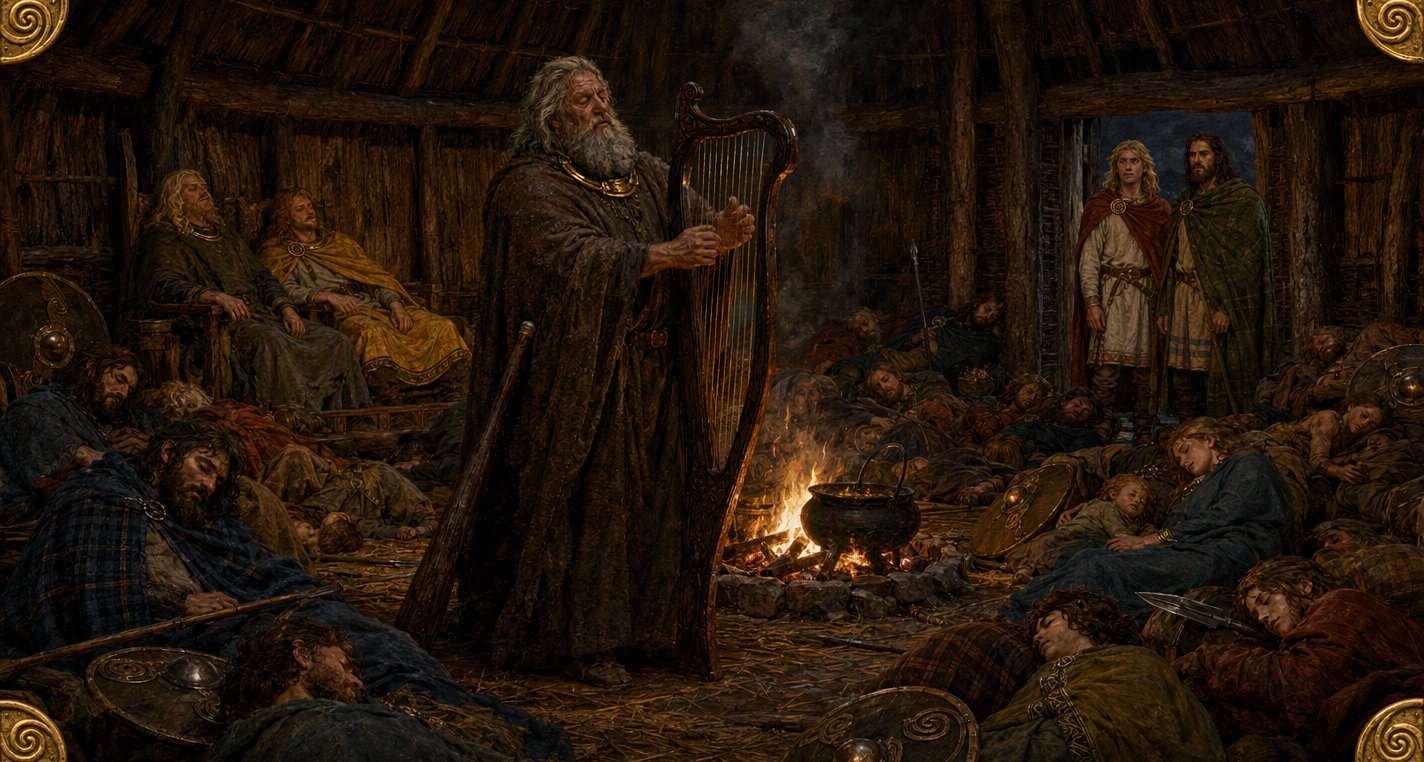
Then he played them the three strains that the harper’s art is known by. He played the goltraí, the strain of sorrow, and their women wept. He played the geantraí, the strain of laughter, and their women and children laughed. He played the suantraí, the strain of sleep, and the whole host fell asleep. And the three of them went out through the sleepers unhurt, though the Fomorians would gladly have killed them.
When the battle was won and the dead were cleared away, the Morrígan went out to proclaim the victory: to the royal heights of Ireland and its hosts of the sídhe, to its great waters and the mouths of its rivers. Have you any tale? everyone asked her. And she said:
Peace up to heaven,
Heaven down to earth,
Earth under heaven,
Strength in everyone 8
Then she looked on to the end of the world. She would not see a world that was dear to her, she said: summer without flowers, cows without milk, women without modesty, men without valour, false judgements from old men and false law from judges, every man a traitor and every boy a thief; an evil time, when son would deceive father and daughter deceive mother.
What the tale keeps
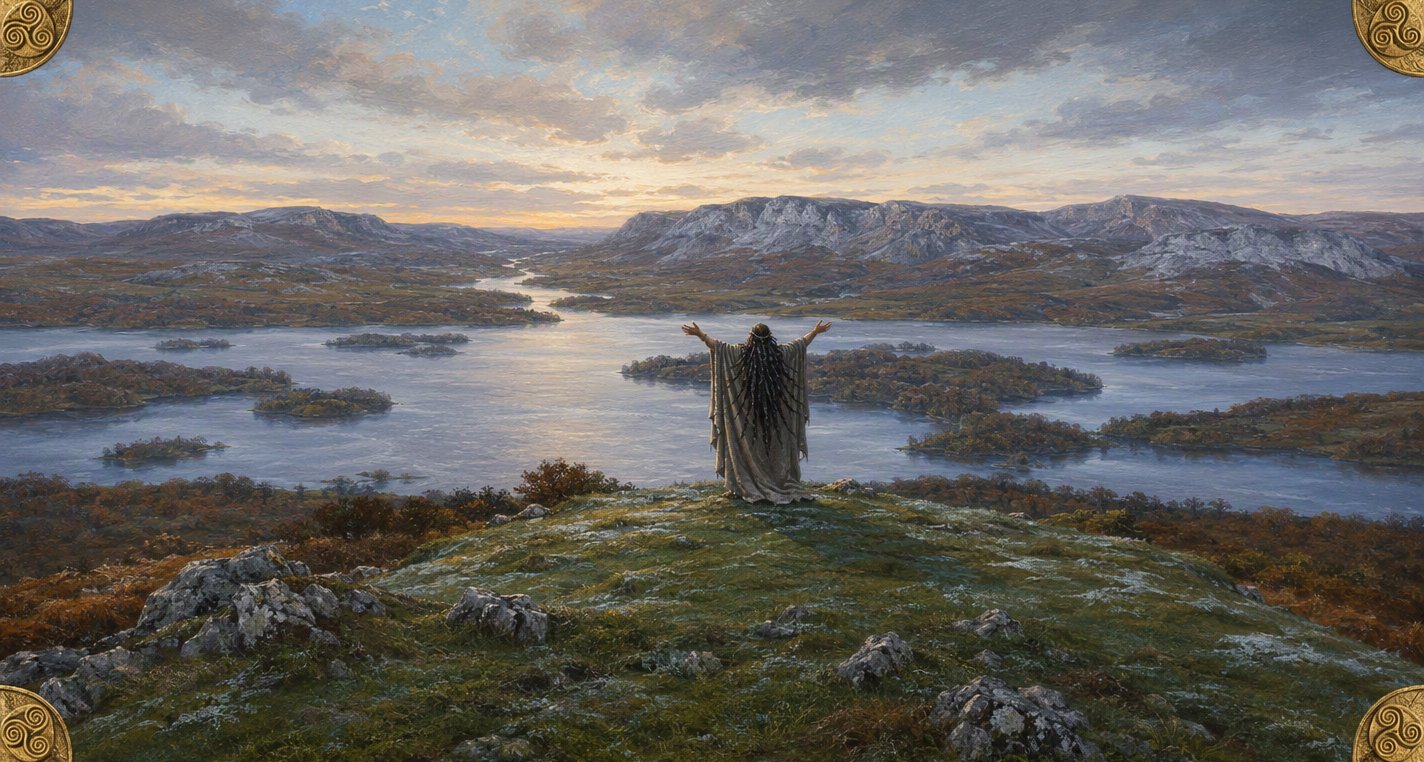
A war of the gods, and at the end of it, a harp. It hung on an enemy’s wall and would sound for no one else, and when its master called it by its names, it came to him across the hall. Then he played the whole of what music can do.
The tale holds all three strains. Bríg’s shriek over her son, the first keening in Ireland. A god scraping porridge from a hole in the ground while his enemies laugh at his belly. A hall full of enemies, asleep. And when the war was over, the Morrígan cried peace to the land itself, to its heights and waters and the mouths of its rivers, and then foretold a summer without flowers. The old book keeps both her songs, as the harp keeps sorrow, laughter and sleep.
Notes
- Stokes’s translation calls her “Eri, Delbaeth’s daughter, a woman of the Tuath Dé” (Whitley Stokes, The Second Battle of Moytura, 1891). It does not say whether she is the Ériu of the Book of Invasions, whose name Ireland bears. ↩
- “Herbs three hundred and sixty five, according to the number of his joints and sinews, grew through the grave.” No one knows their proper cures, the text goes on, “unless the [Holy] Spirit should teach them afterwards” (Whitley Stokes, The Second Battle of Moytura, 1891). The word in brackets is Stokes’s. A Christian hope stands in the middle of a tale of the old gods. ↩
- Coirpre’s satire as Whitley Stokes translated it (The Second Battle of Moytura, 1891); the bracketed word is his. Stokes spells the poet Corpre. “That is the first satire that was made in Ireland,” the text says. ↩
- Stokes translates fidchell as chess. Here the text stops for a remark that chess “had not reached Ireland then, for the battle of Moytura and the destruction of Troy occurred at the same time”: “obviously a scribe’s note,” says Stokes (Whitley Stokes, The Second Battle of Moytura, 1891). ↩
- The text names the singers at the well as “Dian-cecht and his two sons, even Octriuil and Miach, and his daughter Airmed” (Whitley Stokes, The Second Battle of Moytura, 1891), though it has already told how Miach died. The well, it adds, was also called Loch Luibe, for Dian Cécht used to put into it one of every herb that grew in Ireland. ↩
- The text says that “the champion Ogma son of Elathu, and Indech son of Dé Domnann, the king of the Fomorians, fell in single combat” (Whitley Stokes, The Second Battle of Moytura, 1891). Yet soon after, Ogma finds Orna, the sword of Tethra, and goes with Lugh and the Dagda after the Fomorians who had carried off the Dagda’s harper, so this telling lets him live. Elsewhere Stokes’s English calls him son of Ethliu, and son of Etáin. ↩
- The Dagda’s call, and the harp’s two names, “Dur-da-bla, ‘Oak of two (greens)’ and Coir-cetharchuir, ‘Four-angled music’”, as Whitley Stokes translated them (The Second Battle of Moytura, 1891); the Codex writes them Daur Dá Bláo and Cóir Cethairchuir. On his first night at Tara, Lugh too had played the three strains on a harp: a sleep-strain, and the hosts slept until the same hour next day; then a wail-strain, and they wept; then a smile-strain, and they were merry. ↩
- “Peace up to heaven, / Heaven down to earth, / Earth under heaven, / Strength in everyone, etc.” Stokes’s English of the poem stops there. Her second song begins: “I shall not see a world that will be dear to me. / Summer without flowers, / Kine will be without milk, / Women without modesty, / Men without valour.” (Whitley Stokes, The Second Battle of Moytura, 1891) ↩
Where the tale comes from
Medieval manuscript. Irish prose and verse, surviving in one sixteenth-century manuscript, British Library Harleian 5280. It is thought to have been put together in the eleventh or twelfth century from older material.
- The tale survives in a single manuscript, British Library Harleian 5280, written in the sixteenth century; the text is thought to have been put together in the eleventh or twelfth century, mainly from ninth-century material. Whitley Stokes edited the Irish with an English translation in Revue Celtique 12 (1891), and this retelling follows his translation.
- Stokes’s English has gaps where the manuscript is obscure, and he left some of the verse in Irish, among it the chant Lugh sang as he went round the host. Where the text has Lugh and Balor speak before the sling-stone, he wrote only: “Here is omitted an unintelligible dialogue between Lugh and Balor.”
- Like nearly all early Irish writing, it was written down and copied by Christian scholars, and their faith shows: a note setting the battle beside the fall of Troy, which Stokes calls “a scribe’s note inserted in the text by the copyist”, and a hope that the Holy Spirit might one day teach the cures of Miach’s herbs. Stokes adds that the Annals of the Four Masters date the battle to the year of the world 3330.
- The Fate of the Children of Tuireann tells the coming of Lugh another way. He rides up to a gathering on the Hill of Uisneach with the host of the Land of Promise, and the Fomorians come against him under Bres son of Balor.
- Lady Gregory retold the war in Gods and Fighting Men (1904). In her telling the Fomorians carry off the harp itself, “that was called Uaitne”; Lugh puts out Balor’s eye with “a cast of his red spear”; and the Dagda plays “the crying tune”, “the laughing tune” and “the sleepy tune”. She sets the second Magh Tuireadh “to the north, near Ess Dara”.
- Tradition places this battle at Moytirra, on the high ground east of Lough Arrow in Sligo. The first battle of Mag Tuired, against the Fir Bolg, is set at another plain of the same name, by Cong in Mayo.
Sources
- "The Second Battle of Moytura", Revue Celtique 12 (1891) · Whitley Stokes
- Gods and Fighting Men: "The Great Battle of Magh Tuireadh" · Lady Gregory (1904)
- Placenames Database of Ireland · logainm.ie
- Cath Maige Tuired · Wikipedia
- Cath Maige Tuired: manuscripts and editions · CODECS: Online Database and e-Resources for Celtic Studies
- Moytirra East Court Tomb · Wikipedia
- Lough Arrow · Wikipedia
- Heapstown Cairn · Wikipedia
- Balor · Wikipedia