The Mythological Cycle
The Song of Amairgen
Lebor Gabála Érenn
A poet sets his right foot on Ireland and sings that he is the wind on the sea. Three queens of the old gods meet him, and each asks for the island’s name.
I The Tower of Bregon
Far away to the south, in Galicia in Spain, Bregon built a tower.
On a winter’s evening, when the air is clearest and the eye reaches farthest, his son Íth stood on the top of that tower and looked out over the sea. Far off, where he had never noticed land before, he saw a coast. 1
He took thrice thirty fighting men and sailed to it, and he came ashore in the south-west of Ireland, at the mouth of the Scéne.
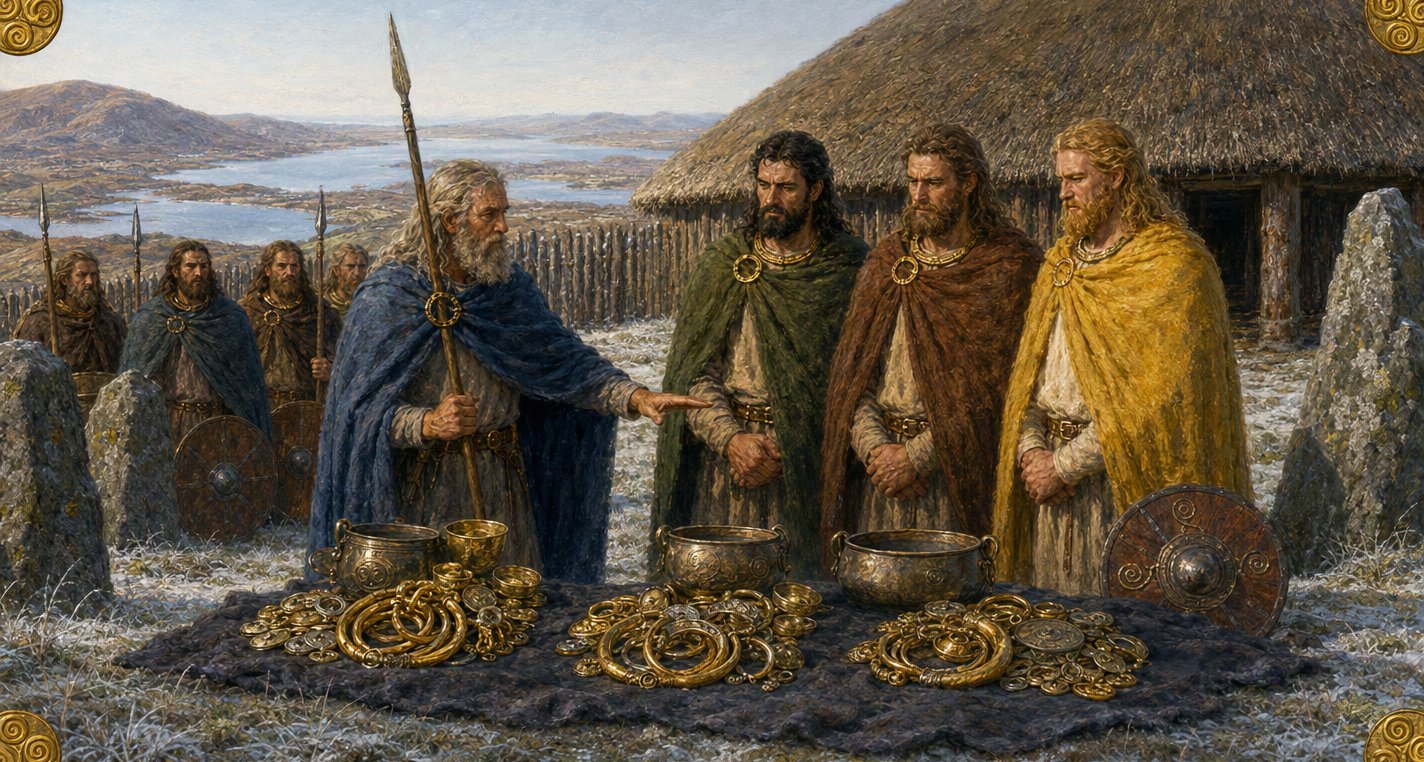
Ireland in those days belonged to the Tuatha Dé Danann. Three brothers were kings over it, the sons of Cermait, grandsons of the Dagda, and they held the kingship by turns, a year each. Íth found them in the north, at Ailech, quarrelling over the treasures their forefathers had left them.
They asked the stranger to settle it between them. Act justly, he told them, and share it in three equal parts. Then he said more than was wise. This is a good island you have, he said. There is honey in it, and fruit, and fish, and milk, and corn, and the weather is neither too hot nor too cold.
The kings heard that. A man who praised a land like that, they thought, would be back for it with an army. So when Íth set out for his ship, they sent thrice fifty men after him, and on a plain in the north they caught up with him. Íth fell there, and the plain is called after him, Mag Itha, Íth’s Plain. His men carried him to the ship, and he died out on the sea among them.
They brought him home to Spain. But before they buried him, they laid his body in front of the sons of Míl, his kinsmen, and let them look at it.

II The Hog’s Back
The sons of Míl went to Ireland, to avenge Íth and to take the island from the Tuatha Dé.
Thirty ships sailed out of Spain, with thirty fighting men in each besides the women and the rest of the people, and forty chiefs over them all. Eight of the chiefs were sons of Míl: Donn, who was the eldest, and Airech, Éber, Ír, Colpa, Arannan, Érimón, and Amairgen, who was their poet, their druid and their judge.
They came first to Inber Sláine, on the coast of Leinster. But the Tuatha Dé had seen them coming. By draíocht they spread a mist over the water, and when the sons of Míl looked for the land, all they could see in front of them was the back of a hog. That is why one of the old names of Ireland is Muicinis, Pig Island. 2
There was no landing on that. So they turned away and went on along the coast, south and then west, until Amairgen by his art found the very place where Íth had come ashore before them: the mouth of the Scéne.
It was a Thursday, the first day of May, the feast of Bealtaine, and the seventeenth day of the moon, when the sons of Míl came into Ireland.
III The Right Foot
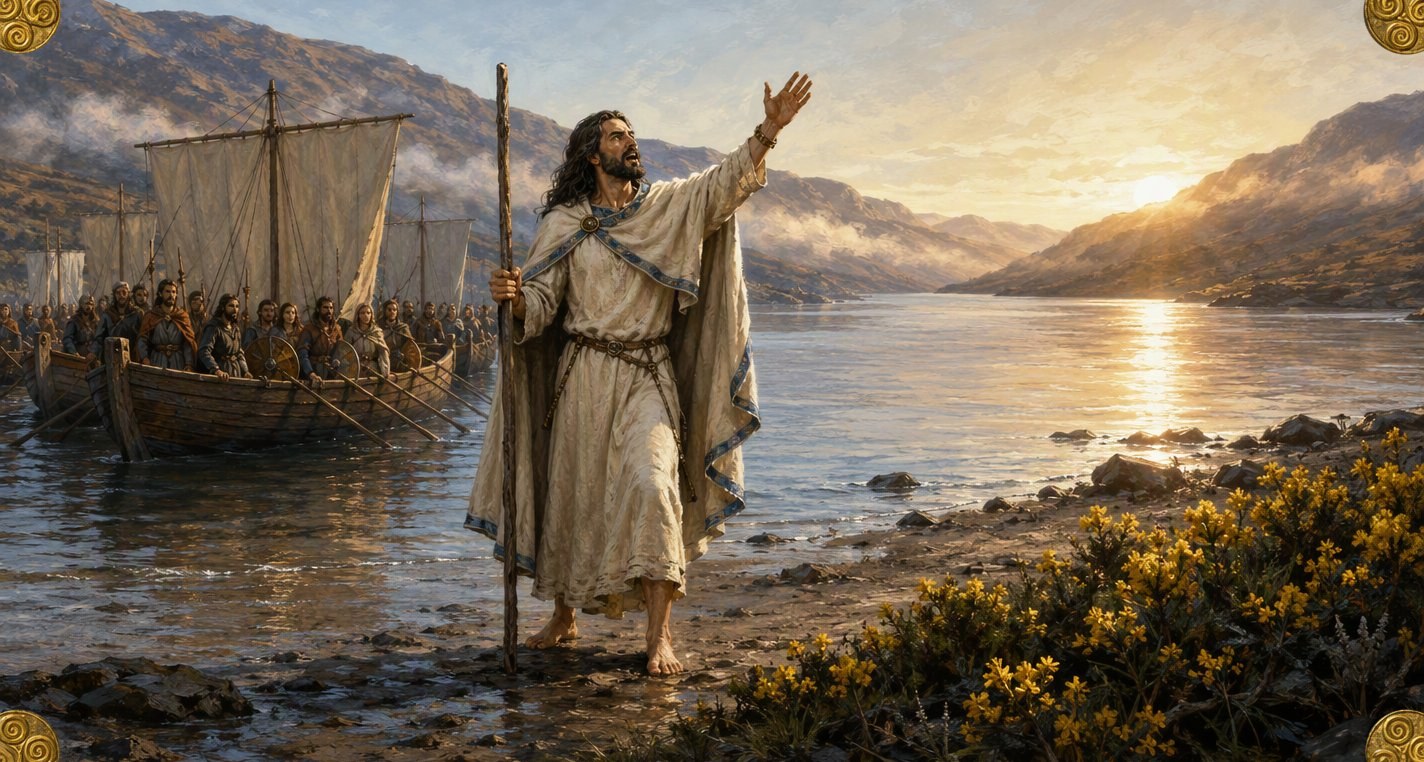
Amairgen was the first of them to land. He set his right foot on the strand of Inber Scéne, and stood on the shore of Ireland, and sang.
I am the wind which breathes upon the sea,
I am the wave of the ocean,
I am the murmur of the billows,
I am the ox of the seven combats,
I am the vulture upon the rock, 3
He was a ray of the sun, he sang, and the fairest of plants, and a wild boar for valour. He was a salmon in the water, and a lake on the plain. He was the craft of the craftsman, and a word of knowledge, and the spear-point that gives battle. He was the god who kindles the fire of thought in a man’s head.
Who but he, he asked, lights up the gathering on the mountain? Who but he can tell the ages of the moon? Who but he knows the place where the sun goes down to rest?
Then the host came ashore behind him, and they went up into the country to look for the kings of Ireland. On the first mountain they came to, a queen was waiting for them.
IV Banba and Fódla
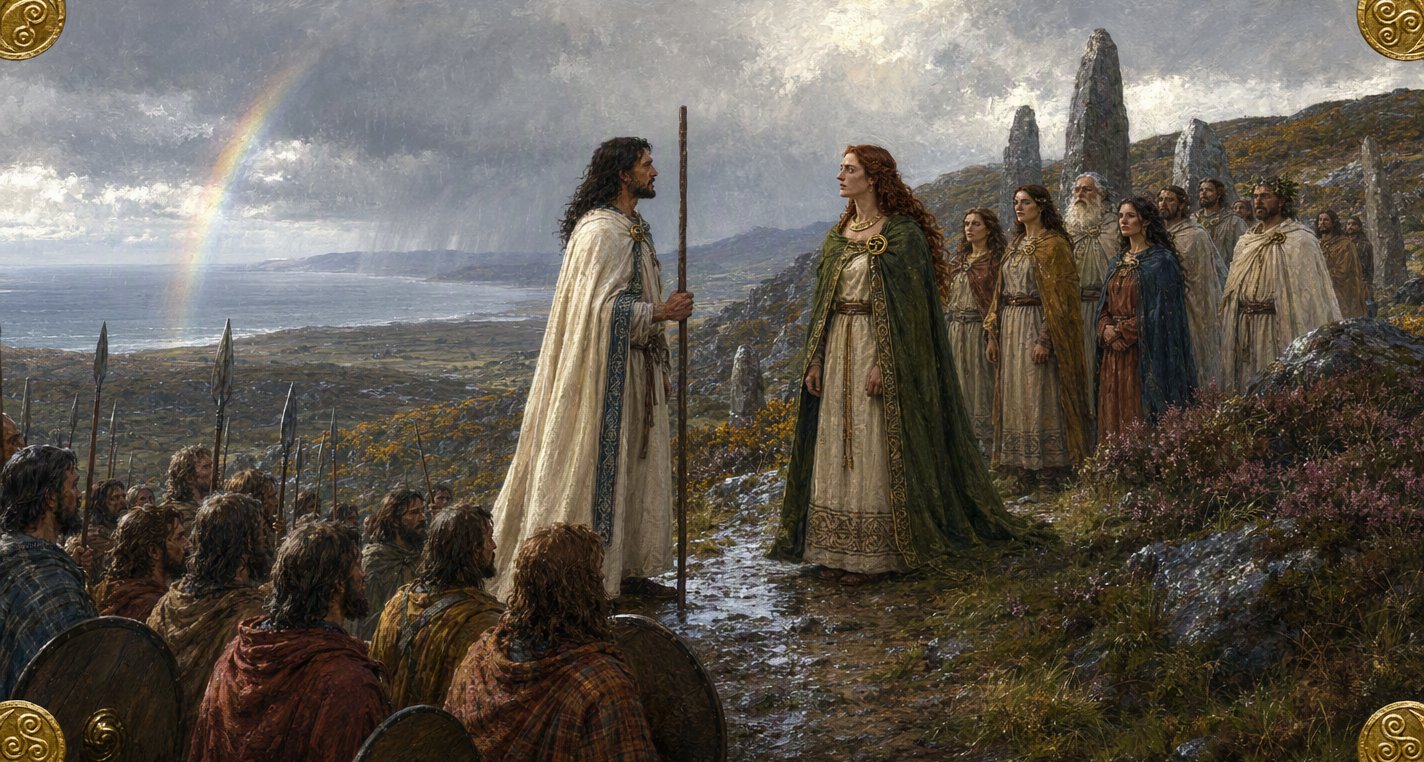
The mountain was Sliabh Mis, and the queen was Banba, the wife of Mac Cuill. She stood across their road with her women about her and her druids behind her.
Amairgen asked her name, and she told him. If you have come to take Ireland, she said, there is no right on your side.
To take it is what we have come for, said Amairgen.
Then grant me one thing, said Banba. Let this island be called by my name.
It shall be, said Amairgen. 4
They went on, north and east, and on the hills of Sliabh Eibhlinne a second queen met them: Fódla, the wife of Mac Cécht. Amairgen asked her name, and she asked him for what Banba had asked, and he gave her the same answer.
Then they went on into the middle of Ireland, to the hill where the five fifths meet. And there a third woman came towards them over the grass.

V Ériu at Uisneach
The hill was Uisneach, and the woman was Ériu, the wife of Mac Gréine. She came to them with a welcome.
Welcome, warriors, she said. You have come from far away, and from now on this island is yours. Between the setting sun and the rising sun there is no better land, and no people will ever be more perfect than yours.
Then Donn, the eldest son of Míl, cut across her. We will owe you no thanks for it, he said. Whatever we win here, we will win by our own strength.
What I foretell is nothing to you, said Ériu. You will not live to enjoy this island, and neither will your children. 5
She turned to Amairgen then, and asked him for what Banba and Fódla had asked: that the island should be called by her name.
It will be its chief name, said Amairgen.
So it is. The names of all three queens were given to Ireland often enough in the time after. But the name the island answers to is hers: Éire.
From Uisneach they went east to Tara, where the three kings were waiting for them.

VI The First Judgment
Tara was called Druim Caín in those days, the Beautiful Hill. The three kings were there before them, Mac Cuill, Mac Cécht and Mac Gréine, with all their host of draíocht about them.
The sons of Míl gave them their choice: give up the kingship of Ireland, or fight for it.
Give us three days, said the kings. Leave the island for three days while we make up our minds.
The sons of Míl would not do it. Once their ships were out on the water, they knew, the druids of the Tuatha Dé would never let them back.
Then let your own poet judge between us, said the kings. But if he gives a crooked judgment, he will die at our hands.
Donn turned to Amairgen. Will you take it on? he said.
I will, said Amairgen, and he gave his judgment there on the hill.
The land belongs by right to the people we found living in it, he said. So you must go back to Inber Scéne, and take to your ships, and go out over nine waves. If you can come to land again in spite of them, fight them, and the land is yours by right of battle. You want the land they hold, he told his brothers. Even so, you owe them justice.
Both sides held that a fair judgment. The Tuatha Dé were well content with it, for they were sure their druidry would keep the sons of Míl off the land forever.
That was the first judgment ever given in Ireland. 6
So the sons of Míl went back to Inber Scéne, and took to their ships, and rowed out beyond the ninth wave.

VII The Druids’ Wind
When the druids of the Tuatha Dé saw them out on the sea, they raised a wind against them. It blew off the land and threw up a great storm, so that the ships could make no way towards the shore.
That is a druid wind, said Donn.
So it is, said Amairgen.
Arannan, the youngest of the sons of Míl, climbed the mainmast to look. A gust caught him and threw him down onto the deck, and he died there.
Then Amairgen lifted up his voice, and he called on the land of Ireland herself:
I invoke the land of Eriu!
The shining, shining sea!
The fertile, fertile hill!
The wooded vale! 7
He called on her streams and her rivers, line after line, and the land of Ireland was pleased to be kind to them. The druid wind dropped. The sea went down under the ships, and the sons of Míl turned their prows to the shore, rejoicing.
Then Donn spoke.

VIII The House of Donn
Now, said Donn, I will put everyone in Ireland to the sword.
The words were hardly out of him when the storm sprang up again. It broke up the fleet, and it drove the ship that Donn was in away from all the others. Off the west of Munster, at a place called Dumhacha, it went down, and Donn was drowned there, and every soul who sailed with him: four-and-twenty warriors and five chiefs, his brother Airech among them, twelve women, four servants, eight rowers and fifty young lads in fosterage.
The place is called after him: Tech Duinn, the House of Donn. 8 Ériu’s word had found him. He had said that he would owe her no thanks for the island, and he did not live to enjoy it.
The storm took Ír’s ship away from the fleet too, and Ír was drowned. They buried him on Sceilg Mhichíl, out in the ocean off Kerry.
The rest were beaten about the coasts for a long time. At last, what was left of them came to land.
IX Tailtiu
They came ashore in two companies. Éber brought his ships in to Inber Scéne again, in the south. Érimón took his round the coast, with Ireland on his left hand the whole way, to the mouth of the Boyne, and there Colpa of the Sword was drowned as he came ashore. Five of the eight sons of Míl were gone. Only Éber and Érimón and Amairgen were left.
Three days after Éber’s landing, Ériu came against them on Sliabh Mis with a host, and they fought. Fás, the wife of Ún, fell there, and Scota, the wife of Míl, and they buried Scota in the glen where she fell, on its north side, beside the sea.
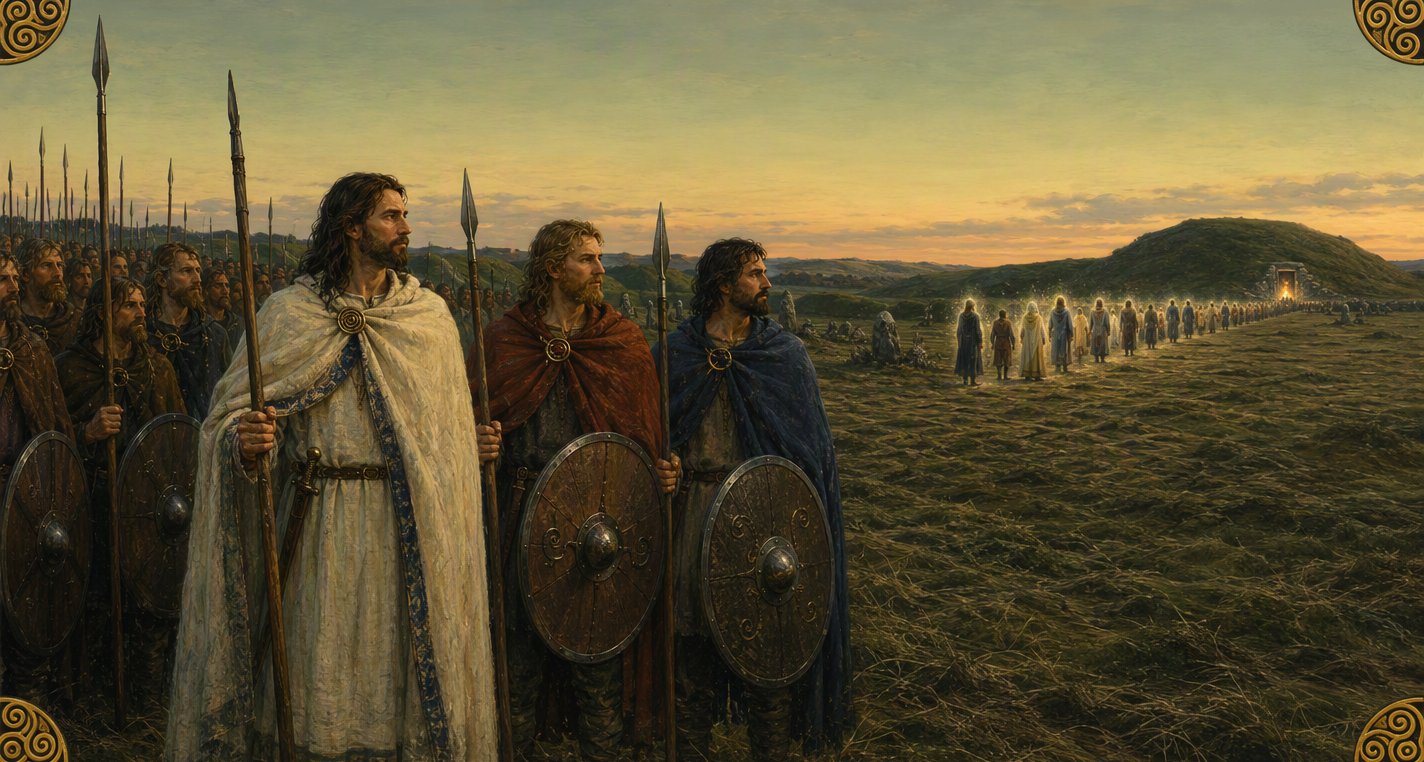
Then the sons of Míl came together with all their strength, and met the Tuatha Dé on the plain of Tailtiu, and that was the last battle. The three kings fell there: Mac Gréine by the hand of Amairgen, Mac Cuill by Éber and Mac Cécht by Érimón. The three queens fell with them, Ériu and Banba and Fódla, and the greater part of their host.
So the Tuatha Dé Danann lost Ireland. But they did not leave it. They went off by themselves, and Manannán found them the loveliest hills and valleys in the land, and set walls about them that no other eye could see through. Those inside could see out through them, and walk through them.
They went into the hills, into the sí, and left the face of the land to the sons of Míl. 9

What the tale keeps
A poet comes in from the sea and sets his right foot on the strand, and the first thing he sings is not that the land is his. He sings that he is the wind on the sea and the wave, the salmon in the water and the lake on the plain. When the druids’ wind drives him back, he does not curse it. He calls on Ireland by her own sea and hills, and she lets him in.
The man who said he would owe no one thanks for the island did not live to enjoy it. The place where the sea took him is called his house.
Three queens asked for one thing, and were given it. The gods lost the land and kept the hills. And the island still answers to the name Ériu asked for.
Notes
- Geoffrey Keating did not believe in the tower. Íth was sent, he says, because of famine in Spain, and because Spain and Ireland had long traded together, “and not, as others assert, that he had seen it in the clouds of heaven on a winter’s night from the summit of the tower of Breoghan.” (Keating, The History of Ireland, tr. Comyn and Dinneen, 1908) In his telling Íth takes thrice fifty men and lands in the north. D’Arbois de Jubainville read the “Spain” of the story as the Land of the Dead: “It was the same law which enabled Ith one fine winter evening to perceive from the Tower of Bregon, in the Land of the Dead, the shores of Ireland, or the land of the living.” (tr. R. I. Best, 1903, quoted by T. W. Rolleston, 1911) ↩
- Keating says the druids’ mist made the sons of Míl believe “that the island in front of them was a hog’s back, and hence Ireland is called Muicinis.” (Geoffrey Keating, The History of Ireland, tr. Comyn and Dinneen, 1908) Lady Gregory’s retelling has “some large thing that had the appearance of a pig.” (Gods and Fighting Men, 1904) ↩
- (Douglas Hyde, A Literary History of Ireland, 1899) The rest of the lay is told here from T. W. Rolleston’s English (1911), who followed d’Arbois de Jubainville’s translation. George Sigerson’s note on it: “When Amergin of the Fair Knee first placed his right foot on the land of Erinn he composed this song in Rosg metre.” (Bards of the Gael and Gall, 1897) Lady Gregory’s English (1904) begins “I am the wind on the sea; / I am the wave of the sea; / I am the bull of seven battles;”, and she sets it after the storm, when Amergin comes ashore at last. ↩
- In Keating’s telling the queens only tell Amairgen their names: “Banbha is my name, said she; and it is from me that this island is called Inis Banbha.” (tr. Comyn and Dinneen, 1908) It is Keating who has Banba come “with her women and her druids”. Her warning, the three requests and Amairgen’s answers are in Charles Squire’s telling (The Mythology of the British Islands, 1905, reissued as Celtic Myth and Legend), which draws on the Book of Invasions. ↩
- “That which I prophesy has no concern with you,” retorted the goddess, “and neither you nor your descendants will live to enjoy this island.” (Charles Squire, The Mythology of the British Islands, 1905, reissued as Celtic Myth and Legend) In Lady Gregory’s telling (1904) it is Érimón who meets her, and “in the one moment she would be a wide-eyed most beautiful queen, and in another she would be a sharp-beaked, grey-white crow.” ↩
- Lady Gregory (1904) calls the three kings “the three sons of Cermait Honey-Mouth, son of the Dagda”; their queens name them Mac Cuill, Son of the Hazel, Mac Cecht, Son of the Plough, and Mac Greine, Son of the Sun. Keating calls the three sons of Cermait Eathur, Ceathur and Teathur when the sons of Míl meet them at Tara. Charles Squire (1905) gives Tara its old name, Drumcain, and makes the three kings sons of Ogma. T. W. Rolleston (1911) calls Amairgen’s “the first judgment which was delivered in Ireland”. ↩
- (Charles Squire, The Mythology of the British Islands, 1905, reissued as Celtic Myth and Legend; from d’Arbois de Jubainville) Squire also prints a longer version from Owen Connellan’s translation in the Transactions of the Ossianic Society, which begins “I implore that we may regain the land of Erin, / We who have come over the lofty waves”. J. A. MacCulloch (1918) called the invocation “an archaic animistic rune, embedded in the later story”. The druid wind and Arannan’s fall are as Keating tells them. In Squire’s telling a man sent up the mast finds the air still there, and that is how they know the wind is a druid’s. In Lady Gregory’s, Donn accuses their own learned men of treachery: “It is treachery our knowledgeable men are doing on us, not to put down this wind.” ↩
- “And it is from Donn son of Milidh, who was drowned there, that it is called Teach Duinn.” (Keating, tr. Comyn and Dinneen, 1908) Keating puts the place at Dumhacha in west Munster; the name means sandbanks or dunes. Tech Duinn is usually identified now with the Bull Rock off Dursey Island, at the end of Béarra. In Charles Squire’s telling (1905) it is Manannán who raises this second storm: “Manannán, son of the sea and lord of headlands, shook his magic mantle at them, and hurled a fresh tempest out over the deep.” ↩
- The hidden walls are Lady Gregory’s, at the start of the fourth book of her Gods and Fighting Men (1904): Manannán “put hidden walls about them, that no man could see through, but they themselves could see through them and pass through them.” Charles Squire (1905): “Defeated and disheartened, they gave in, and, retiring beneath the earth, left the surface of the land to their conquerors.” Keating’s account ends with the battle and the chase northwards: the greater part of the host of the Tuatha Dé fell, he says, and he says no more of the rest. Squire says only that two battles were fought, one in Glenn Faisi on Slieve Mish and one at Tailtiu, and that the three kings were killed by the three surviving sons of Míl. ↩
Where the tale comes from
Medieval manuscript. The last invasion in Lebor Gabála Érenn, the Book of Invasions: a history of Ireland put together by Christian scholars, probably in the 11th century, and kept in the Book of Leinster and later manuscripts.
- The coming of the sons of Míl is the last of the invasions in Lebor Gabála Érenn, the Book of Invasions: a history of Ireland put together by Christian scholars, probably in the eleventh century. They brought the Gaels to Ireland by long wanderings out of Scythia and Egypt by way of Spain, and made the old gods one more people who held the island before them. Versions of the book survive in the twelfth-century Book of Leinster and in later manuscripts, and Charles Squire names the Book of Lecan and the Book of Ballymote as keeping Amairgen’s song.
- Geoffrey Keating told the whole story again in Irish, from the old books, in his Foras Feasa ar Éirinn, finished about 1634, and David Comyn and Patrick Dinneen translated it for the Irish Texts Society (1902–1914). His telling is plainer. He does not believe in the tower; his Íth lands in the north with thrice fifty men; his queens only tell Amairgen their names; he gives Amairgen no song, and his druids’ storm blows once, with no invocation to calm it and no second storm. He gives the drowned of Donn’s ship by number, and the verse that names who killed each king and queen at Tailtiu.
- Lady Gregory tells it in Gods and Fighting Men (1904), in “The Landing” and “The Battle of Tailltin”. Her Amergin sings his song when he comes ashore after the storm, Érimón meets Ériu at Uisneach, and Donn accuses their own learned men of treachery for not putting down the wind. Charles Squire (1905) and T. W. Rolleston (1911) draw on H. d’Arbois de Jubainville’s study of the Irish mythological cycle (Paris, 1884; English by R. I. Best, 1903), which translates much of the Book of Invasions. Squire makes the three kings sons of Ogma, has Arannan fall from the mast as they first come in to land, and lets Manannán raise the second storm; Rolleston brings the survivors ashore in the mouth of the Boyne, and gives the fleet thirty-six chiefs, each with his own ship, where Keating counts thirty ships and forty leaders.
- Amairgen’s songs were put into English many times before 1930: by George Sigerson in verse (Bards of the Gael and Gall, 1897), by Douglas Hyde (1899), by Lady Gregory (1904) and by Rolleston (1911). Sigerson calls the second “The Incantation”, and J. A. MacCulloch (1918) heard in it something older than the story around it: “an archaic animistic rune, embedded in the later story”.
Sources
- Foras Feasa ar Éirinn: The History of Ireland · Geoffrey Keating, ed. and tr. David Comyn and Patrick S. Dinneen (Irish Texts Society, 4 vols, London, 1902–1914)
- Celtic Myth and Legend, chapter X: "The Conquest of the Gods by Mortals" · Charles Squire (London; first published in 1905 as The Mythology of the British Islands, and reissued in the Gresham series as Celtic Myth and Legend)
- Myths and Legends of the Celtic Race, chapter III: "The Irish Invasion Myths" · T. W. Rolleston (London, 1911)
- Gods and Fighting Men, Part I, Book III: "The Landing" and "The Battle of Tailltin"; Book IV: "Bodb Dearg" · Lady Gregory (London, 1904)
- A Literary History of Ireland · Douglas Hyde (1899)
- Bards of the Gael and Gall: "The Lays of Amergin" · George Sigerson (London, 1897)
- The Mythology of All Races, vol. III: Celtic, chapter 2 · J. A. MacCulloch (Boston, 1918)
- The Irish Mythological Cycle and Celtic Mythology · H. d'Arbois de Jubainville, tr. R. I. Best (Dublin, 1903)
- Placenames Database of Ireland · logainm.ie