The Cycles of the Kings
The Destruction of Da Derga’s Hostel
Togail Bruidne Da Derga
A king bound by geasa breaks them one by one on the road, and knows exactly what it means.
I The Cowherds’ Foster-child
There was a king over Ireland called Eochaid Feidlech, and on the green of Brí Léith he found a woman at the edge of a well, washing in a silver basin, with a comb of silver and gold in her hand. She was Étaín, the woman of the síd whose story the Wooing of Étaín tells, and she had loved him, she said, since she was old enough to speak. 1
Their one daughter was called Étaín after her mother, and was married to Cormac, king of Ulaid. She bore him a daughter and no other child, and for that he put her away. When he took her back, he would not keep the child. It was to be killed.
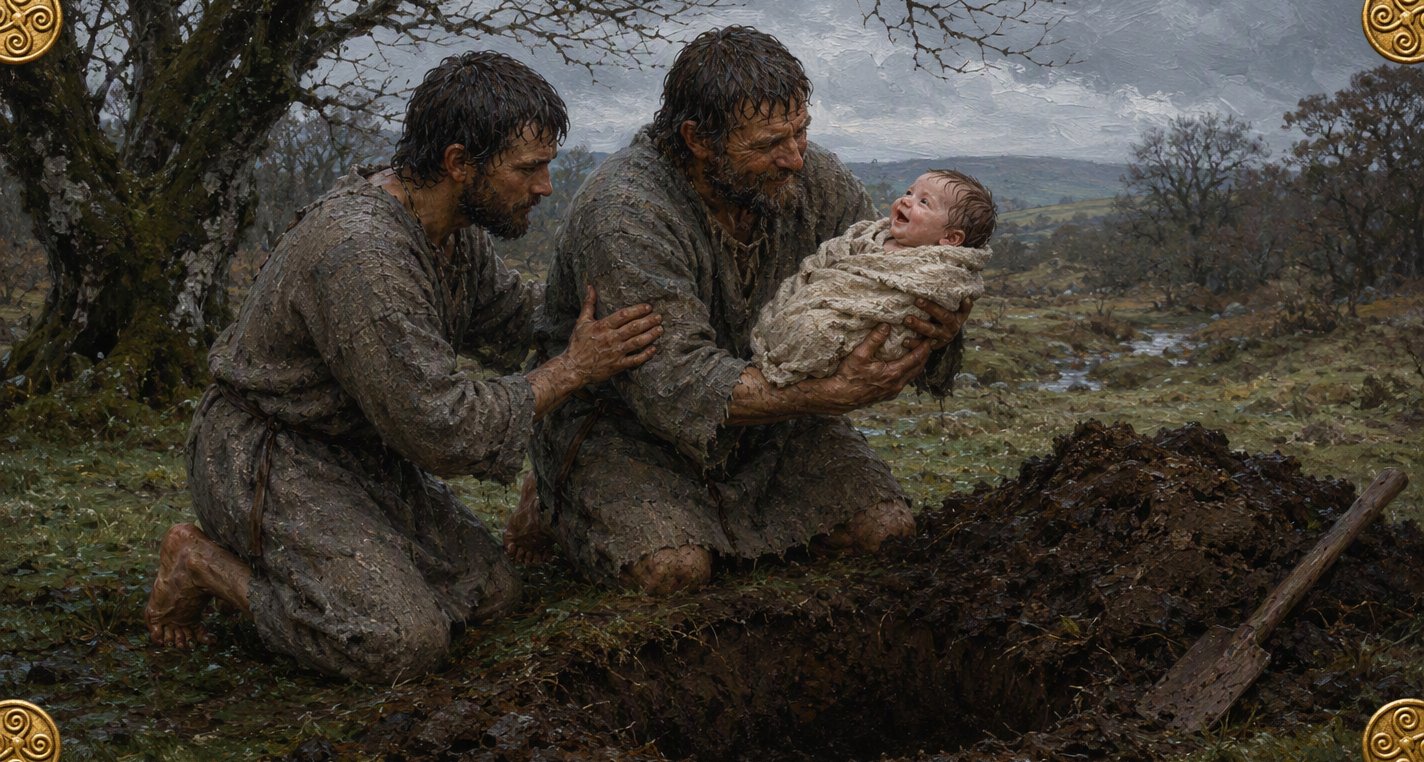
His two thralls carried the baby out to a pit. As they were putting her into it she smiled up at them, a laughing smile, and their kindness came back to them. They carried her instead to the calf-shed of the cowherds of Eterscél, king of Tara, and there she was reared, until she was a fine embroiderer and there was no king’s daughter in Ireland dearer than she.
A house of wickerwork was made for her, with no door at all: only a window, and a skylight in the roof. The king’s people passed it and took it for the cowherds’ food-store, until one of them went and looked in through the skylight, and saw the loveliest of girls.
Eterscél had no son. His druids had told him that a woman of unknown race would bear him one. This is the woman, said the king, and he sent his men to break open the house and bring her to him.
Before they came, something else came to her.

II The Bird on the Skylight
A bird came down to her through the skylight. On the floor of the house it let its birdskin fall, and it was a man, and he went to her and took her.
The king’s men are coming, he said, to break your house and carry you off to him. You will bear me a son, and that son must not kill birds. Let him be called Conaire, son of Mess Buachalla. For that was her name: Mess Buachalla, the cowherds’ foster-child.
Then the king’s men came and brought her to Eterscél. He married her, and gave her seven cumals, and seven more to her fosterers, and she bore the king a son, Conaire. The men of Ireland knew that boy on the day he was born.
Three boys were fostered with him, Fer Le, Fer Gar and Fer Rogain, the great-grandsons of Donn Désa the champion. Conaire had three gifts, the gift of hearing, the gift of sight and the gift of judgement, and he taught one to each of them. The four ate together, and wore the same clothes and armour, and rode horses of one colour.
When Eterscél died, the men of Ireland held a bull-feast to find their king. A bull was killed, and one man ate his fill of its flesh and drank its broth, and a spell of truth was chanted over him as he slept. Whoever he saw in his sleep would be king. If he lied, he would die.
At the end of the night the sleeper saw a man coming along the road to Tara, stark naked, with a stone in his sling.

III Birds on the Wave
Conaire was on the plain of the Liffey with his three foster-brothers, the four at their game in their chariots, when his fosterers came to take him to the bull-feast. I will come after you in the morning, he said.
Then he left the others at their game and turned his chariot, and drove until he was at Áth Cliath. There he saw great white-speckled birds, wonderful in size and colour and beauty. He went after them until his horses were tired. They kept always a spear’s cast ahead of him, and no further.
He got down with his sling and followed them on foot to the sea. The birds went out on the wave. He went out to them and overcame them, and they let their birdskins fall and turned on him with spears and swords.
One of them protected him. I am Némglan, he said, king of your father’s birds. You were forbidden to cast at birds, for there is no one here who is not dear to you, through your father or your mother. 2
Go to Tara tonight, he said. There is a bull-feast there, and through it you will be king. A man stark naked, who comes at the end of the night along one of the roads to Tara with a stone and a sling: he is the one who will be king.
IV The Geasa
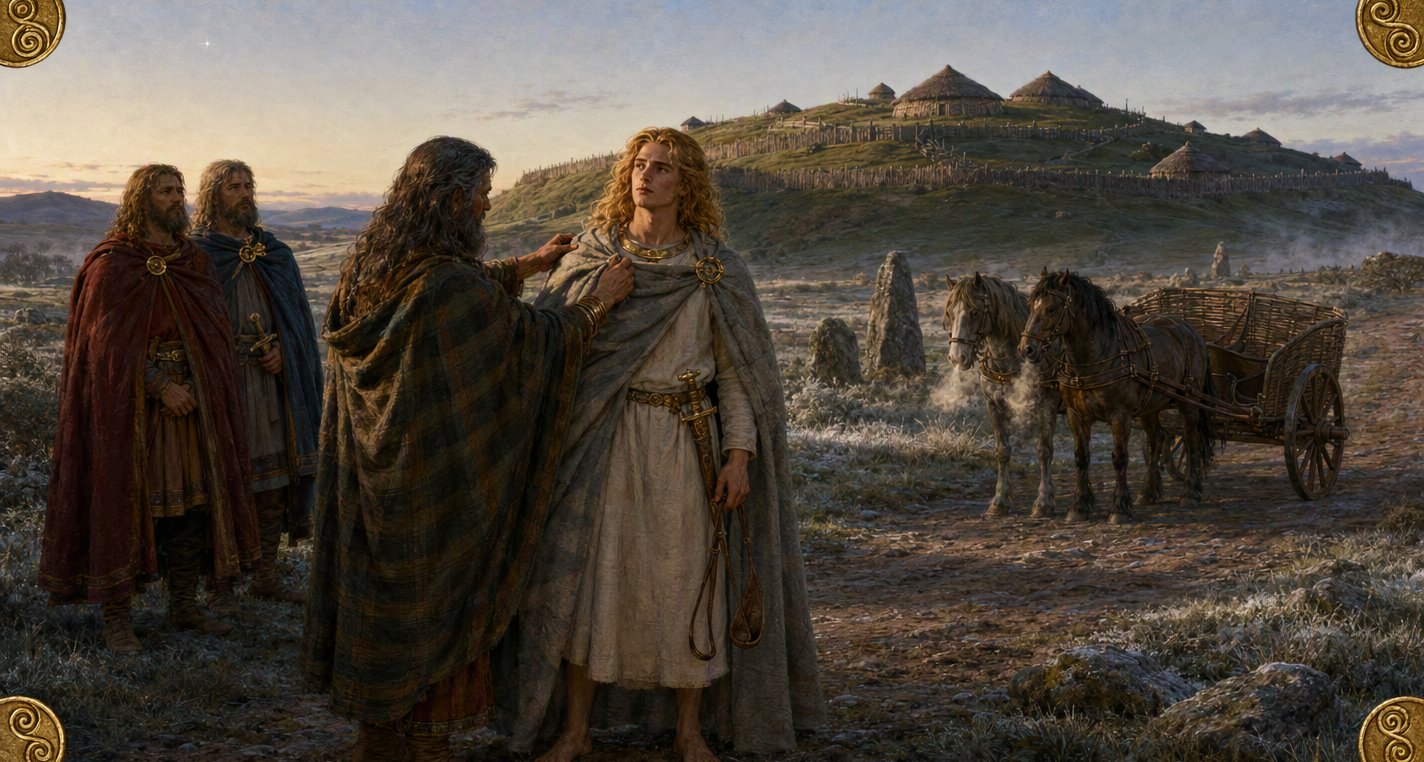
So Conaire went to Tara as he was. On each of the four roads into Tara three kings were waiting with clothes for him, for it had been foretold that he would come naked. His fosterers saw him from their road, and they put the king’s clothes on him and set him in a chariot.
Our bull-feast has failed, said the people of Tara, if all it has shown us is a young, beardless lad.
It is no disgrace, said Conaire, for a young, generous king to hold the kingship. The binding of Tara’s pledges is mine by right of my father and my grandfather.
Excellent, excellent, said the host, and they gave him the kingship of Ireland.
He had said all that as the man at the wave had taught him, and that man had said more. Your reign will be bound, he had said, but the bird-reign will be noble, and these are your geasa. 3 You shall not go right-handwise round Tara, or left-handwise round Brega. You shall not hunt the evil beasts of Cerna. You shall not go out beyond Tara every ninth night. You shall not sleep in a house whose firelight shows outside after sunset. Three Reds shall not go before you to the house of Red. There shall be no plunder in your reign. After sunset, no company of one woman or one man shall come into the house where you are. And you shall not settle the quarrel of your two thralls.
And his reign was golden. Seven ships came into Inber Colptha every June. Every autumn the oak-mast was up to the knees, and every June the Bush and the Boyne were full of fish. No one in Ireland killed another, and every man’s voice was as sweet to his neighbour as the strings of a lute. From the middle of spring to the middle of autumn no wind stirred a cow’s tail.

V Wolves in Connacht
But his foster-brothers grumbled. Theft and robbery, plunder and the slaughter of men, had been their fathers’ gifts and their grandfathers’, and the king had taken them away. So every year they stole a pig, an ox and a cow from the same farmer, to see what the king would do. Go to Donn Désa’s great-grandsons yourself, Conaire told the farmer; and whenever he went, they all but killed him.
Pride took hold of them, and they went reaving with the sons of the lords of Ireland about them. They had thrice fifty young men running as wolves in Connacht when the swineherd of Maine Milscothach saw them, and fled, and shouted. The people of the two Maines came at the shout, and took the whole band, and brought them to Tara.
Conaire gave judgement. Let every father kill his own son, he said, but let my foster-brothers be spared.
So be it, said everyone. It shall be done for you.
No, said Conaire. That doom I have given is no cast of life for me. No one shall hang. Let them go over the sea with old warriors, and do their reaving on the men of Alba.
So they put to sea, and there they met Ingcél the One-eyed, son of the king of Britain, with thirteen hundred men. Let us make peace, said Ingcél. You have been put out of Ireland, and we out of Alba and Britain. Come and do your reaving in my country, and I will come and do mine in yours.
They cast a lot for which country came first, and it fell on his. On the night they came, his father and mother and his seven brothers were guests in the house of the king of his district, and Ingcél destroyed them all in one night.
Then they turned their boats towards Ireland, to pay him the destruction he was owed.

VI The Geasa Broken
There was peace in Ireland in Conaire’s reign, except in Thomond, where the two Cairbres, foster-brothers of his, had come to blows. It was a geis of Conaire’s to go and part them before they came to him. He went all the same, and made the peace, and stayed five nights with each of them; and that was a geis of his too.
He was going home to Tara past Uisneach of Mide when he saw raiding on every side, from east and west and south and north: war-bands and hosts, men stark naked, and the land round him a cloud of fire.
What is this? said Conaire.
Easy to know, said his people. The king’s law has broken down, since the country has begun to burn.
Where shall we go? said Conaire. North-east, they said. So they went right-handwise round Tara and left-handwise round Brega, and the evil beasts of Cerna were hunted by him, and he did not see it until the hunt was done. It was people of the síd who had made that smoky mist of draíocht over the world, because Conaire’s geasa had been broken. 4
Great fear came on him then, for there was no road left to him but the road of Midluachair and the road of Cualu. They went south along the coast, and on the road of Cualu he asked where they would stay that night.
The men of Ireland have vied more often over who should have you for a guest, said his champion, Mac Cécht, than you have gone looking for a house.
I had a friend in this country, said Conaire, if only we knew the way to him: Da Derga of Leinster. He came to me once for a gift, and he did not go home refused.
I knew his house, said Mac Cécht. The road you are on runs into it and through it. It has seven doorways and only one door, and that door is turned to whichever doorway the wind blows on. I will go ahead and strike a fire for you there.
VII Three Reds Riding
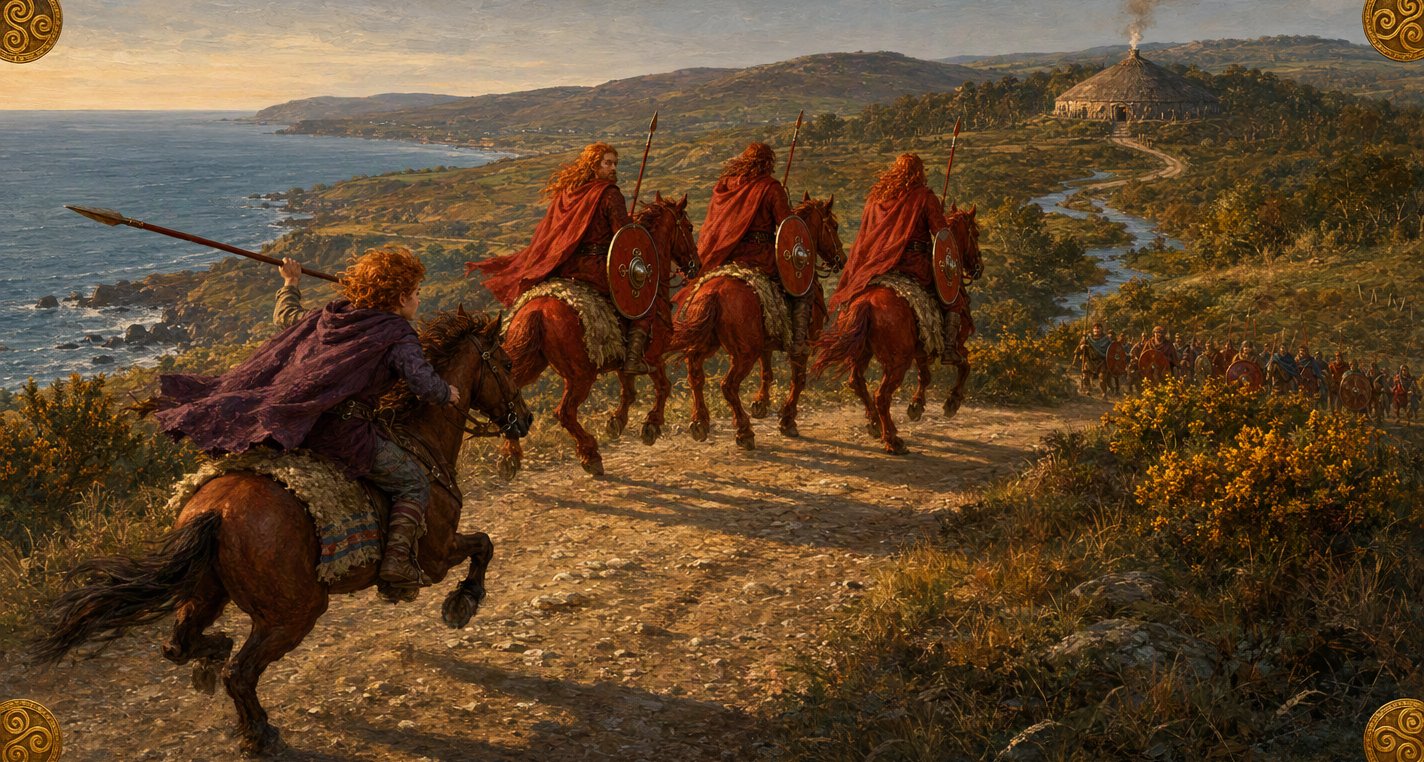
On the road ahead Conaire saw three horsemen riding towards the house. Three red tunics they wore and three red cloaks; three red shields they carried and three red spears; three red horses they rode, and red were their three heads of hair.
It is a geis of mine, said Conaire, for those three to go before me, three Reds to the house of Red. Who will follow them, and tell them to come back behind me?
I will, said Lé fri flaith, Conaire’s son.
He went after them, lashing his horse, and could not catch them. There was a spear’s cast between them always: they gained nothing on him, and he gained nothing on them. One of the three sang to him over his shoulder: Lo, my son, great the news, news from a hostel. 5
Twice more Conaire sent the boy after them, with oxen and bacon-pigs to offer, and the king’s leavings, and gifts in the morning. Their last answer was this. We ride the horses of Donn Tetscorach from the síd. Though we are alive, we are dead. Great are the signs: the sating of ravens, the feeding of crows, the wetting of sword-edges, shields with broken bosses after sundown.
All my geasa have seized me tonight, said Conaire. The three Reds rode on, tied their red horses at the door of the house, and went in.
Then a man overtook the king’s company on the road: black-haired, cropped, with one hand and one eye and one foot, and a black singed pig on his back, squealing and squealing. Behind him came a woman, huge and dark and big-mouthed, her lower lip hanging to her knee.
Welcome, master Conaire, he said. Your coming here has long been known.
He was Fer Caille, and the pig was for the king, so that he would not go fasting that night. Any other night you like, said Conaire, I will come to you. Leave us alone tonight.
No, said Fer Caille. We will go to you tonight, wherever you are, fair little master Conaire.
That too was a geis of his.
VIII The Woman at the Door
The reavers lay out at sea off Benn Étair, thrice fifty boats with five thousand men in them. When Mac Cécht struck the fire in Da Derga’s Hostel, the sound of the spark flung the boats out onto the shoulders of the sea; and when they ran ashore at the strand of Fuirbthe, the noise of it shook the Hostel till every spear and shield fell crying from the racks.
What is this noise? said everyone. What is it like, Conaire?
I know nothing like it, said Conaire, unless the earth is breaking, or the boat of the sons of Donn Désa has come to land. Alas that it is not they. Dear foster-brothers of ours they were.
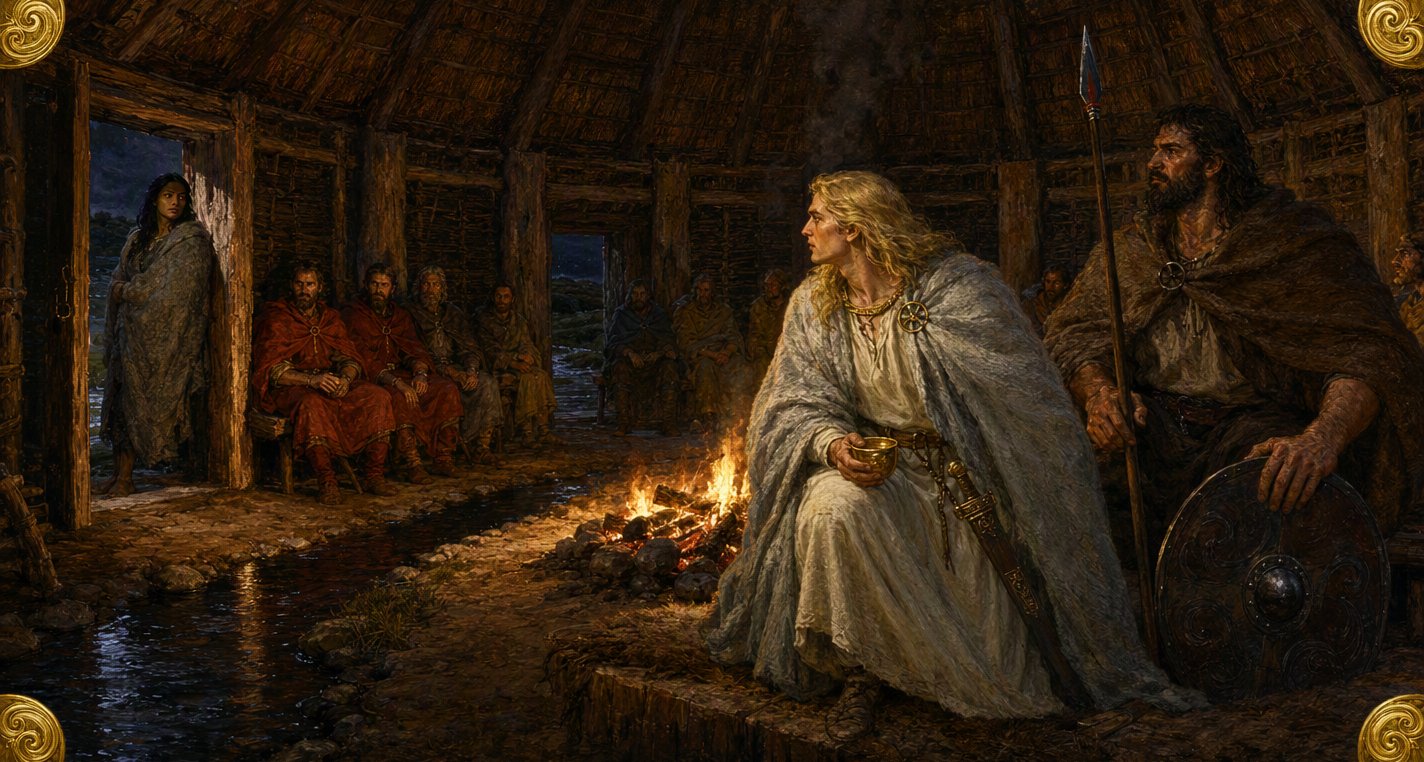
Then a woman came alone to the door of the Hostel after sunset, and asked to be let in. Her shins were as long as a weaver’s beam and as dark as a stag-beetle’s back, and she wore a greyish, woolly cloak. She put one shoulder against the doorpost and cast an evil eye on the king.
If you are a seer, said Conaire, what do you see for us?
Neither skin nor flesh of yours, she said, will leave this place you have come into, except what the birds carry away in their claws.
Her name was Cailb. Standing on one foot, with one hand raised, in one breath, she chanted all her other names from the door. 6
It is a geis of mine, said Conaire, to let in one woman after sunset.
If the king has no room in his house for the meal and the bed of one woman, she said, they will be had from someone with generosity in him.
That is a savage answer, said Conaire. Let her in, though it is a geis of mine.
From their ships the reavers could see the king’s great fire, its light shining out through the wheels of his chariots at every door. It is like nothing but the fire of a king, said Fer Rogain. May God not bring that man there tonight. 7
Ingcél went close and looked in through the wheels with his one eye. He saw a young man asleep, his hair like the sheen of smelted gold, his cloak like the mist of Mayday, and saw him wake, and rise, and sing: a cold wind over perilous edges, and a night to destroy a king is this night. 8 When Ingcél told it, Fer Rogain knew the king, and wept until the front of his cloak was wet. It was Conaire son of Eterscél, he said, the most splendid and noble king who has come into the whole world.
IX The Golden Cup
Then the reavers came against the Hostel. Six hundred of them fell by Conaire before he could reach his arms. Three times the house was set on fire, and three times the fire was put out, and still they could not take it. So their druids put a thirst on the king.
A drink, master Mac Cécht, said Conaire.
That is not the order I have had from you before, said Mac Cécht. There are cupbearers to bring you drink.
But every drop in the house had been spilt on the fires, and the cupbearers found no drink for him in the Dodder, though the Dodder had flowed through the house.
A drink, my fosterer, said Conaire. It is all one to me what death I go to, for I shall die anyway.
Leave the king to us, said Conall Cernach, and go for the drink, for it is you he asks.
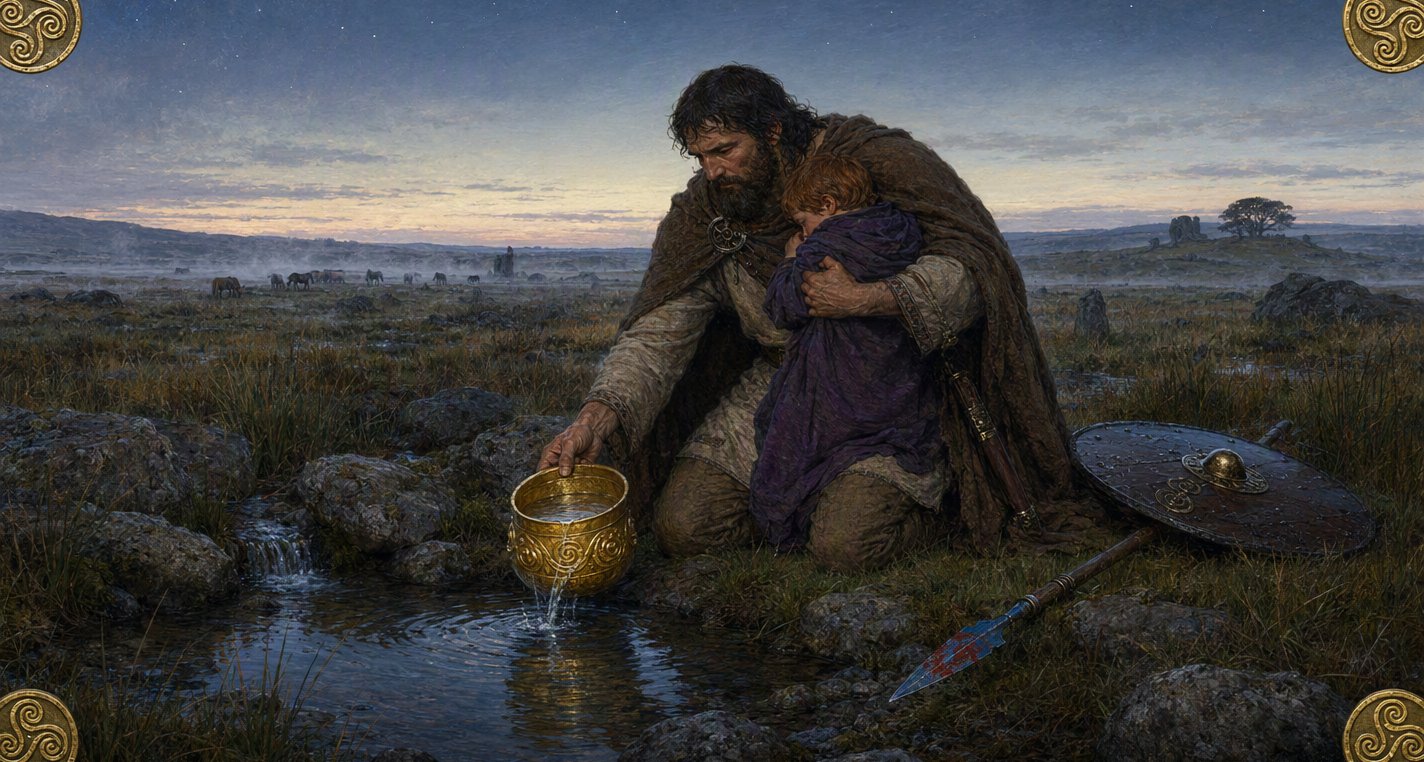
So Mac Cécht took Conaire’s son, Lé fri flaith, under his arm, and the king’s golden cup, so big that an ox and a bacon-pig could be boiled in it, and broke out through the reavers with an iron spit, nine falling at every blow.
He went first to the well of Casair, near at hand in Crích Cualann, and it would not fill his cup. Before morning he had gone round the great rivers of Ireland, the Boyne and the Bann, the Barrow, the Shannon, the Suir and the Slaney and the rest, and none of them gave it. Before morning he had gone round the great lakes, Lough Derg, Lough Foyle, Lough Mask, Lough Corrib and Lough Neagh, and none of them gave it either. Then he came to Uarán Garad on Mag Aí. It could not hide itself from him, and he filled his cup.
But in the Hostel the thirst had burned the king up, and Conaire died for want of his drink.
Mac Cécht came over the third ridge before morning, and two men were striking off the king’s head. He struck the head off the one, and broke the other’s back with a pillar-stone as he ran with the head. Then he poured the water into the head, into its gullet and its neck, and the head spoke. A good man, Mac Cécht, it said, a good warrior without and within. He gives a drink, he saves a king, he does a deed. If I were alive, I would be good to him. 9
The boy had died under Mac Cécht’s arm, of the warrior’s heat and sweat. At the end of the third day Mac Cécht took his king on his back to Tara, and buried him there, as some say.
What the tale keeps
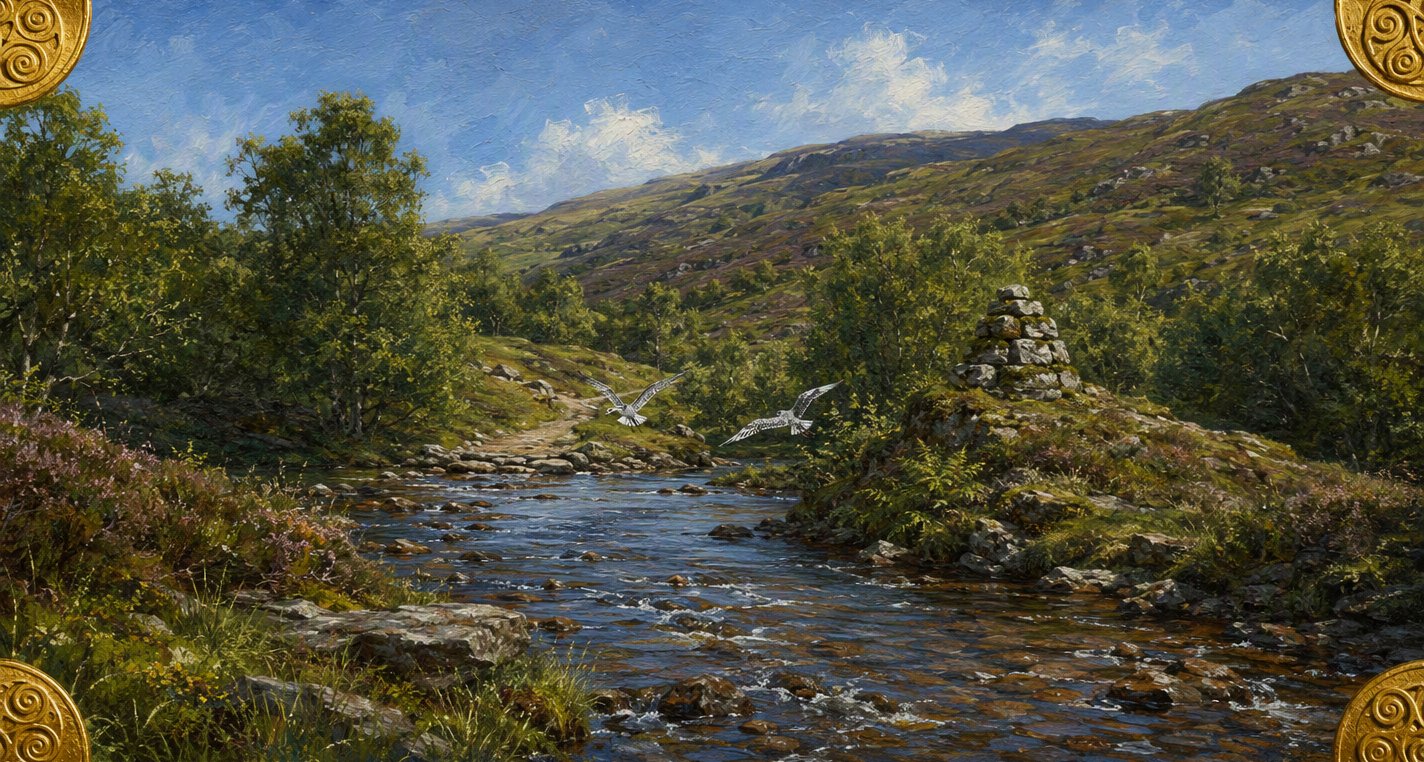
A king begotten by a bird, and forbidden to kill birds. A reign so gentle that no wind stirred a cow’s tail, held inside a ring of geasa the way a field is held inside its fence. The geasa were small things: which way to go round a hill, who might come in after dark. He broke one riding out to make peace between two foster-brothers, and after that they broke one by one, and he saw them go.
What the tale keeps at the last is the cup. A man went round the great rivers and lakes of Ireland in one night for a drink for his king, and found the one spring that could not hide from him. He came back too late, and gave it anyway, and the head spoke, and praised him.
Notes
- Whitley Stokes’s translation begins: “There was a famous and noble king over Erin, named Eochaid Feidlech.” In The Wooing of Étaín the king who finds her at a spring and marries her is Eochaid Airem. T. W. Rolleston (1911) joins the two tales: “Her daughter, Etain Oig, as we have seen from the genealogical table, married Cormac, King of Ulster.” ↩
- “I am Némglan, king of thy father’s birds; and thou hast been forbidden to cast at birds, for here there is no one that should not be dear to thee because of his father or mother.” (Whitley Stokes, 1901) ↩
- Stokes translates geis as “tabu”. The man at the wave told Conaire: “Thy reign will be subject to a restriction, but the bird-reign will be noble.” (Whitley Stokes, 1901) ↩
- “They that made of the world that smoky mist of magic were elves, and they did so because Conaire’s tabus had been violated.” (Whitley Stokes, 1901) T. W. Rolleston (1911) gives the people of the síd an older grudge: Conary’s death was “compassed by the Danaans in vengeance for the devastation of their sacred dwellings by Eochy”, when Brí Léith was dug open in The Wooing of Étaín. ↩
- The first song begins “Lo, my son, great the news, news from a hostel”. The last answer: “We ride the steeds of Donn Tetscorach(?) from the elfmounds. Though we are alive we are dead.” (Whitley Stokes, 1901) The question mark is Stokes’s own. ↩
- Her other names, as Stokes prints them, run to some thirty, among them Némain, Badb and Mache. Stokes’s translation does not say who she is. T. W. Rolleston (1911) does: “It was the Morrigan, the Danaan goddess of Death and Destruction.” ↩
- When the ships run aground, Conaire wonders whether it is “the earth that has broken, or the Leviathan that surrounds the globe”. Then a reaver prays: “May God not bring that man there tonight! ‘Tis a pity to destroy him!” (Whitley Stokes, 1901) The tale was written down by Christian monks, and their world shows through it. ↩
- Conaire’s song, as Ingcél tells it: “The howl of Ossar (Conaire’s dog) ... cry of warriors on the summit of Tol Géisse; a cold wind over edges perilous: a night to destroy a king is this night.” (Whitley Stokes, 1901) ↩
- The head’s words begin: “A good man Mac cecht! an excellent man Mac cecht! A good warrior without, good within, He gives a drink, he saves a king, he doth a deed.” (Whitley Stokes’s translation, as reprinted in Epic and Saga, 1910) Of Uarán Garad, the same text says: “It could not hide itself from him.” Rolleston (1911) makes it “Loch Gara in Roscommon”. ↩
Where the tale comes from
Medieval manuscript. An Old Irish prose saga by unknown monastic authors, first written down between about 600 and 900, as CELT dates it; the oldest copy is in Lebor na hUidre, written about 1100.
- The oldest copy of the saga is in Lebor na hUidre, written about 1100. CELT lists nine manuscripts in all, among them the Yellow Book of Lecan and British Library Egerton 1782, and places the story itself in the Old Irish period, between about 600 and 900, “by one or more unknown author(s) in Irish monasteries”.
- Whitley Stokes edited the Irish text and translated it in Revue Celtique 22 (1901), and it appeared as a book in Paris in 1902. His English was reprinted “with slight modification” in Epic and Saga (Harvard Classics, 1910), which describes his text as built “on the basis of eight manuscripts, the oldest going back to about 1100 A.D.” This retelling follows Stokes, and draws on the long account of the companies in the Hostel only for Mac Cécht and the king.
- T. W. Rolleston retold it in Myths and Legends of the Celtic Race (1911) after the story of Étaín and Midir, which he calls an “introductory tale” to it: Conary’s death is the revenge of the Danaans for the digging of Brí Léith. His bird drops its plumage and is “a glorious youth”; he names the woman at the door as the Morrígan; and his Mac Cécht fills the cup at Loch Gara.
- Stokes’s text goes on past the speaking head. Mac Cécht lay wounded on the battlefield, and at the end of the third day a woman he called to dragged a wolf out of his wound and called it “an ant of ancient land”; he killed it with one blow. When he had buried the king at Tara, as some say, he went home to Connacht to be healed. Conall Cernach came home to his father Amairgin at Tailtiu with thrice fifty wounds in his shield-arm. And the reavers who lived each took his stone back from the cairn, so that the stones left in Carn Lecca are their dead, a man for every stone.
- Like nearly all the old tales, it was written down by Christian monks. A raider prays to God, Conaire thinks of the Leviathan, and Stokes’s translation, as reprinted in 1910, ends: “It endeth: Amen: it endeth.”
Sources
- The Destruction of Da Derga's Hostel · ed. and tr. Whitley Stokes, Revue Celtique 22 (1901), pp. 9–61, 165–215, 282–329 and 390–437, reprinted as a book (Paris, 1902); via CELT
- The Destruction of Da Derga's Hostel, in Epic and Saga (The Harvard Classics, vol. 49) · tr. Whitley Stokes, reprinted "with slight modification" (New York: P. F. Collier & Son, 1910), via sacred-texts
- Myths and Legends of the Celtic Race, chapter IV: "The Early Milesian Kings" · T. W. Rolleston (London, 1911)
- Bóthar na Bruíne/Bohernabreena · logainm.ie, Placenames Database of Ireland
- Bohernabreena Townland, Co. Dublin · townlands.ie
- Glenasmole · EastWest Mapping
- Bruiden · Wikipedia, citing Gustamh Hamaltún, "Where was Bruiden Dá Derga?", Ériu 3 (1907), and Henry Morris (1935)